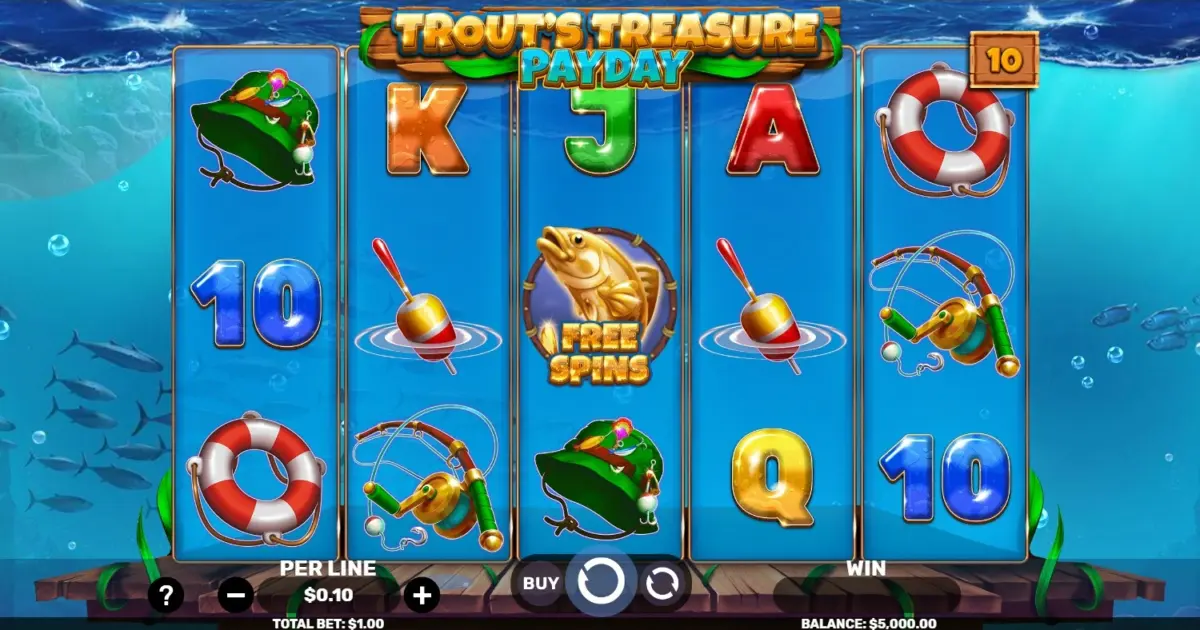
If you want the short version: this is a five-reel fishing slot from Spinomenal with a published return to player of 96.2%, and a free demo is available so you can watch the reels behave before committing money. That RTP sits above both the Spinomenal house average and the wider average across the games tracked here, which is the main reason it earns a look.
Beyond the reel count, RTP, provider and theme, Spinomenal has not published detailed specifications for the trouts treasure – payday slot. There is no confirmed max win, no stated volatility rating, no documented bonus structure and no published stake range. That absence shapes this review: what follows is the maths you can rely on, plus honest notes on where the data stops.
The 5-reel grid explained
Five reels is the default layout in modern slot design, and it exists for a mathematical reason. More reels mean more symbol positions, which gives a designer room to build combinations that pay rarely but pay larger, alongside frequent small returns that keep a balance moving.
What five reels does not tell you is the row count. A 5×3 grid holds 15 symbol positions; a 5×4 holds 20. Those two layouts can feel completely different at the same RTP because the number of possible outcomes differs. Spinomenal has not published the row count for this title, so the demo is where you find out.
The reel count also has no bearing on your expected return. RTP is set by the paytable and the reel strip weightings, not by grid size. A five-reel game can return 92% or 97%. This one is documented at 96.2%, and that figure holds regardless of how the grid is arranged.
| Provider | Spinomenal |
|---|---|
| RTP | 96.2% |
| Reels | 5 |
| Theme | Fishing |
| Free demo | Yes |
Paylines, ways and how Trouts Treasure – Payday pays
No payline or ways count has been published for this game, so treat any specific number you see quoted elsewhere as unverified. What is worth understanding is how the two main systems differ, since one of them will apply here.
Fixed-payline games evaluate matches along set paths across the reels. Your stake is divided across those lines, and a combination only pays if it lands on one of them. Ways-based games, sometimes labelled 243 ways or 1,024 ways, pay for matching symbols in any position on consecutive reels from the left. Neither system is inherently better. Both are priced into the same RTP.
Many slots layer wilds, scatters and free-spin rounds on top of the base mechanic, and fishing-themed games in particular have popularised money-symbol collection features. None of that is confirmed for this title. Spinomenal has not documented a feature set, so assume nothing until the demo shows you the paytable.
96.2% RTP put in context
An RTP of 96.2% means the game is built to return £96.20 for every £100 wagered, measured across a sample large enough to smooth out variance. That means millions of spins, not your session. Over 500 spins at £1, the mathematically expected return is £481.00 against £500 staked, but the realistic range of outcomes around that number is wide in both directions.
The comparisons are where this figure earns its keep. Spinomenal’s average across 548 games is 95.11%, so this title runs roughly 1.1 points ahead of its own studio. Against the 95.71% average across all games tracked here, it is 0.49 points better. Neither gap is dramatic, but both point the same direction.
Within fishing slots, it is mid-pack. Big Bass Bonanza and Bigger Bass Bonanza both publish 96.71%, about half a point higher. If RTP is your only filter, those two win. If you want a different studio’s take on the theme, this one still clears the average comfortably.
Volatility and hit patterns
Spinomenal has not published a volatility rating or hit frequency for this game, which is a genuine gap. Volatility describes how returns are distributed over time, and it matters more to how a session feels than RTP does.
Low volatility means frequent small wins and slow, steady bankroll movement. High volatility means long stretches with little coming back, punctuated by larger hits. Two games can share an identical 96.2% RTP and deliver completely opposite experiences depending on where they sit on that scale.
Without a published figure, the demo is your measuring tool. Run 200 to 300 spins at a fixed stake and count how often anything pays. Roughly one in four spins paying something suggests a lower-variance build; long droughts suggest the opposite. That tells you what bankroll the game realistically needs.
One thing to be clear about: each spin is independent. A drought does not make a payout more likely on the next spin, and a good run does not mean the game has turned. There is no such thing as a game being due.
Choosing a stake between the minimum and maximum
The stake range for this title has not been published, so the demo screen or a real-money lobby is where you will read the actual minimum and maximum. That is not a small omission — stake limits determine whether a game fits your budget at all.
The useful way to set a stake is to work backwards from session length. Decide what you are willing to spend, then decide how many spins you want out of it. A £50 budget at £0.20 a spin gives you around 250 spins. The same £50 at £2 gives you 25. Same RTP, wildly different session.
Higher stakes do not improve your return rate. RTP is a percentage and applies identically at every bet level. Raising your stake raises both the size of wins and the speed of losses in equal measure. And no staking pattern — doubling after a loss, stepping up after a win, waiting for a cold streak — changes the expected value of a single spin.
Demo play versus real money
A free demo of this game is available, which means you can test the grid, read the paytable and get a feel for hit patterns without wagering. Use it for exactly that. The demo runs the same certified maths, so it is an honest preview of mechanics.
What it cannot do is predict your real-money results. A strong demo run is variance, not a signal, and no sequence of demo spins carries into a funded session.
Slots are paid entertainment, not income. Play only if you are 18 or over, decide your budget before you open the game, and stop when it is spent rather than chasing it back. If it stops being fun, close the tab.
Verdict on Trouts Treasure – Payday
The case for this game is straightforward: 96.2% RTP beats the Spinomenal average of 95.11% and the 95.71% corpus average, and a free demo is available. It also sits in the 92nd percentile for popularity at rank 1594, so plenty of people are playing it.
The case against is the missing data. No volatility rating, no stake range, no published max win, no confirmed feature set. You can only judge those things by playing the demo, which is more work than a fully documented release asks of you.
If you want the theme with a higher published return, Big Catch Bonanza: Perfect Haul posts 96.25% and is worth a side-by-side look. If you would rather stay with Spinomenal, 1 Reel – Demi Gods 7 runs a much simpler single-reel format at 95.42%. Start with the demo here, note the volatility yourself, then decide.
Frequently Asked Questions
Can I play Trouts Treasure - Payday for free?
A free demo of Trouts Treasure - Payday is available, so you can spin the five reels and read the paytable without wagering. The demo uses the same certified 96.2% RTP maths as the real-money version, making it an accurate preview of mechanics. It cannot, however, predict what a funded session will return.
What does the 96.2% RTP actually mean for me?
It means the game is designed to return £96.20 per £100 staked, averaged across a sample of millions of spins rather than your session. Over 500 spins at £1, the expected return is £481.00, but actual results scatter widely around that. At 96.2% it beats Spinomenal's 95.11% average.
How volatile is Trouts Treasure - Payday?
Spinomenal has not published a volatility rating for this title, so treat any figure quoted elsewhere with caution. The practical workaround is to run 200 to 300 demo spins at a fixed stake and count how often something pays. Frequent small returns suggest lower variance; long dry stretches suggest higher.
Who is Spinomenal and what else do they make?
Spinomenal is the studio behind this fishing slot and has 548 games tracked here, averaging 95.11% RTP across the catalogue. Their range spans mythology, fantasy and stripped-back formats, including 1 Reel - Demi Gods 7 at 95.42% RTP. This title runs roughly 1.1 points above their house average.
How does it compare to Big Bass Bonanza?
Big Bass Bonanza publishes 96.71% RTP against 96.2% here, so it returns about 51p more per £100 wagered over a very large sample. Both are fishing slots, but Big Bass Bonanza comes from a different studio with a documented feature set, while this Spinomenal title leaves volatility and mechanics undisclosed.