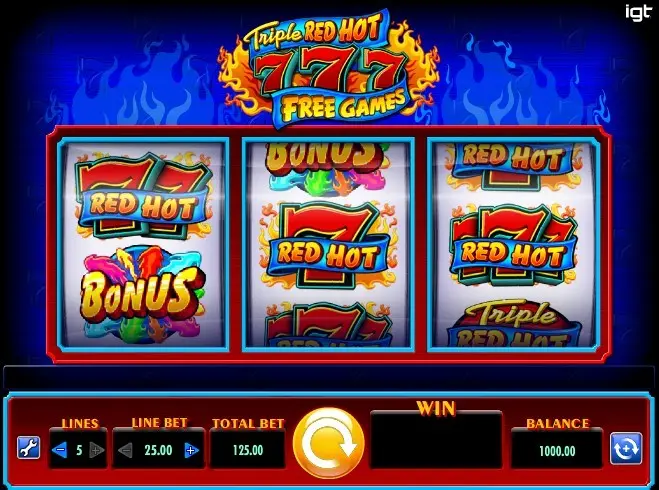
If you are deciding whether this one is worth your time, the headline figure is 96.13% RTP on a three-reel machine from IGT. That is above the average for the games we track, and above IGT’s own catalogue average, which makes it one of the better-priced titles in the studio’s range on paper. It is also a stripped-back format: three reels, no modern six-by-five grid, no cascading anything.
What follows is what the published numbers imply for a real session, what IGT has not published, and which comparable games are worth a look before you commit a bankroll.
Triple Red Hot 777 versus the average slot
The average RTP across the games in our database is 95.71%. This one is listed at 96.13%, so it runs 0.42 percentage points above that corpus average. That sounds trivial. Over a large sample it is not nothing, but it is also not transformative.
Here is the arithmetic. On £100 of total wagering, a 95.71% game gives back £95.71 in theory and a 96.13% game gives back £96.13. The gap is 42p per £100 staked. Spin £1 a thousand times and you have wagered £1,000, so the expected difference between this game and a typical one is about £4.20. That is the honest scale of the advantage: real, measurable across tens of thousands of spins, invisible across a hundred.
Against IGT’s own average of 95.64% the gap is slightly wider at 0.49 points. So within the studio’s library, this title is priced better than the typical IGT release rather than worse. If you are choosing between IGT games purely on published return, that is a point in its favour.
Popularity is a separate matter. It ranks 1628 in our database, which places it in the 91.8th percentile for traffic. Plenty of people are looking it up. Popularity says nothing about return, but it does mean the game is easy to find in demo form.
RTP breakdown: 96.13% in context
RTP is a long-run average, not a session forecast. A 96.13% figure means that across an extremely large number of spins, the machine is modelled to return £96.13 for every £100 wagered, leaving £3.87 as the house edge. The number is calculated over millions of simulated rounds. Your two hundred spins on a Tuesday evening will not resemble it.
Two practical consequences. First, the house edge is a rate applied to turnover, not to your deposit. Deposit £50, play £1 spins, and if you cycle that money through the machine four times you have wagered £200, and the expected cost of the entertainment is £7.74 regardless of what your balance says at any given moment. Turnover is the number that matters.
Second, every spin is independent. The reels have no memory of the last result, so nothing you observed in the previous ten minutes changes what happens next. There is no stake pattern, timing choice or progression that alters the 3.87% edge. Betting more per spin simply moves more money through the same percentage, faster.
| Figure | Value |
|---|---|
| Provider | IGT |
| RTP | 96.13% |
| Reels | 3 |
| Type | Slot Machine |
| Theme | Classics and retro, 3-Reels |
| Popularity rank | 1628 (91.8th percentile) |
| Free demo | Available |
Volatility profile
IGT has not published a volatility rating for this title, and our data set does not carry one either. So treat any confident claim you read elsewhere about it being low or high variance as unsourced. That absence is worth knowing before you size a bankroll.
What volatility does, in general, is control the shape of your results rather than the long-run average. Two games can both return 96.13% and feel completely different. A low-variance design pays small amounts often, so your balance drifts down gently and sessions last a long time on a modest bankroll. A high-variance design pays rarely and larger, which means long stretches of nothing punctuated by occasional bigger returns, and it needs a much deeper bankroll to survive the dry spells without busting early.
Reel count is a hint, not a rating. Three-reel machines have fewer symbol positions and therefore fewer possible combinations than a modern five-reel game, which historically tends to produce simpler, tighter payout distributions. That is a general tendency across the format, not a measured fact about this specific game.
Since the rating is unpublished, the sensible approach is to establish it yourself in the demo. Play a couple of hundred spins and watch how often anything lands and how deep the losing runs get. That tells you more than a label would.
IGT as a studio
IGT is one of the oldest names in slot manufacturing, with roots in physical cabinets before online play existed. We track 114 IGT titles, and their average RTP across that library is 95.64% — below the 95.71% corpus average, which makes this game’s 96.13% a comparatively strong entry within their own range.
Their catalogue leans on recognisable land-based conversions. Cleopatra is the obvious reference point and returns 95.02%, more than a full percentage point below this game. Da Vinci Diamonds sits at 94.94%, and Cats at 94.93%. All three are better known than this title, and all three are priced worse on published return.
That pattern is the useful takeaway. IGT’s most famous games are not their most generous ones. If published RTP is your filter, the studio’s back catalogue rewards looking past the marquee names.
Three Classics and retro alternatives worth comparing
There are 278 games in the Classics and retro category we track, so the format is well populated and three of the closest comparisons beat this one on paper.
The strongest is Love Gems Hold and Win at 97.10%, nearly a full percentage point ahead. On £1,000 of turnover the expected difference is around £9.70 in its favour. 40 Super Hot returns 95.81%, and Sizzling Hot Deluxe 95.66% — both slightly below this game.
So of these three, only one is a clear upgrade on return. The other two are close enough that the choice comes down to how each plays rather than the percentage. Retro slots vary widely in payline count and hit pattern even at similar RTP, which is exactly the thing a demo session settles quickly.
Getting the most out of the free demo
A free demo is available, and with the volatility rating unpublished it is the most informative tool you have. Two hundred spins will show you the rhythm of the game: how often anything returns, how long the flat stretches run, whether the pace suits you. That is information no spec sheet is giving you here.
What demo play cannot do is predict real-money results. The demo runs the same maths but your sample is tiny, so a good demo run is variance rather than evidence. Do not read it as a signal.
Slots are 18+ paid entertainment, not a way to make money. Decide the amount you are willing to lose before you start, treat it as spent the moment you deposit, and stop when it is gone rather than topping up. If you find yourself chasing losses or playing longer than you meant to, take a break and look up a support service in your country.
Should you play Triple Red Hot 777?
It is a reasonable pick if you want a simple three-reel machine and care about published return. 96.13% is above both the corpus average of 95.71% and IGT’s house average of 95.64%, and it comfortably beats the studio’s better-known titles like Cleopatra and Da Vinci Diamonds.
The reservations are about missing information rather than bad numbers. There is no published volatility rating, no stake range in the data we hold, and no maximum win figure — so any of those quoted elsewhere should be checked against IGT’s own paytable rather than taken on trust. And within the retro category, Love Gems Hold and Win is priced better at 97.10%.
Try the demo, watch how the losing runs behave, and decide from there. The maths is fine; the fit is personal.
More from IGT
- Da Vinci Diamonds — 94.94% RTP
- Balloonies — 96.23% RTP
- Cleopatra — 95.02% RTP
- Kitty Glitter — 94.92% RTP
Frequently Asked Questions
Can I play Triple Red Hot 777 for free?
A free demo is available, so you can spin it without depositing. That matters more than usual here because IGT has not published a volatility rating for the game, and a couple of hundred demo spins will show you how often it returns and how long the flat stretches run better than any spec sheet.
What is the RTP of Triple Red Hot 777?
The published RTP is 96.13%, meaning a theoretical return of £96.13 per £100 wagered across an extremely large sample, with a house edge of 3.87%. That sits 0.42 percentage points above the 95.71% average across the games we track. It is a long-run model, not a forecast for your session.
Is Triple Red Hot 777 high or low volatility?
No volatility rating has been published for this title, so treat confident claims elsewhere as unsourced. Volatility shapes your results without changing the 96.13% average: low variance means frequent small returns and longer sessions, high variance means rare larger ones and a deeper bankroll requirement. The demo will show you which pattern applies.
Who makes Triple Red Hot 777 and what else do IGT produce?
IGT built it, a manufacturer with roots in physical cabinets. We track 114 IGT titles averaging 95.64% RTP, which is below the 95.71% corpus figure. Their best-known games are priced worse than this one: Cleopatra returns 95.02%, Da Vinci Diamonds 94.94% and Cats 94.93%.
How does it compare to Love Gems Hold and Win?
Love Gems Hold and Win is the better-priced game on paper at 97.10% RTP, nearly a full point above 96.13%. Across £1,000 of turnover that gap is worth roughly £9.70 in expected return. Both sit in the Classics and retro category, which holds 278 games in our database, so there is plenty else to compare.