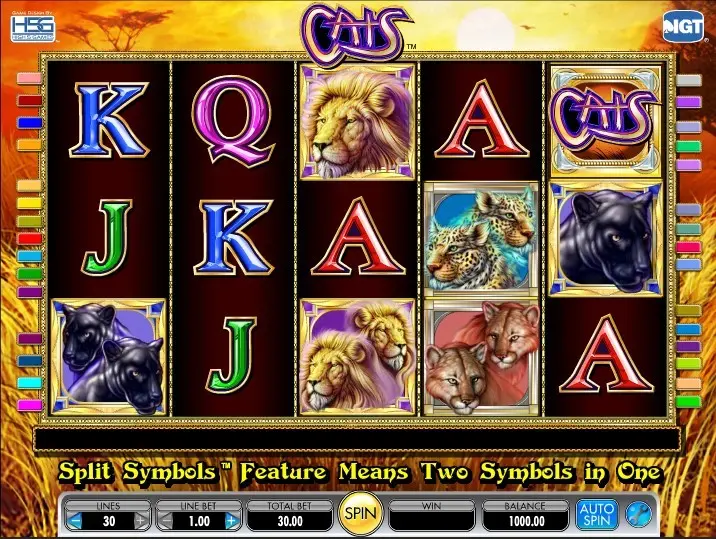
If you are comparing animal-themed slots and checking whether Cats Slot by IGT deserves your spin budget, the headline number is a 94.93% RTP. That is 0.78 percentage points below the corpus average of 95.71% and 0.71 below IGT’s own studio mean of 95.64%. For a game that ranks 218th by volume across our library, the popularity is real but the mathematical case is weak.
Cats versus the average slot
The RTP gap is the single most important number here. At 94.93%, Cats returns £94.93 per £100 wagered across a very large sample, compared with £95.71 for the average slot in our database. That difference of 78 pence per £100 is not trivial when you consider that a typical session might involve 500–1,000 spins at £1 each, producing cumulative bets of £500–£1,000. Over a thousand spins at one pound each, you wager £1,000, and the statistical expectation under Cats is a £949.30 return versus £957.10 under an average slot — a difference of £7.80 in that session alone.
Against IGT’s own portfolio, Cats sits slightly below their provider average of 95.64%, meaning even within the studio’s catalogue you could find titles that return more. This matters because IGT is not a small operation; we have 114 titles from them on record, and many exceed this figure.
RTP breakdown: 94.93% in context
RTP is a long-run statistical average calculated across millions of spins. No single session reflects it. Over 100 spins, variance will overwhelm the RTP entirely — you could finish up or down by hundreds of percent on a small sample. The 94.93% figure only stabilises over tens or hundreds of thousands of spins.
Where you see RTP quoted elsewhere, verify it matches this figure. Operators can negotiate different configurations from the same provider, so a casino listing Cats at 96% is either using a different game version or publishing an inaccurate number.
IGT publishes 94.93% as the theoretical RTP for this title. That places it in the lower tier of their own catalogue and below the market average. The math is straightforward: every 100 pounds you stake into this game, the house retains approximately £5.07 over an unlimited time horizon, before any promotional adjustments or bonus conditions apply.
Volatility profile
IGT has not published a volatility rating for Cats in the data we carry, and there is no hit-frequency figure either. Without these numbers you cannot reliably predict session length, swing size, or the bankroll depth required to survive a dry stretch. That absence is itself a reason for caution: if the developer does not disclose volatility publicly, you should treat any third-party label — “medium” or “high” — as unverified.
In general terms, a 5-reel slot with no published volatility data means you are playing with incomplete information. If you still choose to spin it on real money, err on the side of a larger bankroll relative to your stake, because you cannot rule out high-variance behaviour. A prudent approach: divide your entertainment budget by at least 200 and use that as your per-spin stake ceiling.
IGT as a studio
International Game Technology has 114 titles catalogued in our database with an average RTP of 95.64%. Cats sits 0.71 percentage points below that internal benchmark, meaning even within IGT’s own output, there are stronger mathematical choices. If you enjoy the studio’s style, compare their flagship Cleopatra at 95.02% RTP, which recovers roughly 9 pence per £100 over Cats across a long session.
Another animal-adjacent option from the same developer is Wolf Run, returning 94.98% — only 5 pence above Cats but worth noting as the higher figure in a direct comparison.
For reference, IGT’s portfolio-wide average of 95.64% is itself below the corpus mean of 95.71%, so the studio tends toward the conservative end of the market. If IGT’s design language suits you, the best you can do mathematically within their range is seek out their higher-RTP titles rather than assuming consistency across all 114.
Three animal-themed alternatives worth comparing
Cats belongs to a pool of 1,788 animal-themed titles in our database, giving you enormous choice. Several of those alternatives return meaningfully more per wagered pound. Hercules Power Wild delivers 96.2% RTP — a gap of 1.27 percentage points over Cats, worth approximately £12.70 per £1,000 wagered.
Apex Strike Megaways sits at 96.13%, another 1.2 points above. The Megaways mechanic itself is different from a fixed 5-reel layout, so it offers a different play feel as well as a different mathematical edge.
When you have 1,788 games to choose from in a single theme, committing to one that underperforms the average by 0.78% requires a strong reason beyond the subject matter. If you simply like cats, the theme pool is broad enough that you can find higher-returning titles without sacrificing the subject.
Getting the most out of the free demo
Cats is available as a free demo, and that is the responsible way to evaluate it before risking money. Use the demo to get a feel for the reel layout and any feature behaviour you observe over many spins — but understand that demo outcomes carry no predictive relationship to real-money results. The random number generator does not distinguish between demo and paid mode.
What the demo genuinely helps with is budget calibration. Count how many spins your chosen stake lasts before the balance empties. That gives you a personal session-length estimate you can apply when you move to real play, if you choose to. Set a budget before you start, treat the money as entertainment spend you have already decided to lose, and stop when it is gone. You must be 18 or older to play for real money.
Should you play Cats?
With a 94.93% RTP, zero published volatility data, and 1,788 animal-themed alternatives including several above 96%, Cats is a hard recommendation. It ranks 218th by player volume, so the audience exists, but volume measures familiarity and marketing reach more than mathematical quality. If you have played Cats before and enjoy it as a pastime, that is a valid reason to continue — it is paid entertainment, and the cost of entertainment includes the expected loss rate.
If you are comparing slots purely on numbers, the 0.78-point deficit against the corpus average means you are paying an extra ~78 pence per £100 wagered relative to the typical game. Over a long relationship with slots, that compounds. Try the demo, see if the theme holds your interest, but let the RTP figure inform how much real-money time you allocate.
| Metric | Value |
|---|---|
| RTP | 94.93% |
| Reels | 5 |
| Provider | IGT |
| Provider average RTP | 95.64% |
| Corpus average RTP | 95.71% |
| RTP vs corpus | −0.78% |
| Popularity rank | 218 |
| Volatility | Not published |
| Max win | Not published |
Frequently Asked Questions
What is the RTP of the Cats slot by IGT?
Cats Slot carries a published RTP of 94.93%, which means it returns approximately £94.93 per £100 wagered across a very large sample of spins. That figure sits 0.78 percentage points below the corpus average of 95.71% and slightly below IGT's own portfolio average of 95.64%.
Is there a free demo of Cats available?
Yes, a free demo version is available on this site. You can play Cats without depositing real money to observe the 5-reel layout and any feature behaviour. Demo outcomes carry no predictive relationship to real-money play, as the underlying RNG operates identically regardless of mode.
What is the volatility of Cats Slot?
IGT has not published a volatility rating for this title, and no hit-frequency data is available in our records either. Without that information, you cannot reliably estimate session length or bankroll requirements. Treat any third-party volatility label as unverified and plan for a conservative stake-to-budget ratio.
How does Cats compare to other IGT slots?
Cats returns 94.93%, while IGT's Cleopatra offers 95.02% and Wolf Run offers 94.98%. Across IGT's 114 catalogued titles, the average sits at 95.64%, meaning Cats falls slightly below the studio's own norm. Cleopatra edges it by 9 pence per £100 over a long session.
Does a higher RTP guarantee better results in Cats?
No. A higher RTP reduces the long-run expected loss rate but changes nothing about individual sessions. Over 100 or even 1,000 spins, variance dominates completely. The 0.78-point gap between Cats and the corpus average only becomes visible across tens of thousands of spins, making it a planning consideration, not a per-session predictor.