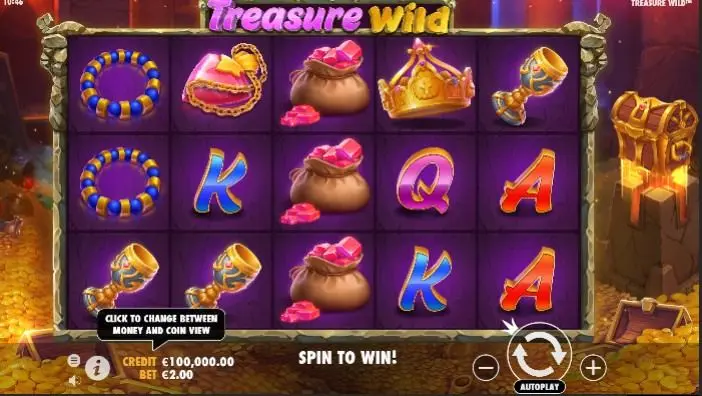
If you are deciding whether this one is worth your time, the headline number is the RTP: 96.53%, which sits above both the Pragmatic Play average of 96.32% and the wider corpus average of 95.71%. It is a five-reel game built on a money-and-wealth theme, and a free demo is available, so you can look at it without staking anything. What Pragmatic Play has not published is the volatility rating, the paylines count, the stake range or a max win figure, and that absence shapes how much you can plan in advance.
Treasure Wild at a glance
Here are the confirmed figures for this treasure wild slot, drawn from the published data and nothing else.
| Field | Value |
|---|---|
| Provider | Pragmatic Play |
| RTP | 96.53% |
| Reels | 5 |
| Primary theme | Money and wealth |
| Type | Slot machine |
| Popularity rank | 1,716 (91.4th percentile) |
| Provider average RTP | 96.32% across 739 games |
| Corpus average RTP | 95.71% |
| Free demo | Available |
That popularity percentile is worth a moment. Sitting in the top 9% of titles by traffic tells you people find and return to it, but popularity is not a measure of return or of risk. It reflects distribution and marketing as much as design. The RTP tells you something concrete; the rank tells you what other players do.
This game suits you if you want a mainstream Pragmatic Play five-reeler with a marginally better-than-house-average return figure and you are content to learn the mechanics by playing rather than by reading a spec sheet. If you plan sessions around published volatility ratings or advertised max win multipliers, the missing data will frustrate you.
What a 96.53% RTP actually returns
RTP is a long-run statistical average, not a session promise. A 96.53% figure means that across a very large number of spins, the game returns £96.53 for every £100 wagered. The remaining £3.47 is the house edge. That average only emerges over hundreds of thousands or millions of spins, which is far more than any individual will ever play.
Work it through. Suppose you place 1,000 spins at £0.20 each. Total wagered is £200. At 96.53%, the mathematically expected return is £193.06, an expected loss of £6.94. Now the important part: almost nobody lands on that number. Over 1,000 spins the actual outcome could be double your stake back or nothing at all, because variance dominates at that sample size. The expected value is the centre of a very wide distribution.
Against the corpus average of 95.71%, this game’s RTP is 0.82 percentage points higher. On that same £200 turnover, the difference is roughly £1.64 in expected return. Real, but small. Compared to stablemates like Sweet Bonanza at 96.51% and Gates of Olympus at 96.5%, the gap is a rounding error. Choose between them on how they play, not on two hundredths of a percent.
Unpublished volatility and what your session will feel like
No volatility rating has been published for this title, so any site quoting one confidently is guessing. Since you cannot know it in advance, here is what the three broad bands do so you can identify which one you are experiencing.
- Low volatility pays small amounts often. Balance drifts rather than lurches, sessions run long on a given budget, and the biggest wins stay modest relative to your stake.
- Medium volatility mixes frequent small returns with occasional larger ones. Swings are noticeable but recoverable within a session.
- High volatility means long dry stretches punctuated by rare large payouts. Two identical bankrolls can produce wildly different sessions, and short-session results tell you almost nothing about the underlying maths.
Note that volatility and RTP are independent. A 96.53% return can be delivered by many small wins or by a handful of large ones, and the published figure does not distinguish between them. In practice, the free demo is how you find out. Play a few hundred spins at a fixed stake and watch how the balance moves: steady erosion with regular small returns points low, long flat stretches broken by spikes points high.
The 5-reel layout and how wins are counted
Five reels is the standard modern configuration, and it is what this game uses. Beyond that, the payline or ways count has not been published, which means the win-evaluation method is unconfirmed. The two dominant approaches across five-reel games work differently enough to matter.
Fixed-payline games evaluate a set number of defined patterns across the reels, typically left to right. Your stake is divided across those lines, and a winning combination must sit on one of them. Ways or cluster systems ignore fixed lines and pay on matching symbol counts anywhere in a column, or on groups of adjacent symbols, which usually means more frequent small hits and a different rhythm to the same overall return.
Many five-reel games also use wilds that substitute for other symbols and scatters that trigger free-spin rounds. Whether this one does, and on what terms, is not in the published data. Open the paytable in the demo before your first real spin. It will tell you the line count, the symbol values and any feature rules in about ninety seconds, and it is the only authoritative source for this specific game.
Stake range and sizing a bankroll
The minimum and maximum stakes have not been published for this game either, and they can vary by operator anyway. The sizing logic does not change, though. Work backwards from what you are willing to lose, not from what a spin costs.
Decide your session budget first. Divide it by the number of spins you want, then set your stake at or below that figure. A £40 budget aimed at 400 spins means £0.10 per spin. If the game’s minimum is above that, you have three honest options: accept a shorter session, raise the budget, or pick a different game. Do not stake more per spin than the arithmetic allows and hope the variance is kind.
One point that gets muddled often: every spin is independent, and no stake pattern or timing changes the expected value. Raising your bet after losses does not improve your odds, it only increases the money at risk per spin. Stake size determines how long your budget lasts and how large the swings feel. That is all it controls.
Playing the Treasure Wild demo before you commit
A free demo is available, which is the sensible starting point given how much of the spec sheet is blank. Demo mode runs on the same certified maths as the real-money version, so it is a fair way to read the paytable, confirm the payline structure, and get a rough feel for hit rhythm. What it cannot do is predict your results. Demo sessions have no bearing on real-money outcomes, and a hot run in play money means nothing.
Treat slots as paid entertainment, not a way to make money. Play only if you are 18 or over, set a budget before you start, and stop when you reach it. If it stops being fun, close the tab.
You can also use the demo to compare directly. Run a few hundred spins here, then the same on Dogmasons MegaWOOF, which shares the money-and-wealth theme and carries a slightly higher 96.8% RTP. Side by side, the differences in pace show up faster than any review can describe them.
Verdict: who should play Treasure Wild
The case for it is the return figure and the pedigree. 96.53% is above the 95.71% corpus average and above Pragmatic Play’s own 96.32% across 739 titles, and this studio’s games are widely distributed and consistently built. Sitting in the 91.4th percentile for popularity, it is easy to find.
The case against is the missing data. No published volatility, no payline count, no stake range, no max win. If you plan around those numbers, you are choosing partly blind, and you should expect to spend your first session in the demo working out what you are actually playing. That is a real cost in effort, even if it is free in money.
The pragmatic route: try the demo, read the paytable, and see whether the rhythm suits you. If you want a broadly similar Pragmatic Play five-reeler with a comparable 96.5% return and a simpler classic structure, Joker’s Jewels is worth a look alongside it.
More from Pragmatic Play
- Chilli Heat — 96.52% RTP
- Joker’s Jewels — 96.5% RTP
- Sweet Bonanza 1000 — 96.53% RTP
- Fortune of Olympus — 96.55% RTP
- Barn Festival — 96.45% RTP
- Eastern Fury — 96.53% RTP
- Big Bass Bonanza Reel Action — 96.5% RTP
- 5 Lions Megaways — 96.5% RTP
Frequently Asked Questions
Can I play Treasure Wild for free?
A free demo of Treasure Wild is available, so you can spin without staking money. Demo mode runs the same certified maths as the real-money version, which makes it useful for reading the paytable and checking the payline structure. Use it to work out the mechanics, since Pragmatic Play has not published the volatility rating or stake range.
What is the RTP of Treasure Wild?
The RTP is 96.53%, meaning the game returns £96.53 per £100 wagered across a very large sample. That is 0.82 percentage points above the corpus average of 95.71% and slightly above Pragmatic Play's own 96.32% average across 739 titles. Over a single session, variance matters far more than the RTP figure.
Is Treasure Wild high or low volatility?
No volatility rating has been published for this title, so treat any figure quoted elsewhere with caution. The published 96.53% RTP does not indicate volatility, since the same return can come from frequent small wins or rare large ones. A few hundred demo spins at a fixed stake will show you how the balance actually moves.
Who makes Treasure Wild?
Pragmatic Play developed it. The studio has 739 games in this database with an average RTP of 96.32%, so this title sits marginally above its own house benchmark. Other widely played Pragmatic Play slots include Gates of Olympus and Joker's Jewels, both at 96.5%, and Sweet Bonanza at 96.51% — all within a rounding error of each other.
How does Treasure Wild compare to Dogmasons MegaWOOF?
Dogmasons MegaWOOF carries a higher published RTP of 96.8% against 96.53% here, and shares the money-and-wealth theme, one of 549 titles in that category. On £200 wagered, that 0.27-point gap is worth about 54p in expected return, so it is not a deciding factor. Compare them in demo mode on pace instead.