Two numbers decide whether this one is worth your time: a 96% return-to-player figure and a free demo you can load without spending anything. That return sits slightly above the average across the games catalogued here, and above Play’n GO’s own house average. What you do not get is a published volatility rating, a stake range or a max win figure, so the risk profile stays an unknown until you spin it yourself in demo mode.
First look at The Sword & The Grail
The sword & the grail slot is a five-reel game from Play’n GO, filed here under Slot Machine and tagged simply as a 5-Reels title. It ranks 2941 in the popularity list on this site, which places it in the 85.3rd percentile — more played than roughly five in six of the games tracked, without being a headline act.
The facts available are deliberately thin, and that matters more than it sounds. There is no published payline count, no “ways” figure, no listed bonus structure and no confirmed stake range. Anything you read elsewhere describing specific symbols, multiplier values or a buy-feature price for this title is not something that can be verified from the data here, so treat it as unsourced.
What is confirmed: five reels, a 96% theoretical return, Play’n GO as the studio, and a working free demo. For a first look, that is enough to decide whether to load it — and the demo costs you nothing to answer the rest.
How a round plays out
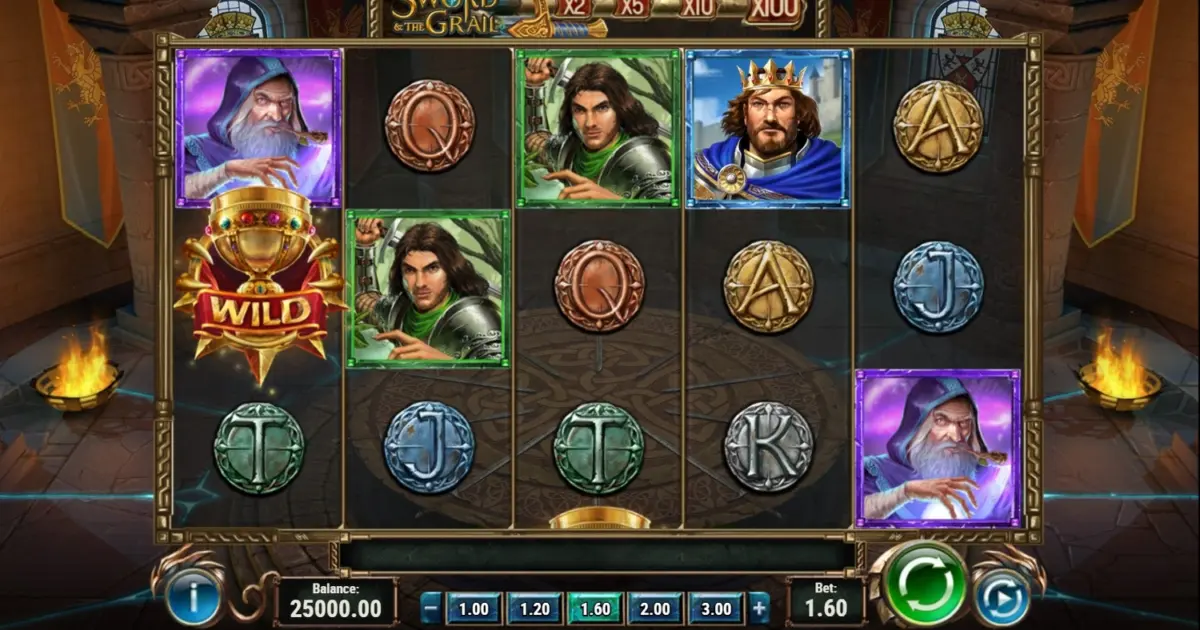
With five reels confirmed and nothing else about the layout published, the honest description is a general one. On a five-reel game, symbols land in five vertical columns and the game checks them against whatever win rule it uses — fixed paylines, adjustable lines, or a “ways” system that counts matching symbols left to right regardless of position. Which of those three applies here is not in the data.
Many slots layer extra mechanics on top: wilds that substitute for other symbols, scatters that trigger a free-spin round, or a paid buy-feature that skips straight to the bonus. Those are industry-standard concepts, not confirmed features of this game. Do not assume a free-spin round exists until you see it in the demo.
One thing is universal and worth stating plainly: every spin is resolved independently of the last. The reels hold no memory of a dry run or a good one. No stake pattern, spin timing or stop-button technique changes the expected return, because the outcome is already determined by the random number generator the moment you commit the spin.
Reading the 96% return figure
A 96% RTP means the game is built to return £96 for every £100 wagered across a very large sample of spins — typically millions, not thousands. Over a short session the figure tells you almost nothing about what you personally will see. Over a long enough sample it is reliable, which is exactly why it is the number to compare between games.
The context makes it look decent. The average RTP across the games catalogued here is 95.71%, so this sits 0.29 percentage points above it. Play’n GO’s own average across 434 titles is 95.8%, so it is also slightly above house form. In cash terms, 96% versus 95.71% is a difference of about 29p per £100 staked — real, but small enough that volatility and stake size will shape your session far more than this margin does.
| Figure | Value |
|---|---|
| Provider | Play’n GO |
| RTP | 96% |
| Reels | 5 |
| Type | Slot Machine |
| Theme tag | 5-Reels |
| Popularity rank | 2941 (85.3rd percentile) |
| Free demo | Available |
| Volatility | Not published |
| Stake range | Not published |
| Max win | Not published |
Why unpublished volatility changes your bankroll maths
Play’n GO has not published a volatility rating for this title, and that absence is the single biggest gap in the picture. Volatility describes how returns are distributed, not how large they are. Two games can both hold a 96% RTP and feel nothing alike.
A low-volatility game pays small amounts often. Balances drift rather than lurch, sessions last longer on the same bankroll, and the swings are shallow. A high-volatility game withholds for long stretches and concentrates its return into rare, larger outcomes. Same 96% over millions of spins, entirely different experience over 300.
The practical consequence is bankroll sizing. On a high-variance game, a stake that feels comfortable can empty a balance in twenty minutes; the usual approach is to divide your budget into a few hundred spins rather than a few dozen. Without a rating, the free demo is your measuring tool — run a couple of hundred spins and watch how often small wins land and how deep the quiet stretches run. That tells you more than a label would.
Bet sizing from an unpublished minimum upwards
No minimum or maximum stake is listed for this game, so treat the figures your operator shows you as the authority and check them before your first real-money spin. The reasoning still works without the numbers.
Stake size is the one lever that genuinely changes your session, because it sets how many spins your budget buys. A £20 budget at 20p a spin is 100 spins. The same £20 at 5p is 400. Neither figure alters the 96% return — that is fixed by the game’s maths regardless of what you bet — but the lower stake gives the average far more spins to express itself, which reduces how wildly your result can deviate from it.
Decide the budget first, then divide. If the number of spins that gives you looks too small to be entertaining, the stake is too high for that budget rather than the budget being too small. And to be explicit: no staking progression, doubling after a loss or raising after a win shifts expected value by a single penny. The maths is indifferent to the pattern.
Where The Sword & The Grail Slot sits among 5-reel titles
There is no populated theme group for the 5-Reels tag here, so the useful comparison is against Play’n GO’s own catalogue of 434 games. The 96% figure holds up reasonably inside it.
The studio’s best-known release, Book of Dead, carries a notably lower 94.25% return — 1.75 percentage points below this game, or £1.75 more retained per £100 staked over a long sample. If return is your deciding factor, this title is the better of the two on paper. Going the other way, Legacy of Dead runs at 96.58%, the strongest of the group, and Divine Divas sits at 96.25%. Both edge ahead of the 96% here.
So the ranking among Play’n GO slots is straightforward: comfortably better than Book of Dead, marginally behind Legacy of Dead and Divine Divas. The gaps at the top are fractions of a percentage point and will be invisible across a single session, but they are free to take if the games otherwise appeal to you equally.
The honest verdict
A solid, unremarkable set of numbers. The 96% return beats both the site-wide 95.71% average and Play’n GO’s 95.8% house figure, which puts it on the right side of the line without making it a standout — two of the three Play’n GO titles listed above return more. The 85.3rd popularity percentile suggests players do return to it.
The reservation is the missing data. With no volatility rating, no stake range and no max win figure published, you cannot judge the risk profile from the spec sheet alone, and you should be sceptical of any site that quotes those numbers with confidence. The free demo is the fix: a few hundred no-download spins will show you the swing pattern for free.
Keep the frame right. This is paid entertainment for adults aged 18 or over, not a way to make money. Set a budget you are content to lose before you start, treat it as spent the moment you sit down, and stop when it is gone. Demo results tell you how a game behaves; they do not predict what real-money play will return.
More from Play'n GO
- Book of Dead — 94.25% RTP
- Fire Joker — 96.0% RTP
- Moon Princess Origins — 96.2% RTP
- Legacy of Dead — 96.58% RTP
- Reactoonz — 96.51% RTP
- Moon Princess — 96.0% RTP
- Rise of Olympus 100 — 96.2% RTP
- Rise of Olympus — 96.0% RTP
Frequently Asked Questions
Can you play The Sword & The Grail for free?
A free demo of this Play'n GO title is available, so you can run it with virtual credits before committing real money. That is the most useful way to gauge how the five reels behave, since no volatility rating has been published. Demo play is also the safest way to test whether the game holds your interest at all.
What is the RTP of The Sword & The Grail?
The return-to-player figure is 96%, meaning the game is designed to pay back £96 per £100 wagered across a very large sample of spins. That sits 0.29 percentage points above the 95.71% average across games listed here, and slightly above Play'n GO's own 95.8% average across 434 titles.
Is The Sword & The Grail high or low volatility?
No volatility rating has been published for this game, so nobody can state it reliably. Volatility describes how a game distributes its 96% return: low variance pays small amounts frequently, high variance pays rarely but larger. Running two hundred demo spins and watching the swing depth will tell you more than any unsourced label.
Who makes The Sword & The Grail?
Play'n GO developed it. The studio has 434 games catalogued here with an average RTP of 95.8%, including Book of Dead at 94.25%, Legacy of Dead at 96.58% and Divine Divas at 96.25%. This title's 96% return sits above their house average but behind their two strongest listed releases.
What is the minimum bet on The Sword & The Grail?
No minimum or maximum stake has been published for this game, so check the limits displayed in the game window before your first spin. Whatever they are, the principle holds: your stake sets how many spins a budget buys, and more spins let the 96% average express itself more reliably.