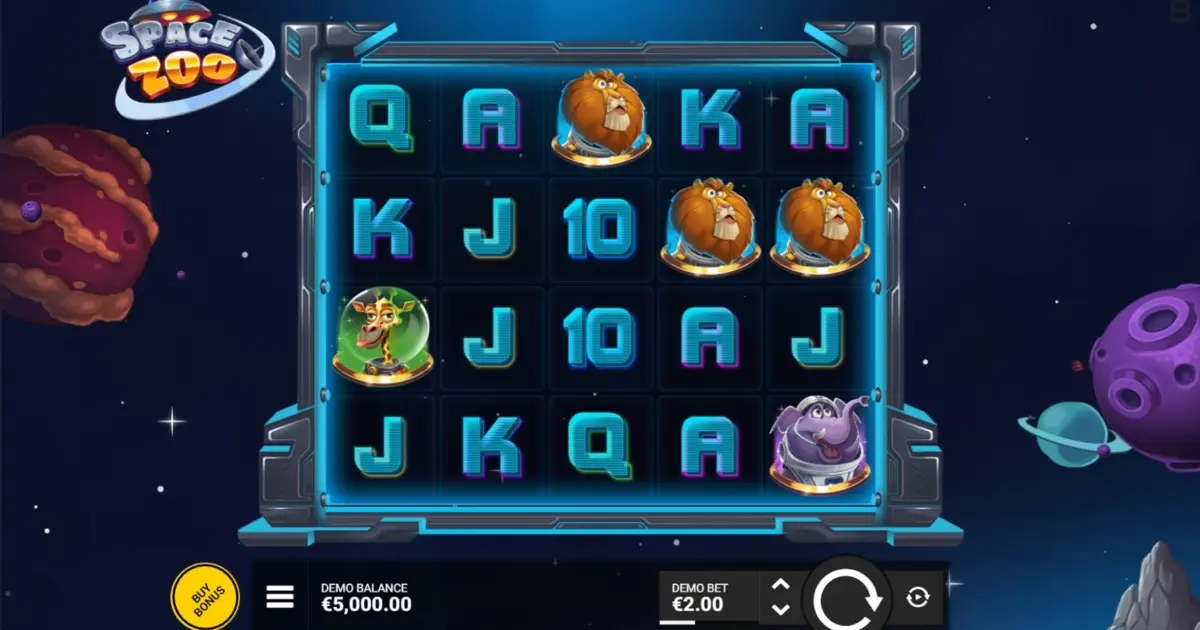
Space Zoo is a 5-reel Space and galaxy slot from Backseat Gaming with a 96.22% RTP that sits just above average, making it worth a look if you compare on numbers first. If you want a clean, theme-led game to test in demo form without digging through missing data, this one fits — you will trade some detail on volatility and staking for a clear RTP edge. The space zoo slot is best approached as a maths check: see how the return and layout suit your session length before you play.
Space Zoo at a glance
Space Zoo is listed as a Slot Machine with 5 reels and primary theme Space and galaxy, with secondary tags of Animals, Aliens and 5-Reels. It is built by Backseat Gaming, a studio with 29 titles in this corpus and an average RTP across those games of 96.07%. That puts Space Zoo marginally above its own stable average by 0.15 percentage points, which is a small but meaningful nudge if you filter by provider consistency.
Its headline figure is 96.22% RTP, which compares to a corpus average of 95.71% across all tracked slots. The difference of +0.51 percentage points is useful context when you rank games purely on long-run return. On popularity, Space Zoo sits at rank 2670 and in the 86.6th percentile for visibility, so it is widely listed but not among the top-trafficked 10% — expect plenty of demo availability without heavyweight hype.
Who it suits comes down to what you value. If you prefer a space-themed, animal-tinged reel set and want a slightly above-average RTP from a smaller provider catalogue, it checks those boxes. If you need full published detail on volatility, max win or stake limits to plan a tight bankroll, you will find gaps here that require a more cautious approach and a demo-first look.
| Item | Detail |
|---|---|
| Game name | Space Zoo |
| Provider | Backseat Gaming |
| RTP | 96.22% |
| Reels | 5 |
| Themes | Space and galaxy / Animals / Aliens / 5-Reels |
| Provider game count | 29 |
| Provider average RTP | 96.07% |
| Corpus average RTP | 95.71% |
| Popularity rank | 2670 (86.6th percentile) |
| Free demo | Available |
What a 96.22% RTP actually returns
RTP is a long-run statistical average, not a promise for a single session. A 96.22% RTP means that, over a very large number of spins, the game is designed to return £96.22 for every £100 wagered, with the remaining £3.78 representing the house edge. That average emerges over millions of spins; any block of hundreds or thousands of spins can sit well above or below it because each spin is independent.
Put the figure through a concrete sample so you can feel the scale. If you ran 1,000 spins at £1 per spin, you would have wagered £1,000 in total. At exactly the theoretical return, you would get back about £962.20, for a net loss of £37.80 across that block. Change the stake and the maths scales linearly: 1,000 spins at £0.20 is £200 wagered and about £192.44 returned; at £2 it is £2,000 wagered and about £1,924.40 returned. Real sessions will vary widely around those midpoints, and you should not expect to land on the average.
Against the wider market, 96.22% is 0.51 percentage points above the corpus average of 95.71%. Over the same £1,000 wagered example, the corpus-average game would return about £957.10 versus Space Zoo at £962.20 — a £5.10 difference per £1,000 staked in theory. Compared to its provider’s own average of 96.07%, Space Zoo is 0.15 points higher, so it is also slightly above what you typically get from Backseat Gaming slots. That does not make wins more likely on any given spin, but it does improve the long-run cost per spin if you play a large volume.
For related comparisons, Cosmos Cash sits at 96.00% in the same Space and galaxy group, a touch below Space Zoo, while Cosmic Cash at 96.55% sits above it. Seeing those neighbours helps you rank on return alone before you consider volatility or features, which are not detailed in the available facts for this title.
Volatility not published and what your session will feel like
Backseat Gaming has not published a volatility rating for Space Zoo in the facts available, so there is no official low, medium or high label to anchor expectations. Missing data is itself useful: it tells you to plan for uncertainty and to use the demo to observe swing behaviour rather than relying on a label.
As general concepts, volatility describes how a slot tends to distribute returns. Low-volatility games typically produce more frequent, smaller wins that help stretch a session, but they rarely deliver large spikes. High-volatility games do the opposite — longer dry stretches punctuated by bigger swings — which demands a larger bankroll and a higher tolerance for variance even though RTP can be identical. Medium sits between, mixing steadier hits with occasional larger jumps. These are broad tendencies across many slots, not specific claims about Space Zoo.
Without a stated rating, treat bankroll planning conservatively. Assume you could experience either extended flat periods or sudden clusters, and size stakes so that 150 to 250 spins at your chosen level remain affordable without chasing. Every spin is independent, so no pattern of wins or losses makes the next spin more likely to pay. If you compare to a peer where you do know volatility, you can use that as a reference point, but do not assign that profile to Space Zoo — let a longer demo sample show you how often your balance moves rather than guessing.
The 5-reel layout and how wins are counted
Space Zoo uses a 5-reel layout, the most common reel count in modern video slots. In practical terms, five reels give designers more combinations and pay structures than a 3-reel classic, and they usually pair with multiple rows to create a grid where symbols line up horizontally, diagonally or in other defined patterns.
How wins are counted depends on whether the game uses paylines or ways, and the facts here do not specify a payline count, ways count, row count or hit frequency for Space Zoo. As background, many 5-reel slots use fixed or selectable paylines where you need matching symbols on consecutive reels along a defined line, while “ways” games pay for matching symbols on consecutive reels regardless of exact line position, with total ways calculated as the product of symbols per reel. Without that detail published for this title, you should not assume either system.
What you can take from the reel count alone is session-planning context. Five-reel games commonly support a broader spread of stake levels and bonus concepts than simpler layouts, but the absence of published win-mechanic detail for Space Zoo means you should confirm specifics in the in-game paytable during your demo. Look for how many symbols are needed for a win, whether wins pay left-to-right only, and how wilds and scatters are defined — those rules vary widely even among games that share the same reel number and theme.
Stake range and sizing a bankroll
No minimum or maximum stake has been published in the facts for Space Zoo, so a precise £-per-spin range cannot be quoted here. When stake limits are missing, the safest approach is to treat that gap as a prompt to check the paytable directly in demo mode before committing any budget.
In general terms, stake range interacts with bankroll through simple division. Your total budget divided by your stake equals the number of spins you can afford before a refill, before considering any returns along the way. A player with £50 who chooses £0.20 per spin buys 250 spins of runway; at £0.50 that falls to 100 spins; at £1 it is 50. Because each spin is independent and expected value does not change with stake size, picking a level is about how long you want the session to last, not about improving your odds.
With the published 96.22% RTP, the theoretical cost per spin over a large sample is about 3.78% of your stake. At £0.20 that is roughly £0.0076 per spin on average; at £1 it is about £0.0378. Those are long-run averages, not session guarantees, and variance will dominate short samples. Until you confirm the actual stake limits for Space Zoo, keep stakes low in demo, note the smallest and largest increments the game allows, and set a hard stop for both time and spend. If you prefer a comparable title where you can also compare RTP, Infernus from the same provider lists 96.27%, just above Space Zoo, which can serve as a nearby benchmark on return alone.
Playing the space zoo slot demo before you commit
Free demo availability for Space Zoo is confirmed, which lets you inspect the paytable, pay structure and pacing without wagering. Use the Space Zoo free demo to verify the details that are not in the summary facts — stake limits, win mechanics and any help-screen notes — and to get a feel for spin cadence. Demo play does not predict real-money results; the same random number generator and RTP apply, but outcomes remain independent and variable.
A practical demo routine helps. Run a set number of spins at a low, consistent stake, note how often wins occur and how they affect your balance, and open the info pages to confirm rules rather than inferring them from animations. If the game offers autoplay or turbo settings, test them briefly to see how they affect control over your session length. Keep the focus on understanding cost per spin and session flow, not on chasing a pattern.
Set a budget and time limit before you move from demo to any real-money play, and treat slots as paid entertainment where the cost is the expected loss over time. You must be 18+ to gamble, never stake money you cannot afford to lose, and use deposit or time limits if you need them. If play stops feeling enjoyable, step away and seek support from a responsible-gambling organisation in your jurisdiction. The demo is there to inform your choice; it does not change the odds when you switch to real stakes.
Verdict: who should play Space Zoo
Space Zoo makes sense for players who rank by RTP first and want a Space and galaxy theme on a standard 5-reel layout. The 96.22% return sits above both the corpus average and the provider average, which is a clear, numbers-led reason to put it on a shortlist, especially if you are browsing Backseat Gaming slots and want the slightly higher of the available returns. If you like comparing within theme, Sleepy Grandpa at 96.23% is almost identical on RTP, so your choice between the two can come down to theme and how each feels in demo.
The trade-off is incomplete published detail. With no confirmed volatility, payline or stake information in the facts, you will need to do more homework in the demo than you would with a fully documented title. That is manageable if you are comfortable using the free demo to fill gaps and you prefer to judge pacing firsthand rather than trusting a label.
Try the demo for a measured sample, confirm the mechanics and limits in the paytable, and decide on fit based on session length and cost per spin. If the numbers and theme align with how you like to play, Space Zoo is worth the test; if you need a fully specified volatility and staking profile upfront, shortlist a more documented alternative alongside it.
Frequently Asked Questions
Can I play Space Zoo for free before wagering real money?
Free demo availability for Space Zoo is confirmed in the facts, so you can try it without wagering. Use the demo to check the paytable, reel behaviour and pacing. Demo play uses the same random outcomes as real play and does not predict future results, since each spin is independent.
What is the RTP of Space Zoo and what does it mean for my session?
Space Zoo has a 96.22% RTP, which is the long-run average return per £100 wagered. Over 1,000 spins at £1 ( £1,000 wagered) the theoretical return is about £962.20, a £37.80 average loss. Short sessions vary widely around that figure because variance dominates in small samples.
What volatility does Space Zoo have and how will that affect risk?
No volatility rating has been published for Space Zoo in the available facts, so there is no official low, medium or high label. In general, high volatility means larger swings and longer dry spells, while low volatility favours smaller, more frequent wins. Treat the missing rating as a reason to test cautiously in demo.
Who makes Space Zoo and what else do they offer?
Space Zoo is made by Backseat Gaming, which has 29 titles in this corpus with an average RTP of 96.07%. Related Backseat Gaming slots include Sleepy Grandpa at 96.23% and Infernus at 96.27%, both marginally above Space Zoo, giving you close comparisons on return within the same provider.
Does playing the demo of Space Zoo pay real money?
Demo play does not pay real money; it uses play credits to let you explore the game. Real-money wins require wagering real funds at a licensed site, and the same 96.22% RTP applies in both modes as a long-run average. Demo is for learning the layout and cost per spin, not for earning.