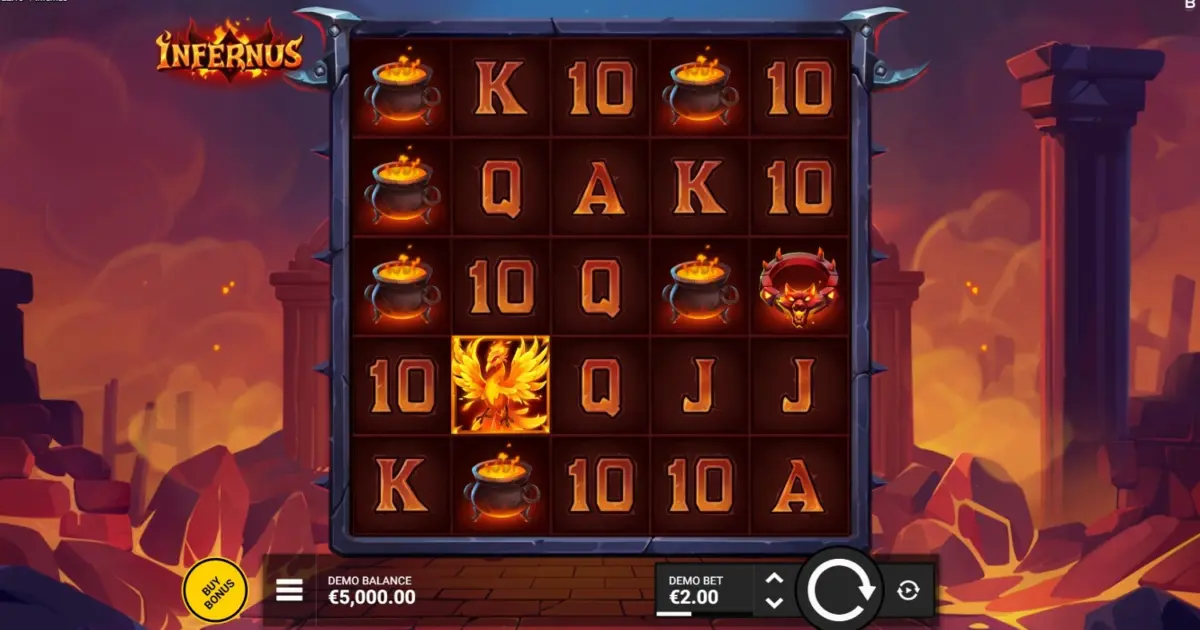
Infernus is a 5-reel horror slot from Backseat Gaming that returns 96.27% to players across a large sample of spins. The game sits above the industry-wide average, which already puts it ahead of the majority of titles competing for your attention on free-play review sites. Whether it holds your interest for a full session depends on how its risk profile matches your bankroll and patience.
Infernus versus the average slot
The single most useful number for a first-pass comparison is how this game stacks up against the broader pool. Infernus carries an RTP of 96.27% against a corpus average of 95.71%, a spread of 0.56 percentage points in the game’s favour. That gap is not enormous, but across a 500-spin session at £1 per spin, it represents a theoretical difference of £2.80 in expected loss. Over longer sessions that margin compounds.
The game also earns a popularity percentile of 99.1, meaning only 0.9% of slots tracked here are played more often. It ranks 182nd by volume among several thousand titles. Popularity and RTP do not move in lockstep — plenty of low-RTP games attract players for entertainment reasons that have nothing to do with mathematics — but the combination suggests that Infernus draws people in and gives them a statistically fairer deal than the median slot they might otherwise pick.
For readers who want to see how this number compares with other games from the same provider or the same visual category, the sections below break down both.
RTP breakdown: 96.27% in context
RTP is a long-run theoretical return calculated over millions of spins by the game’s mathematician. It is not a promise about any individual session. A 96.27% figure means that across an enormous sample, the game retains 3.73% of all money wagered as the house edge. In a single 200-spin session at £2 per spin, you will experience results that diverge wildly from that average — some players walk away up, others down, and neither outcome proves anything about the underlying maths.
Where 96.27% sits on the landscape: slots below 95% are generally considered poor value, the 95–96% band is common at regulated UK and European operators, and anything above 96% is competitive. The corpus average here is 95.71%, so Infernus clears that bar by a noticeable margin. Backseat Gaming’s own portfolio average is 96.07%, meaning Infernus also beats its sibling titles by 0.20 percentage points.
That provider-internal comparison matters because it tells you this is not an outlier being propped up with an above-average number to attract attention. It is one of the better-returning titles in a studio that already operates slightly above the market average. The table below summarises the key figures.
| Metric | Value |
|---|---|
| RTP | 96.27% |
| Corpus average RTP | 95.71% |
| Difference vs corpus | +0.56 percentage points |
| Provider average RTP | 96.07% |
| Provider portfolio size | 29 games |
| Reels | 5 |
| Popularity percentile | 99.1% |
| Free demo available | Yes |
Volatility profile
Backseat Gaming has not published a volatility rating or hit-frequency figure for Infernus in the data available here. That absence is worth noting because volatility shapes the texture of a session far more than RTP does. Two slots with identical RTPs can feel completely different to play if one is low-volatility (frequent small wins, flat session curve) and the other is high-volatility (long dry spells punctuated by large payouts).
General slot math: a low-volatility game typically has a hit frequency above 35%, meaning you see a winning spin roughly every three. A high-volatility game may hit below 20%, meaning five or six spins pass between any return. Your bankroll needs to survive the gaps, not just the average. Without a published figure for this specific game, treat any session-planning advice you see elsewhere with caution and rely on your own demo results to form an expectation.
One indirect signal: Infernus sits in a portfolio where the provider average is 96.07% across 29 titles. Studios that publish games clustered tightly around a high average often operate in a similar volatility band across their catalogue, but this is a generalisation, not a rule, and it should not override what you observe in free play.
Backseat Gaming as a studio
Backseat Gaming maintains a portfolio of 29 tracked titles with an average RTP of 96.07%. That is a small but consistent catalogue — small enough that each release carries weight in the studio’s reputation, and consistent enough that you are unlikely to stumble onto a mathematically hostile outlier in their back catalogue. The range across their games, however, tells a different story. Lord Venom returns just 92.35%, a figure that falls well below even the corpus average and would put it at the bottom quartile of regulated slots.
Against that low point, Infernus and its siblings look strong. Sleepy Grandpa pays 96.23%, within four hundredths of a point of Infernus. The Cursed King pays 96.28% — one hundredth of a point above this game. Those two are statistically interchangeable from an expected-value standpoint, so the choice between them comes down entirely to theme and presentation preference rather than mathematics.
When comparing providers, a portfolio average above 96% with a tight spread between highest and lowest is a sign of mathematical discipline. Backseat Gaming passes that test on average but not on range, given the Lord Venom figure. If you are browsing their catalogue, checking the RTP of each title before committing real money is advisable.
Three horror alternatives worth comparing
Infernus belongs to a horror-and-scary category that contains 479 tracked slots on this platform. That depth means you have genuine alternatives to test before you settle. Three related titles in the same visual family offer different trade-offs.
Hand of Anubis returns 96.24%, essentially identical to Infernus within rounding, and draws on Egyptian mythology rather than generic horror imagery. If you want the same expected value with a different aesthetic, it is the closest functional substitute in the dataset.
Trickstar Spins pays 94.0%, a full 2.27 percentage points below Infernus. That is a significant gap. Across 1,000 spins at £1, the difference works out to roughly £22.70 in additional theoretical loss. Unless presentation alone justifies the sacrifice, the maths favours Infernus decisively.
Halloween Crystals has no published RTP in the data available here, so it cannot be meaningfully compared on return. Free demo play lets you observe its pace and hit pattern, but you cannot verify its long-run maths from outside.
Getting the most out of the free demo
Infernus is available as a free demo on this site. That matters more than it might seem, because demo play is the only zero-cost way to form a personal read on a game whose volatility rating has not been published. The 96.27% RTP tells you what the game does over millions of spins. The demo tells you what the game feels like over two hundred, which is the timeframe you will actually experience at a table.
Use the free version to track three things: how many spins pass between wins (your personal hit-frequency estimate), how your balance moves over 100-spin blocks, and whether the pacing holds your interest. Demo results do not predict real-money outcomes — the RNG is independent on every spin — but they do give you an honest sense of whether the session rhythm suits your preferences.
When you move to real money, treat the game as paid entertainment with a fixed budget you are prepared to lose entirely. Set that budget before you deposit, not during a session. If gambling stops feeling like entertainment, stop. Players under 18 should not be accessing this game at any operator.
Should you play Infernus?
If you are comparing horror-themed 5-reel slots and want a mathematically sound starting point, the infernus slot is a defensible pick at 96.27% RTP. It beats both the corpus average and the provider average, sits at the 99th percentile for player interest, and has a free demo available so you can evaluate pacing without financial risk. The main caveat is the missing volatility data, which means session-planning relies on your own observation rather than a published rating.
Against the field of 479 horror slots, Infernus holds a statistically favourable position. Against Backseat Gaming’s own catalogue, it is one of the better titles. And against your bankroll, the 3.73% house edge is moderate by industry standards — not the best available, but clearly above the median. Whether the theme engages you enough to keep spinning is a personal question the demo answers better than any review can.
Frequently Asked Questions
Is Infernus slot available to play for free?
Yes, the game is available as a free demo on this site. Backseat Gaming has made it playable without registration or deposit, so you can evaluate the pacing and hit pattern over several hundred spins before deciding whether real-money play suits you.
What is the RTP of Infernus and how does it compare to other slots?
Infernus has an RTP of 96.27%, which is 0.56 percentage points above the corpus average of 95.71%. Within Backseat Gaming's own 29-title portfolio, the average is 96.07%, so Infernus also beats its studio average by 0.20 points.
What is the volatility of Infernus slot?
No official volatility rating has been published for this game in the available data. The RTP is 96.27% across 5 reels, but without a hit frequency or volatility classification you should rely on extended free demo play to gauge how the game distributes wins over a typical session.
Who makes Infernus and what other games does Backseat Gaming have?
Backseat Gaming is the developer, and they maintain a catalogue of 29 tracked titles with a portfolio average RTP of 96.07%. Other games include The Cursed King at 96.28% and Lord Venom at 92.35%, showing a wide spread in mathematical returns across their range.
How does Infernus compare to Hand of Anubis for horror slot players?
Infernus returns 96.27% and Hand of Anubis returns 96.24%, making them statistically near-identical from an expected-value standpoint. Both sit within the same 5-reel framework. The practical difference is thematic: Infernus draws on generic horror while Hand of Anubis uses Egyptian mythology imagery.




