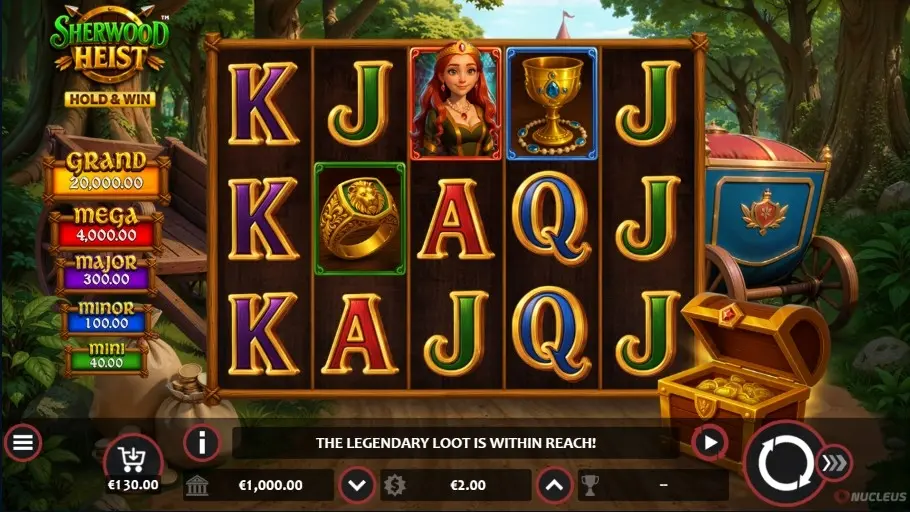
Sherwood Heist Hold & Win sits at 96.11% RTP, forty basis points above the cross-provider average of 95.71%, and twenty points ahead of Nucleus Gaming’s own 95.91% portfolio mean. That edge matters over long sessions, though the game does not publish volatility or max-win figures, so you’re planning blind on swing size. If you value transparent maths and need to know worst-case variance before you load a slot, the missing data is a deal-breaker.
| Specification | Value |
|---|---|
| RTP | 96.11% |
| Reels | 5 |
| Provider | Nucleus Gaming |
| Popularity rank | 36 (99.8th percentile) |
| Free demo | Yes |
Sherwood Heist Hold & Win at a glance
Nucleus Gaming has published an RTP of 96.11%, which places this title comfortably above both the studio’s 95.91% average and the 95.71% figure across the wider catalogue. The game ranks 36th by traffic and sits in the 99.8th percentile for popularity, so it is pulling players. The 5-reel layout is standard. Nucleus does not disclose volatility, hit frequency, maximum win potential, or the stake range, so you cannot model session length or calculate a sensible starting bankroll from the specs alone.
The absence of a published volatility band is the bigger omission. RTP tells you the long-run cost; volatility tells you whether that cost arrives as steady bleed or violent swings. Without it, demo play becomes the only way to gauge risk, and even then you’re inferring from a small sample.
What a 96.11% RTP actually returns
RTP is the percentage of total stakes returned as wins across millions of spins. A 96.11% figure means the game is designed to pay back £96.11 for every £100 wagered when measured over an infinite sample. Your own session—whether ten spins or a thousand—will deviate from that average, sometimes wildly, because each spin is an independent random event.
Take 1,000 spins at £0.20 per spin: you stake £200. At 96.11% RTP, the expected return is £192.22, so the theoretical cost is £7.78. A game with the corpus average of 95.71% would return £191.42 over the same sample, costing you £8.58. The forty-basis-point advantage saves you eighty pence per thousand spins. That difference compounds if you play longer sessions or higher stakes, but it does not change the fact that in any given run you can finish well ahead or well behind the average.
Compared to Nucleus Gaming’s portfolio mean of 95.91%, Sherwood Heist Hold & Win offers an extra twenty basis points—£0.40 saved per £200 staked—which makes it one of the better-returning titles in the studio’s catalogue. If you rotate between Nucleus slots, prioritise this one and Mermaid’s Treasure: Book of Pearls – Hold & Win, which also features the Hold & Win mechanic, for the strongest mathematical position available from the provider.
Volatility unknown and what your session will feel like
Nucleus Gaming has not assigned a volatility rating—low, medium, or high—to Sherwood Heist Hold & Win, and without that label you cannot predict whether your balance will erode steadily or swing between deep drawdowns and large recovery hits. Low-volatility slots pay frequently but in small amounts, so your balance declines slowly and predictably. High-volatility games go long stretches without wins, then deliver occasional large payouts that may or may not recover the deficit. Medium volatility sits between those two profiles.
The Hold & Win mechanic in the title suggests the presence of a bonus round that locks symbols and awards accumulated values, a feature commonly associated with medium-to-high variance. But that is an inference from naming convention, not a published specification, and treating guesswork as fact is how players end up burning through a bankroll faster than planned.
If you must play without knowing volatility, start with the minimum stake and track your balance over the first hundred spins. Count how many spins return nothing, how many return less than your stake, and whether any single win exceeds ten times your bet. That snapshot will not give you the true volatility—variance reveals itself over tens of thousands of spins—but it will tell you whether your current bankroll can survive the game’s rhythm. Set a loss limit before you start and walk when you hit it, regardless of whether you think a recovery spin is due. It is not.
The 5-reel layout and how wins are counted
Sherwood Heist Hold & Win uses a 5-reel structure, the most common grid format in online slots. Reels spin independently, and wins are evaluated according to the game’s payline configuration or, if it uses a ways-to-win system, by counting matching symbols on adjacent reels starting from the leftmost position. Nucleus Gaming has not published the payline count or whether the game uses ways, so you will see that detail only when you load the paytable inside the slot itself.
In a typical 5-reel slot, low-value symbols appear more frequently than high-value symbols, and the paytable assigns progressively larger payouts to rarer combinations. The gap between low-symbol and high-symbol wins, combined with the frequency of each, determines how the game’s RTP is distributed across the hit spectrum. A game that leans heavily on infrequent high-value hits will feel higher variance than one that spreads return more evenly across the symbol set, even if both share the same RTP.
The Hold & Win element in the title signals a second-screen or reel-modifier feature where certain symbols lock in place while remaining positions respin, building toward a cumulative prize. That mechanic is common in games targeting players who prefer fewer, larger events over constant small wins. If you lean toward frequent reinforcement and steady balance management, a 5-reel slot with a more traditional free-spins feature may suit you better. Bandits and Bounties, also from Nucleus Gaming, offers an alternative thematic approach within the same studio catalogue.
Stake range and sizing a bankroll
Nucleus Gaming has not disclosed the minimum or maximum stake for Sherwood Heist Hold & Win, so you cannot calculate a recommended bankroll from the specifications. In general, a slot bankroll should cover at least one hundred times your chosen stake if the game is low volatility, two hundred times for medium, and three hundred or more for high. Without a published volatility figure or stake range, that formula cannot be applied here.
When the stake floor is unknown, load the demo, check the coin or bet-adjustment controls, and note the lowest and highest values available. Multiply your intended per-spin bet by two hundred as a conservative starting bankroll if you plan a session of typical length—say, thirty minutes to an hour of casual play. If the game proves more volatile than expected during demo testing, increase that multiple to three hundred or simply reduce your per-spin stake when you switch to real-money mode.
Never stake more per spin than 0.5% of your total session budget. A £100 bankroll should not support bets above £0.50 if you want enough runway to ride out a cold stretch. The maths does not change because a game has a Hold & Win feature or a 96.11% RTP—variance can and will drain your balance faster than the RTP predicts over short samples, and you will not get a warning spin before it happens.
Playing the Sherwood Heist Hold & Win demo before you commit
A free-play demo is available for Sherwood Heist Hold & Win, and you should use it. Demo mode runs the same RNG, reel strips, paytable, and bonus triggers as the real-money version, so the hit frequency, win sizes, and feature cadence you observe in demo are representative of what the game will deliver when stakes are live. The only difference is that demo wins and losses have no financial consequence, which makes it the correct environment for learning the interface, testing stake levels, and observing the game’s actual volatility behaviour before you risk your own money.
Run at least two hundred demo spins at your planned real-money stake. Track your balance trajectory: does it decline smoothly, or does it plunge and recover in sharp bursts? Do you trigger the Hold & Win feature frequently enough that it feels like part of the game’s core loop, or does it arrive so rarely that your balance cannot survive the wait? Those observations will tell you whether your intended bankroll is adequate and whether the game’s rhythm matches your tolerance for risk.
Demo play does not predict your real-money results—variance guarantees that your next session will differ from your demo session—but it does let you rule out games that are clearly mismatched to your budget or preference before you deposit. If the demo drains three hundred demo pounds in fifty spins, do not convince yourself that the real-money version will behave differently. It will not.
Set a budget before you play, treat that budget as the cost of entertainment rather than an investment with expected return, and never chase losses by increasing stake size or playing past your limit. If you are struggling to control the time or money you spend on slots, contact BeGambleAware, GamCare, or your national support service. This is an adult product; you must be 18 or older to play.
Verdict: who should play Sherwood Heist Hold & Win
Sherwood Heist Hold & Win offers a better-than-average RTP at 96.11%, ranking it above both Nucleus Gaming’s studio mean and the broader catalogue average, and the game’s 99.8th-percentile popularity rank shows it is resonating with players. The free demo removes the friction of testing the game before you commit real money. Those are the two unambiguous positives.
The missing specifications—volatility, stake range, max win, and hit frequency—are harder to excuse. RTP alone does not tell you what a session will feel like or how much bankroll you need, and the absence of that data forces you to infer risk from demo play or simply gamble blind. If you are comfortable flying without instruments and you have the patience to test thoroughly in demo mode, the RTP advantage and the Hold & Win mechanic may be enough to justify the effort. 12 Animals, another Nucleus Gaming release, is worth comparing if you want to explore the studio’s range.
If you require published volatility and transparent max-win figures before you load a slot—and that is a perfectly rational requirement—skip this one and choose a game whose provider documents the full spec sheet. The forty-basis-point RTP edge is real, but it cannot compensate for planning a session with half the data missing.
Frequently Asked Questions
Is there a free demo version of Sherwood Heist Hold & Win?
Yes, a free-play demo is available. The demo uses the same RNG, paytable, and feature logic as the real-money version, so it accurately represents hit frequency and bonus cadence. Run at least two hundred spins at your intended stake to observe balance trajectory and decide whether the game's rhythm suits your bankroll and volatility tolerance before you deposit.
What does the 96.11% RTP mean for my balance?
RTP of 96.11% means the game returns £96.11 per £100 wagered over millions of spins. Across 1,000 spins at £0.20 each—£200 staked—the expected return is £192.22, a theoretical cost of £7.78. That is forty basis points better than the 95.71% corpus average, saving you eighty pence per thousand spins, though any individual session will deviate from the average due to variance.
Does Nucleus Gaming publish the volatility for this slot?
No. Nucleus Gaming has not assigned a low, medium, or high volatility rating to Sherwood Heist Hold & Win, and without that figure you cannot predict whether your balance will decline steadily or swing sharply. The Hold & Win mechanic suggests medium-to-high variance, but that is inference, not specification. Use the demo to observe actual hit patterns before committing real money.
How does Sherwood Heist Hold & Win compare to other Nucleus Gaming slots?
The 96.11% RTP is twenty basis points above Nucleus Gaming's portfolio average of 95.91%, making it one of the stronger returns in the studio's 108-game catalogue. Mermaid's Treasure: Book of Pearls - Hold & Win shares the Hold & Win feature and may offer a similar mechanical experience, while Bandits and Bounties provides a different thematic direction if you want to stay within the Nucleus catalogue.
Can I win real money playing the Sherwood Heist Hold & Win demo?
No. Demo play uses virtual credits with no cash value. Wins and losses in demo mode have no financial consequence and cannot be withdrawn. Demo mode exists to let you learn the interface, test stake levels, and observe volatility without risk, but only real-money play—following a deposit at a licensed operator—can produce withdrawable winnings.




