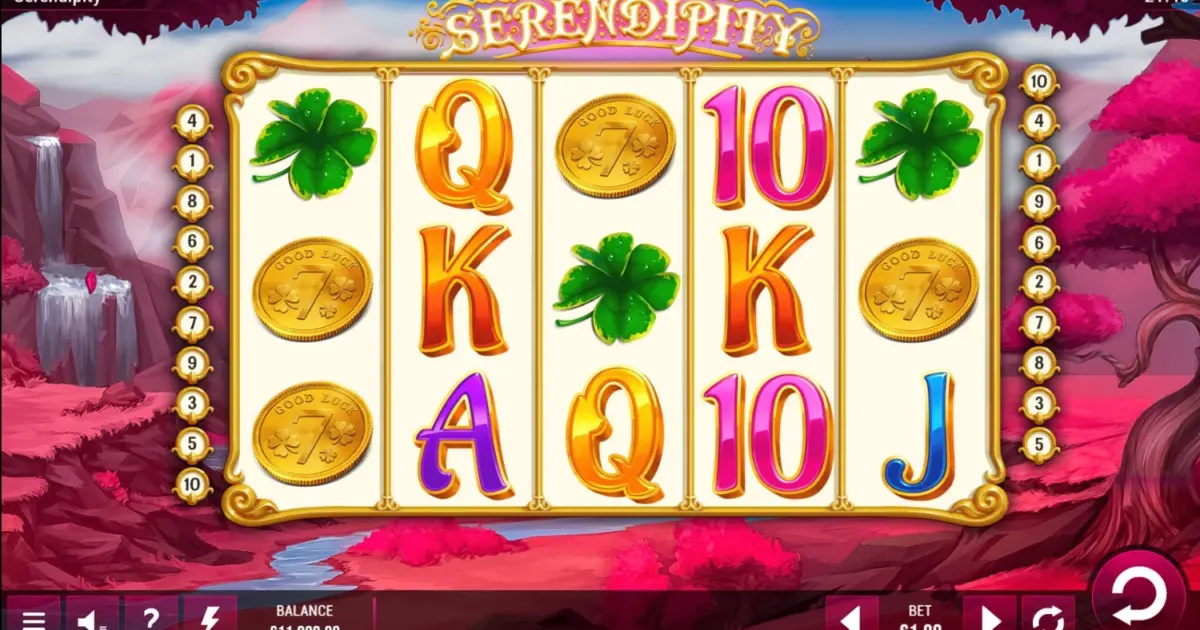
The honest short answer is: probably not, unless you specifically want a Yggdrasil title with a below-average return. The 95.23% RTP sits under both its provider average and the corpus average, which matters over extended play. If you are choosing between games and comparing returns, this one asks you to accept less back per hundred wagered than most of its alternatives.
Is Serendipity worth playing?
Worth playing depends on what you value. If you want the highest possible long-run return, a figure of 95.23% puts this at the lower end of Yggdrasil’s catalogue. The provider’s average across 190 titles is 95.81%, meaning Serendipity gives back roughly 58 pence per hundred pounds less than a typical game from the same studio. Against the broader corpus average of 95.71%, the gap narrows to 48 pence per hundred but remains negative.
On the other hand, its popularity percentile of 92.1% (rank 1,581 overall) suggests enough players find something appealing about it — mechanics, pace, presentation — that a below-average RTP alone does not kill interest. You can play Serendipity free in demo mode before committing money, which lets you judge the gameplay for yourself without staking anything.
| Field | Value |
|---|---|
| Game | Serendipity |
| Provider | Yggdrasil Gaming |
| RTP | 95.23% |
| Reels | 5 |
| Subcategory | Slot Machine |
| Provider average RTP | 95.81% |
| Corpus average RTP | 95.71% |
| RTP vs corpus | −0.48 pp |
| Volatility | Not published |
| Stake range | Not published |
| Max win | Not published |
What 95.23% RTP means over 1,000 spins
RTP is a long-run statistical average calculated across millions of simulated spins, not a promise about any single session. At 95.23%, the theoretical expectation is that for every £100 wagered over a sufficiently large sample, £95.23 returns to players collectively and £4.77 represents the house edge.
Over 1,000 spins at a £1 stake, you wager £1,000 total. The theoretical loss at this RTP is £47.70. At Yggdrasil’s provider average of 95.81%, the same 1,000 spins at £1 would theoretically cost £41.90 — a difference of £5.80 per thousand spins. That number is small enough to disappear in the noise of any real session but large enough to matter when you compare two games you play regularly over weeks or months.
The Serendipity RTP is fixed in the sense that Yggdrasil has published a single figure; many providers configure multiple RTP settings and operators pick from them, but this game lists only one number. Treat the 0.48-percentage-point deficit to the corpus as a small but consistent drag on expected value relative to the average game in this database.
How volatile is the Serendipity slot?
Yggdrasil has not published a volatility rating for this title, so you cannot know from official data whether the game pays frequently in small amounts or rarely in large clusters. This absence is worth taking seriously rather than guessing.
In general terms, volatility governs how a slot distributes its total return across spins. A low-volatility game returns money steadily in small increments, keeping balance swings tight and session lengths more predictable. A high-volatility game concentrates returns into rare, larger hits, meaning longer stretches of small or zero wins followed by sudden spikes. Medium sits between these poles. Without a published figure, the Serendipity free demo is your best tool: play it for a few hundred spins and observe how often you hit a winning line versus how much any single hit pays back relative to your stake.
The lack of a volatility label also means you cannot assess the game’s true risk profile against its 95.23% RTP. Two games with identical RTPs can feel completely different depending on their variance structure.
What the 5-Reels theme brings to the game
The theme label “5-Reels” describes the reel structure rather than a narrative or aesthetic category. On a five-reel layout, each spin presents up to five columns of symbols, and winning combinations typically form along horizontal or diagonal paylines, or via adjacent-symbol “ways” mechanics depending on the specific configuration Yggdrasil has chosen for this title.
Five reels is the most common structure in modern online slots because it balances visual clarity with enough symbol positions to create varied winning combinations. Three-reel games tend toward simpler, lower-hit-frequency designs; six-reel and grid games introduce more complex symbol interactions. A five-reel layout like Serendipity’s sits in the mainstream middle.
The theme game count for this category is zero in the database, which means no other title shares this exact label — the entry is a structural classification rather than a content category with a peer group. You will not find a “more like this” list generated from the theme field alone, so provider and mechanic comparisons are more useful starting points when looking for similar games.
Stakes, session length and bankroll
No minimum or maximum stake range is published for Serendipity, so you cannot calculate a guaranteed number of spins per £50 or £100 bankroll before you open the game. In practice, online slots from established providers usually offer a wide stake range — something like £0.10 to £100 per spin or beyond — but without confirmed figures for this title, treat any range you encounter in the live game as the actual limit for your chosen operator.
What you can plan around is the RTP deficit. At 95.23%, each £1 staked carries a theoretical loss of 4.77 pence. If you play 200 spins per hour at £0.50 per spin, your wagered total is £100 per hour and your theoretical loss is £4.77 per hour. Stretch that to a two-hour session and the figure is £9.54. These are averages over very large samples; a single session will deviate wildly, and the direction of that deviation depends entirely on the unrevealed volatility structure.
Without a volatility figure, budget conservatively. Assume swings could be larger than a low-variance game would produce and size your stake accordingly.
Alternatives if Serendipity is not for you
If the below-average return is your main concern, two other titles from Yggdrasil’s catalogue offer better RTPs. Syncronite returns 96.0% — that is 0.77 percentage points above Serendipity and close to the industry-standard 96% threshold many players use as a baseline. Over a £1,000-wagered session, that difference translates to £7.70 more returned in theory.
At the other end, Trickstar Spins carries a 94.0% RTP, which is worse than Serendipity by 1.23 points. If you are browsing this provider’s games and comparing returns, Trickstar Spins illustrates that Serendipity’s below-average figure still beats some other entries in the same library.
Hillbilly Vegas also comes from Yggdrasil, though no RTP has been published for it in this database. That absence is its own signal: when a provider has not supplied a figure, you are evaluating the game without its most important long-run number, which makes comparisons to Serendipity or any other title incomplete.
Final take
Serendipity is a five-reel slot from Yggdrasil whose main quantifiable weakness is a 95.23% RTP — below the provider average and the corpus average by meaningful margins when you play over many sessions. The missing volatility and stake-range data mean you cannot fully characterise the game’s risk profile before trying it, which is the single biggest reason to spin it in demo mode first rather than committing funds immediately.
Its 92.1st-percentile popularity suggests players do engage with it despite the return figure, so gameplay quality may compensate for the statistical disadvantage. Only you can judge that after a demo session.
Treat this as paid entertainment: 18+, set a budget before you start, and stop when it is spent. Every spin is independent — no sequence of results changes the expected outcome of the next one, and no game is ever “due” for a particular result.
Frequently Asked Questions
Can I play Serendipity slot for free without downloading?
Yes, a free demo version of Serendipity is available with no download required. You can play it in demo mode directly in your browser to evaluate the five-reel layout and get a feel for the game's pace before wagering any money. The demo uses the same mechanics as the real-money version.
What is Serendipity's RTP and is it good?
Serendipity has a 95.23% RTP, which is below Yggdrasil's provider average of 95.81% and below the corpus average of 95.71%. That means over large samples the game retains 4.77% of wagered money, compared to 4.19% for an average Yggdrasil title. It is not the worst return available, but it is not competitive either.
Is Serendipity a high-volatility or low-volatility game?
Yggdrasil has not published a volatility figure for Serendipity, so its risk profile is unknown from official data. This is a meaningful gap because two games can share the same 95.23% RTP yet behave very differently in terms of swing size and winning frequency. Your best workaround is to observe the demo's hit rate and payout spread over several hundred spins.
What else does Yggdrasil Gaming make besides Serendipity?
Yggdrasil has published at least 190 games in this database, with an average RTP of 95.81%. Their catalogue includes titles like Syncronite at 96.0% RTP and Trickstar Spins at 94.0%, so Serendipity's 95.23% falls below their own typical return but above their lowest published figure. The studio spans a range of quality in terms of player return.
What should I know about the stake range before playing Serendipity?
No minimum or maximum stake has been published for Serendipity in this database. The actual range you will see depends on the operator offering the game. Without confirmed figures, plan your bankroll using the 95.23% RTP and assume you need enough balance to weather swings you cannot quantify until volatility data becomes available.