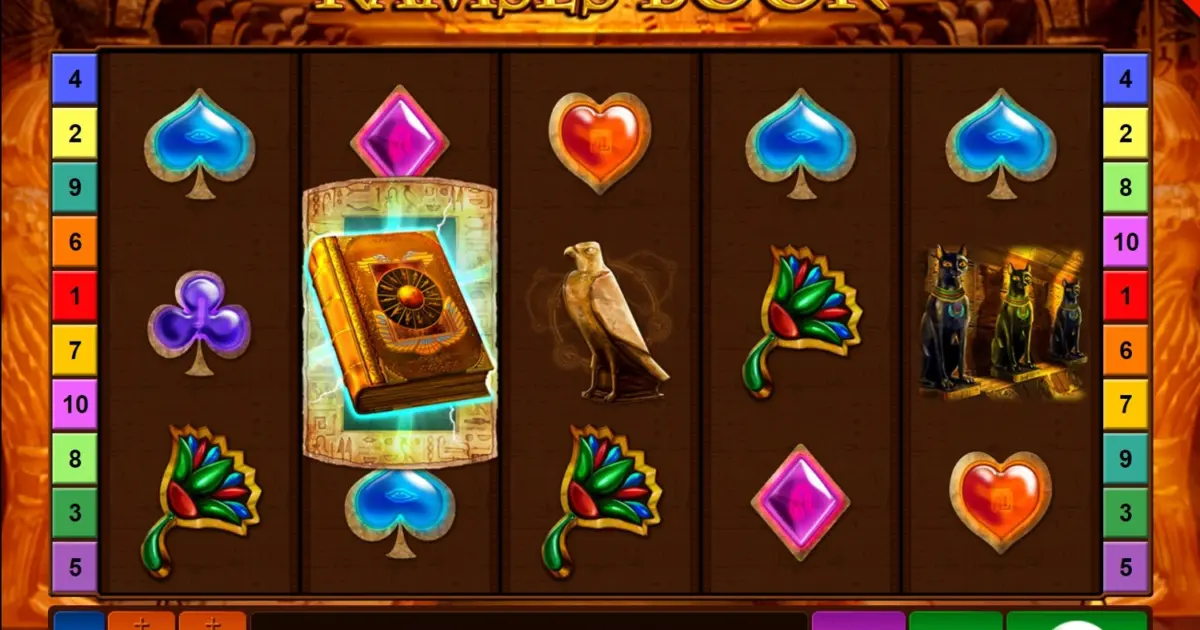
Ramses Book is a 5-reel Egypt-themed slot from Gamomat that offers a free demo and a 96.15% RTP, which puts it just above both the provider and wider market averages. If you want a familiar book-style Egypt slot to compare before you risk any bankroll, the ramses book slot is worth a few demo spins to see if its pace suits you — but missing volatility and stake data limits how precisely you can plan a session.
First look at ramses book slot
Gamomat has built a catalogue of 174 titles, and Ramses Book sits at rank 2059 for popularity, which places it around the 89.7th percentile in the tracked corpus. That rank does not tell you whether the game is good, only that plenty of players have sampled it relative to thousands of other titles. The primary theme is Egypt, paired with the structural tag 5-Reels, so you can expect the visual framing and symbol set to draw on Egyptology rather than any other genre.
What is useful at this stage is separating verified facts from common assumptions. The facts you can rely on are the provider name, the 5-reel structure, the 96.15% RTP, and the availability of a Ramses Book free demo with no download required for comparison play. Gamomat has not published a volatility rating, a payline or ways count, a hit frequency, or a max win figure for this title in the data supplied here, so any numbers you see quoted elsewhere for those attributes should be treated as unverified for this specific game. That absence matters because volatility and pay structure shape how long a bankroll tends to last, and without them you are assessing risk on RTP alone.
In general terms, many slots use wilds to substitute for other symbols and scatters to trigger features, and some offer optional buy features, but those are concepts rather than confirmed features of Ramses Book. Until the provider publishes a full paytable and feature list, the honest starting point is to test the demo for feel while anchoring expectations to the maths you do know.
How a round plays out
From the verified data, each round is played on 5 reels. Beyond that reel count, the FACTS block does not specify how many paylines or ways are active, how symbols pay, or which mechanics are present, so this section can only outline what that generally means and where the gaps are.
In a typical 5-reel slot, you select a stake, start the spin, and the reels stop to reveal a combination that is evaluated against the game’s paytable. If the game uses paylines, only symbols landing on a defined line count; if it uses ways, any matching symbols on adjacent reels from left to right may count. Because Gamomat has not confirmed either structure for Ramses Book here, you should check the in-game help screen during your Ramses Book free demo session to see exactly how wins are formed before you use the game for any bankroll maths.
Wilds, scatters, free spins and expanding symbols appear in many Egypt-themed book games, but asserting they are present in Ramses Book would be invention. The same applies to buy-feature buttons, gamble ladders or jackpots — these are common across the market but are not confirmed for this title in the supplied facts. Every spin remains independent regardless of structure; a previous result does not change the odds of the next. Use the demo to confirm the reel behaviour, pay evaluation and any information screen, and treat anything not shown there as unconfirmed rather than assumed.
Reading the 96.15% return figure
The return to player for Ramses Book is 96.15%, which is a long-run statistical average, not a promise for any single session. It means that across a very large sample — millions of spins — the game is designed to return £96.15 for every £100 wagered, with the remaining £3.85 representing the house edge. That edge applies to total turnover, not to your starting balance in isolation.
To make that concrete, if you wagered £1 per spin for 1,000 spins, your total staked would be £1,000 and the theoretical return would be £961.50, for a theoretical loss of £38.50 over that sample. The key phrase is theoretical: variance ensures individual sessions can finish well above or well below that line, even though the aggregate across all players trends toward the stated percentage.
Context helps you judge the figure. Gamomat’s average RTP across its 174 games is 96.11%, so Ramses Book sits 0.04 percentage points above its own provider mean. The corpus average across all tracked slots is 95.71%, so Ramses Book is 0.44 percentage points above the wider market average. That is a modest but genuine edge in expected return compared with many alternatives, and it matters more the longer you play, because RTP compounds with volume. Over 100 spins the difference between 96.15% and a lower figure is small in cash terms; over 10,000 spins the gap becomes more material.
| Attribute | Value |
|---|---|
| Provider | Gamomat (174 games, avg RTP 96.11%) |
| RTP | 96.15% |
| Reels | 5 |
| Theme | Egypt / 5-Reels |
| Category | Slot Machine |
| Popularity rank | 2059 (89.7th percentile) |
| Corpus average RTP | 95.71% |
| Free demo | Available |
Do not confuse a higher RTP with lower risk. RTP describes average return, while volatility describes how that return is distributed — tight, steady drips versus long droughts punctuated by larger hits. Since volatility is not disclosed here, you can use 96.15% to compare expected cost per £100 wagered, but you cannot use it to predict session length without also knowing swing size.
Why volatility changes your bankroll maths
No volatility rating has been published for Ramses Book in the supplied facts, and that absence is decision-relevant. Volatility is the shorthand for how a game’s returns are spread around the average. A low-volatility game tends to produce frequent but smaller wins, which often stretches a fixed bankroll over more spins. A high-volatility game tends to produce less frequent wins with larger gaps between them, which often shortens the median session but widens the range of possible outcomes.
Without a stated level you cannot map Ramses Book to either pattern, so your bankroll maths should be built around the uncertainty. In general, if you assume moderate swing and your results cluster tightly, your bankroll may last longer than expected; if the game turns out to lean higher in variance, the same stake can deplete faster before any compensating win appears. That is not a prediction about this title, it is how variance works across slots as a category.
What you can control, regardless of undisclosed volatility, is exposure. Every spin is independent, so no count of dead spins makes a win more likely next time, and no staking progression changes the 96.15% long-run expectation. Until Gamomat publishes a volatility figure, treat session planning conservatively: use the demo to get a feel for cadence across a few hundred spins, but do not extrapolate a long-term risk profile from a short sample, because short samples are dominated by variance.
Bet sizing and bankroll planning
The FACTS block does not include a minimum bet, maximum bet or default stake increment for Ramses Book, so a precise pounds-and-pence session plan cannot be built from this data alone. That missing stake range is worth noting because stake size, combined with volatility, determines how many spins a given bankroll can support on average.
In general terms, the maths is straightforward. Your total exposure equals stake per spin multiplied by number of spins, and theoretical cost equals total exposure multiplied by (1 − RTP). At 96.15%, the theoretical cost is 3.85% of turnover. If you were to stake £0.20 for 500 spins, turnover would be £100 and theoretical cost would be about £3.85; at £1 for the same 500 spins, turnover would be £500 and theoretical cost about £19.25. Those figures describe expected cost over a large sample, not a cap on what you can lose in a volatile session.
Because the actual stake limits are not confirmed here, open the game itself or its help file to verify the lowest and highest options before you decide what a comfortable session looks like. Many Gamomat slots share similar ranges, but assuming a specific minimum for this title would be invention, and published limits can vary by operator. Use whatever limits you find to translate RTP into a realistic number of spins for your budget, rather than fixing a spin count first and forcing a stake to fit it.
Where Ramses Book sits among Egypt slots
Egypt is one of the most crowded themes, with 908 Egypt-tagged slots in the corpus, so direct RTP comparisons are a practical way to filter alternatives. Within the related Egypt set supplied, Book of Dead posts 94.25%, which is 1.90 percentage points below Ramses Book, meaning its theoretical cost per £100 wagered is higher over a large sample. Book of the Sun at 96.23% sits 0.08 points above Ramses Book, a small edge in expected return, while Crazy Mummy at 96.00% sits 0.15 points below.
None of those comparisons tells you which game will feel better moment to moment, because feel is driven by undisclosed paylines, hit frequency and volatility alongside RTP. What the numbers do tell you is cost efficiency over time: if you played comparable volumes, Ramses Book would theoretically retain slightly more of your turnover than Book of Dead and Crazy Mummy, and slightly less than Book of the Sun.
Gamomat’s own catalogue offers another lens. Among the provider’s related titles, Fancy Fruits – Red Hot Firepot and Fancy Fruits – Double Rush both show 96.09%, marginally below Ramses Book, while Book of Crazy Chicken – Golden Nights matches it exactly at 96.15%. Exploring those Gamomat slots in demo can show how the provider tends to pace its maths, even if each title remains independent in outcome. Popularity can also guide sampling: at rank 2059 Ramses Book is more widely tried than many long-tail titles, but theme-wide choice is vast, so use RTP and demo feel together rather than rank alone.
The honest verdict
Ramses Book earns consideration on the strength of its 96.15% RTP and clean 5-reel Egypt premise, especially since a free demo lets you verify mechanics without commitment. The figure is modestly above both Gamomat’s 96.11% average and the corpus 95.71% average, which is useful if you compare cost per £100 wagered across several Egypt options. Balanced against that, the lack of published volatility and confirmed stake limits means you cannot yet model session length or max swing with precision.
If you enjoy Egypt themes and want a straightforward baseline for comparison, load the demo, confirm paylines and features in the help screen, and track how a few hundred spins at your preferred stake feel for balance movement. If you find you want either more frequent feedback or more swing, use the RTP gaps noted above to pick a contrasting Egypt title rather than assuming this one will adapt to preference.
Keep play as paid entertainment. You must be 18+, set a budget before you spin and stick to it, and treat any demo session as a way to learn the interface, not as a predictor of real-money results. If you need to step back, use the limit and timeout tools where you play and seek independent support if gambling stops feeling enjoyable.
Frequently Asked Questions
Can I try Ramses Book for free before I stake real money?
Yes, a Ramses Book free demo is listed as available, so you can sample the 5-reel game without deposit in demo mode. Free play uses virtual credits, lets you check the paytable structure, and does not pay real money or predict future real-money results.
What is the RTP of Ramses Book and what does 96.15% mean in practice?
Ramses Book has a 96.15% RTP, meaning it is designed to return £96.15 per £100 wagered across millions of spins. It is a long-run average, not a per-session guarantee. That figure sits 0.44 points above the corpus average of 95.71% and 0.04 points above Gamomat's 96.11% provider average.
What volatility does Ramses Book have?
No volatility rating has been published for Ramses Book in the verified facts supplied. Without it you cannot tell whether the game leans toward frequent small returns or rarer larger swings. Use the RTP for cost comparison and treat session-length estimates cautiously until volatility is disclosed.
Who makes Ramses Book and what else do they offer?
Ramses Book is made by Gamomat, a provider with 174 tracked titles averaging 96.11% RTP. Related Gamomat games in the data include Fancy Fruits - Red Hot Firepot at 96.09% and Book of Crazy Chicken - Golden Nights at 96.15%, which matches Ramses Book exactly.
How does Ramses Book compare to Book of Dead?
On headline return, Ramses Book at 96.15% is 1.90 percentage points above Book of Dead at 94.25%, so theoretical cost per £100 wagered is lower on Ramses Book over a very large sample. Volatility, features and pay structure remain unconfirmed for Ramses Book, so compare variance and feel in demo rather than on RTP alone.