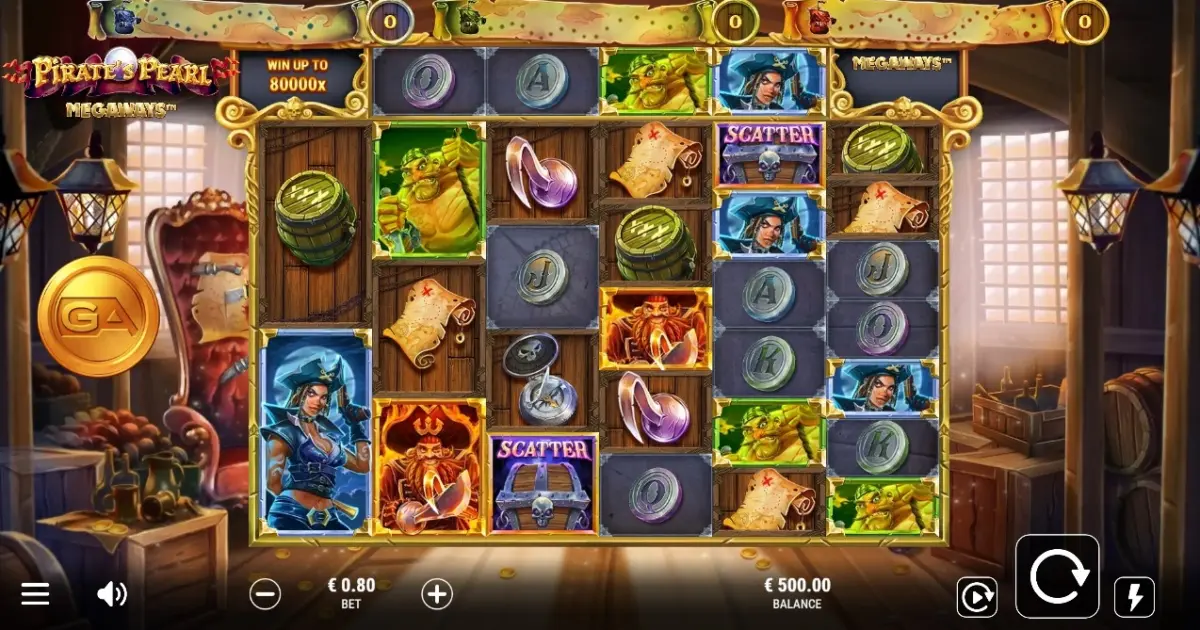
The headline number on the pirate’s pearl megaways slot is a 95.58% RTP, which sits 0.13 percentage points under the 95.71% average across the games in this catalogue and a wider 0.50 points under GameArt’s own house average of 96.08%. That is the practical starting point: the maths is slightly less friendly than the studio’s typical release. Against that, GameArt has released no volatility rating, no max win figure and no hit frequency for this title, so anything you read about swing size elsewhere is somebody’s guess rather than published data. A free demo is available, which is the sensible way to see how the six reels behave without committing money.
Who makes Pirate’s Pearl Megaways
GameArt is the developer, and this catalogue lists 178 of their titles. That is a substantial back catalogue by any measure — large enough that the studio has a recognisable house style and a spread of RTP settings rather than one fixed number applied across every release.
Studio size matters to you for one reason: consistency. A developer with 178 games in circulation has usually settled on how it builds a slot, which means the interface, the bet controls and the general pacing tend to feel familiar once you have played two or three of their games. If you get on with one GameArt release, the odds are reasonable you will get on with the next.
What GameArt has not published for this particular game is the detail many players look for first. There is no stated volatility band, no maximum win multiplier and no paytable data in the information available here. That absence is worth registering rather than filling in. When a studio publishes an RTP but stays quiet on max win, the honest reading is that you do not know the shape of the distribution — only its long-run average. Treat quoted “max win” figures from third-party sites with caution unless they cite the game’s own rules screen.
| Provider | GameArt |
|---|---|
| RTP | 95.58% |
| Reels | 6 |
| Theme | Pirates |
| Free demo | Yes |
Where Pirate’s Pearl Megaways sits in the GameArt catalogue
Inside GameArt’s range, this title is on the lower half of the RTP spread. Compare it directly: Sweet FTN runs at 96.55%, a full 0.97 points higher, which over a very large number of spins is the difference between a theoretical £95.58 and £96.55 returned per £100 staked. Kukulkan’s Queen sits at 96.06%, effectively level with the studio average and still ahead of this game.
Not every GameArt title has a published figure. Dynamite Fruits Deluxe has no RTP listed at all, which is a different problem again — you cannot compare a number that does not exist. If return percentage is your main filter, the games with published figures are the only ones you can actually rank.
None of this makes 95.58% a bad setting. It is a shade below the corpus average of 95.71% and a shade below GameArt’s own 96.08%. The gap to the studio average, 0.50 points, costs roughly 50p per £100 wagered over a very large sample. On a short session that difference disappears into variance entirely. On a long one, it compounds.
On popularity, the game ranks 1955 and sits in the 90.2nd percentile of the catalogue — well-played rather than obscure, which usually means it is easy to find in demo form.
RTP: 95.58% against a 96.08% house average
RTP is a long-run statistical average, not a session promise. A 95.58% return means that across an extremely large sample of spins — millions, not hundreds — the game is modelled to return £95.58 for every £100 wagered, keeping £4.42 as house edge. Nothing about that figure tells you what happens in your next twenty spins.
Put concrete numbers on it. Stake £0.20 a spin for 500 spins and you have wagered £100; the modelled return is £95.58, so the expected cost of that session is about £4.42. Run 5,000 spins at the same stake and you have wagered £1,000 with a modelled cost near £44. The expected loss scales with total money wagered, not with time played or with how the previous spins went. Every spin is an independent event, and the game has no memory of what came before it.
Against the 96.08% GameArt average, this title’s 4.42% house edge is about 12% larger than the studio’s typical 3.92%. Against the 95.71% corpus average, the gap is small enough to be almost immaterial. So the fair summary is: slightly below average for the developer, essentially average for the market.
One more thing the RTP does not tell you: how the return is distributed. Two games can share a 95.58% figure and feel completely different — one paying small amounts often, the other paying rarely and larger. Without a published volatility rating, you cannot tell which pattern applies here from the numbers alone.
Volatility and who it suits
No volatility rating has been published for this game, so this section is about what the categories mean and what you can infer from structure rather than what GameArt has confirmed.
Low volatility slots pay small amounts frequently. Balance drifts down gradually and sessions last a long time on a modest bankroll. High volatility slots do the opposite: long stretches with little return, punctuated by larger hits, which means the same bankroll can vanish much faster or stretch much further depending on nothing but chance. Medium sits between the two.
The one structural hint available is that this is a six-reel game. As a general rule across the market, wider reel sets and variable-ways mechanics tend to sit in the medium-to-high volatility range, because prizes are concentrated into fewer, larger combinations. That is a tendency across many slots, not a confirmed fact about this one.
The practical response to unknown volatility is straightforward: assume it swings more than you expect and size your stake accordingly. If you would normally play £1 a spin on a game whose volatility you know, start lower here until the demo shows you how the balance actually moves. Playing the free version for a few hundred spins costs nothing and tells you more about pacing than any rating would.
Playing Pirate’s Pearl Megaways for free
A free demo is available, which means you can load the game in a browser and spin with play credits before deciding whether it is worth real stakes. No download, no account, no deposit. The demo runs the same maths as the paid version, so the mechanics, paytable and pacing you see are the real ones.
What the demo cannot do is predict your results with money. Demo sessions are drawn from the same random model, and a good run in play credits carries no information about the next real session. Use it to answer questions the numbers cannot: does the pace suit you, are the bet controls clear, does the pirate theme hold your attention past fifty spins.
This is an 18+ game. Set a budget before you start and treat the money as the price of entertainment rather than an investment you expect back — the 95.58% figure tells you the house keeps a slice of everything wagered over time. If tracking your spend stops being comfortable, stop playing.
Similar picks
The pirate theme covers 293 games in this catalogue, so there is no shortage of alternatives if this one does not land. Worth noting that several of the closest matches carry lower RTPs than the 95.58% here.
1 Reel Caribbean Treasure returns 95.42%, only 0.16 points below and structurally the opposite — a single reel rather than six, which changes the feel completely. Jaws and Jewels Power Combo sits at 94.25%, a 1.33-point drop that costs about £1.33 more per £100 wagered long-run. Cursed Pirates is lower still at 94.00%.
Read that comparison carefully: within this theme, 95.58% is actually the strongest of the four figures listed. If you want a genuinely better return, the GameArt games named earlier are the better hunting ground than the pirate category.
Verdict
A 95.58% RTP six-reel game from a studio with 178 titles, playable free, with more unpublished than published detail. The return is marginally under the market average and half a point under GameArt’s own, which matters on long sessions and disappears on short ones.
The honest reservation is the missing information. Without a volatility rating or max win figure, you are choosing on RTP and theme alone. That is enough for a demo session; it is thin for a decision about real money. Load the free version, watch how the balance moves over a few hundred spins, and compare it against Sweet FTN at 96.55% before you commit anything.
Frequently Asked Questions
Can I play Pirate’s Pearl Megaways for free?
Yes — a free demo of this GameArt title is available, so you can spin with play credits in a browser without depositing or downloading anything. The demo uses the same 95.58% RTP model as the real-money version, so pacing and mechanics are identical. What it will not do is predict how a paid session goes.
What is the RTP of Pirate’s Pearl Megaways?
The published RTP is 95.58%, meaning the game is modelled to return £95.58 per £100 wagered across a very large sample of spins, with £4.42 retained as house edge. That is 0.13 points below the 95.71% catalogue average and 0.50 points below GameArt's own 96.08% average across their 178 titles.
Is Pirate’s Pearl Megaways high or low volatility?
GameArt has not published a volatility rating for this game, so nobody can state it with confidence. The only structural clue is the six-reel layout; wider reel sets across the market often sit medium-to-high, though that is a general tendency rather than a fact about this title. Size stakes conservatively until the demo shows you.
Who is GameArt and what else do they make?
GameArt is the developer behind this pirate slot, with 178 games in this catalogue and an average RTP of 96.08% across them. Their range includes Sweet FTN at 96.55% and Kukulkan’s Queen at 96.06%, both higher-returning than this title. Some releases, like Dynamite Fruits Deluxe, have no published RTP figure at all.
How does it compare to Cursed Pirates?
This game returns 95.58% against 94.00% for Cursed Pirates, a 1.58-point advantage that works out to roughly £1.58 more returned per £100 wagered over a very large sample. Among the pirate-themed titles listed here, including Jaws and Jewels Power Combo at 94.25%, 95.58% is the strongest published figure.