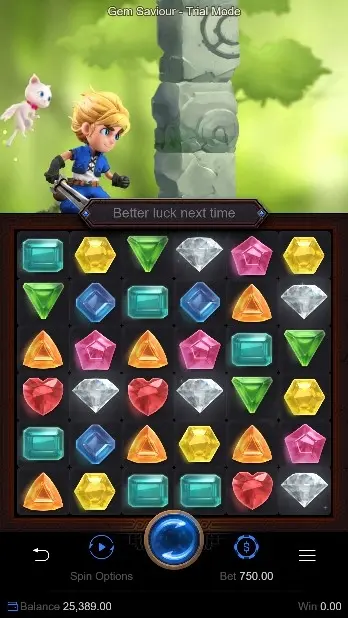
If you’re comparing gem-themed slots and want numbers before you spin, here’s the short answer: the gem saviour slot pays back 96.82% across a very large sample, which beats PG Soft’s own catalogue average by more than a fifth of a percentage point. It runs on six reels and carries a popularity percentile of 99.0, meaning it sits in the top one percent of every game tracked in this corpus. The rest of this article breaks down what those figures actually mean for your session length and bankroll decisions.
Who makes Gem Saviour
Gem Saviour is published by PG Soft, also known as Pocket Games Soft. The studio operates within a mobile-first development philosophy, meaning most of its titles render cleanly on portrait-mode phone screens as well as desktop browsers. That design orientation matters practically: a six-reel layout like Gem Saviour’s must compress symbols without making them unreadable on a five-inch display, and PG Soft’s catalogue suggests they treat that constraint seriously.
PG Soft currently lists 150 titles across its portfolio. Across those 150 games, the published RTP figures average out to 96.61%. That number matters because it establishes a baseline: any individual game from this provider that exceeds 96.61% is, at minimum, above the studio’s own median. Gem Saviour clears that bar by 0.21 percentage points, and it also clears the broader corpus-wide average of 95.71% by 1.11 points.
One thing this article cannot tell you: PG Soft has not published a volatility rating for Gem Saviour in the data available here. The absence is itself useful information — it means you should treat any volatility label you see on third-party sites as unverified.
Where Gem Saviour sits in the PG Soft catalogue
Positioning a single game within a 150-title provider requires comparing its RTP to sibling titles that share the studio’s engineering culture. Three examples from PG Soft’s recent output illustrate where Gem Saviour lands:
- Mahjong Ways 2 returns 96.95% RTP — thirteen-hundredths of a point higher than Gem Saviour.
- Fortune Tiger returns 96.81% — one-hundredth of a point below Gem Saviour, statistically negligible.
- Fortune Rabbit returns 96.75% — seven-hundredths below Gem Saviour.
The pattern: Gem Saviour occupies a middle-to-upper band within PG Soft’s RTP distribution. It isn’t the studio’s highest-paying title, but the gap between it and Mahjong Ways 2 is so small that the practical difference over any realistic session length would be difficult to observe. A hundredth of a point means one additional unit returned per ten thousand wagered.
RTP: 96.82% against a 96.61% house average
RTP is a theoretical long-run percentage. It does not predict any individual session’s outcome. Over one hundred spins, variance dominates the RTP figure almost entirely. The number becomes meaningful only across samples large enough to approximate the statistical distribution PG Soft designed the game around.
Here are the figures that are verified:
| Metric | Value |
|---|---|
| RTP (published) | 96.82% |
| Provider average RTP | 96.61% |
| Corpus average RTP | 95.71% |
| Reels | 6 |
| Popularity percentile | 99.0 |
| Volatility | Not published |
| Max win | Not published |
| Hit frequency | Not published |
At 96.82% RTP, a player wagering one hundred units across an enormous sample would expect to receive back 96.82 units. The theoretical house edge is 3.18%. Compare that against the corpus average of 95.71%: every hundred units you wager on Gem Saviour costs you 1.11 units less in expected terms than a game sitting at the corpus mean. Over ten thousand spins at one unit per spin, that translates to 111 additional units retained. Over a one-hundred-spin session, the difference is still just 1.11 units, which falls well within normal variance.
Missing data points matter: PG Soft has not published max win, hit frequency, or volatility figures for this title. Any source quoting those numbers for Gem Saviour is estimating or fabricating. The three rows above marked “not published” are genuinely absent from the verified dataset.
Volatility and who it suits
Volatility — sometimes called variance — describes how spread out a game’s payouts are around its RTP. A high-volatility slot returns most of its RTP through rare, large wins; you will experience longer dry stretches followed by occasional spikes. A low-volatility game distributes returns more evenly across frequent small hits.
PG Soft has not published a volatility rating for Gem Saviour in the available data. Without that figure, you cannot responsibly choose a starting stake that matches the game’s swing profile, because you do not know whether the game swings gently or violently. What you can do instead is treat the game as medium-to-high risk by default: a six-reel layout from this provider with a popularity percentile of 99.0 tends to attract players who tolerate variance in exchange for occasional large returns, though that reasoning is inferential rather than confirmed.
If you prefer frequent small wins and want to extend your session on a fixed budget, you should look for a slot that explicitly publishes a low-volatility rating. Gem Saviour does not offer that confirmation.
Playing Gem Saviour for free
Gem Saviour is available as a free demo on this site. Free play replicates the same reel mechanics and random-number outcomes as real-money play, so it lets you observe how often you hit lines and how the game distributes wins over a sample of spins you choose yourself.
One critical caveat: demo results tell you nothing about what will happen when you wager real money. Each spin is independent. If a demo session shows twenty dead spins in a row, the next spin in real money carries exactly the same odds as if the demo had shown five wins in a row. No sequence is “due” to reverse.
Use the free version to decide whether you enjoy the pacing of a six-reel gem layout. If you later play for real money, set a budget before your first spin and treat the entire session as paid entertainment — the cost of an evening’s amusement, not an investment with an expected return. You must be eighteen or older to wager real money.
Similar picks
If Gem Saviour’s gem-and-diamond theme interests you, here’s how it compares to other games in that category across 484 tracked titles:
- Joker’s Jewels publishes 96.50% RTP — 32-hundredths of a point below Gem Saviour, but a simpler layout that may suit players who want fewer reels to track.
- Love Gems Hold and Win lists 97.10% RTP, putting it 28-hundredths above Gem Saviour. If your only criterion is RTP, this title edges ahead.
- Gemonex shares the gem theme, but no RTP figure is published in the available dataset for that title, so no direct comparison is possible.
Love Gems Hold and Win and Gem Saviour sit close enough in RTP that the difference is unlikely to matter in any session shorter than several thousand spins. Theme preference and reel-count comfort are the more meaningful decision factors between them.
Verdict
Gem Saviour is an above-average RTP title in a provider’s mid-to-upper band, and its 96.82% return rate beats both PG Soft’s catalogue mean and the wider corpus benchmark. The six-reel format and gem theme place it in a crowded category, and the absence of published volatility, max win, and hit frequency data means you are making this comparison with incomplete information — a fact that should weigh on your confidence regardless of how good the RTP number looks.
At a 99.0 popularity percentile, the game has clearly resonated with a large number of players. That doesn’t validate it mathematically, but it does confirm that thousands of humans have found the session pace and presentation agreeable enough to return.
What to watch: three key metrics are missing from PG Soft’s published data. Until those are released, the honest assessment is that Gem Saviour’s RTP is its strongest confirmed selling point, and everything about the shape of its volatility remains unverified.
Frequently Asked Questions
What is the RTP of Gem Saviour?
Gem Saviour returns 96.82% RTP, a long-run theoretical figure published by PG Soft. That means across an enormous number of spins, the game is expected to return 96.82 units for every 100 wagered. It exceeds PG Soft's own 96.61% catalogue average and sits 1.11 percentage points above the broader corpus average of 95.71%.
Is Gem Saviour made by PG Soft?
Yes, Gem Saviour is published by PG Soft, also called Pocket Games Soft. The studio currently maintains a catalogue of 150 titles. PG Soft designs games with a mobile-first approach, which is relevant because Gem Saviour runs a six-reel layout that must remain readable on small phone screens as well as desktop monitors.
Where can I play Gem Saviour for free?
Gem Saviour is available as a free demo on this site, which lets you observe the game's reel mechanics without wagering real money. Demo play uses the same random outcomes as a real-money version, but results in free play have zero predictive value for what will happen if you later switch to real-money spins.
How does Gem Saviour compare to Mahjong Ways 2?
Gem Saviour returns 96.82% RTP while Mahjong Ways 2 returns 96.95%, a difference of 0.13 percentage points in favor of Mahjong Ways 2. Both titles are published by PG Soft. The practical gap between them is small enough that over most session lengths you would not be able to distinguish which game returned more.
Does PG Soft publish a volatility rating for Gem Saviour?
No. PG Soft has not published a volatility figure for Gem Saviour in the available dataset, along with max win and hit frequency. Without a confirmed volatility rating, you cannot determine whether the game swings gently or aggressively, which makes it harder to size your stake responsibly against your bankroll.