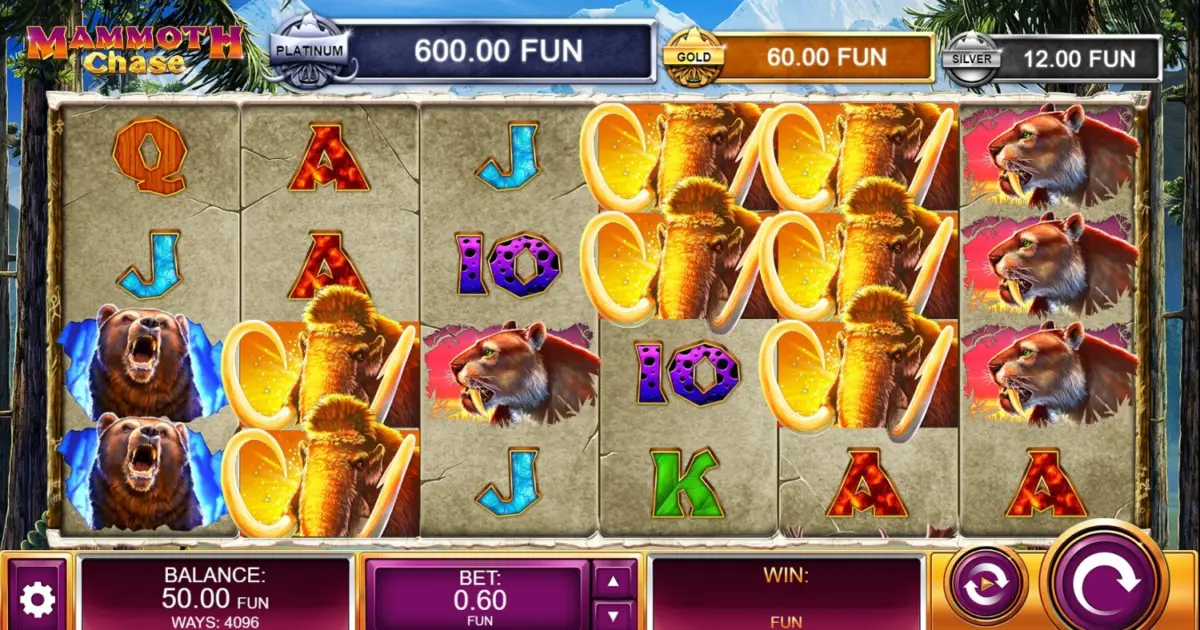
At 96.94% RTP, the Mammoth Chase slot sits well above the corpus average of 95.71%, and its six-reel layout offers a wider horizontal frame than the typical five-reel game. Free play is available here, so you can judge the pace and structure before staking anything. The short answer for most readers: the math is competitive, but the missing data you will see below should shape your expectations.
Mammoth Chase versus the average slot
Kalamba Games built this title around a 96.94% return-to-player figure, which places it 1.23 percentage points above the 95.71% average across the games this review corpus tracks. In practical terms, if you wagered £100 per spin across a large enough sample, the theoretical return would be £96.94 versus £95.71 on an average game — a difference of £1.23 per £100 staked. That gap is meaningful over thousands of spins but invisible over a short session.
Against Kalamba’s own catalogue, the number is even stronger. The studio’s 165 titles average 95.92% RTP, so Mammoth Chase exceeds its developer’s house norm by roughly a full percentage point. You are getting one of the higher-returning games Kalamba has published, not a middling entry.
Where the comparison gets harder is on the features side. The review data for this title does not include a max win figure, hit frequency, or bonus structure. Without those numbers, the RTP advantage is the only concrete edge you can measure, and you cannot yet determine whether the game compensates for that strong RTP with a narrow top-end payout or a lower hit rate.
Popularity rank 1448 might look low at first glance, but the percentile data tells a different story: at 92.7, this game is played more than 92.7% of titles in the corpus. Those two figures are not contradictory — a large, active corpus means a mid-thousands rank can still represent substantial traffic.
RTP breakdown: 96.94% in context
The table below collects every hard figure published for this game. Fields left blank have not been disclosed by Kalamba, and you should treat third-party numbers filling those gaps with caution.
| Attribute | Value |
|---|---|
| Game title | Mammoth Chase |
| Provider | Kalamba Games |
| RTP | 96.94% |
| Reels | 6 |
| Subcategory | Slot Machine |
| Max win | Not published |
| Hit frequency | Not published |
| Volatility | Not published |
| Free demo | Available |
Understanding what 96.94% means over a realistic session requires one caveat: RTP is calculated across millions of spins. In a 200-spin session at £1 per spin, you wager £200 total. The expected theoretical return is £193.88, but actual outcomes can swing far above or below that figure within such a small sample. The variance in any individual session depends heavily on volatility, which — as the table notes — has not been published for this game.
Compared to other Kalamba titles with published RTPs, the landscape looks like this: Pearls of Aphrodite runs at 96.81% and Agent 51 at 96.73%. Both are strong numbers, but Mammoth Chase edges them out, making it arguably the studio’s best return proposition based on available data.
Volatility profile
Kalamba Games has not published a volatility rating for Mammoth Chase. This is a genuine gap in the available information, and it matters because volatility determines how the 96.94% RTP distributes itself over time. A high-volatility game of the same RTP will have long dry stretches punctuated by occasional large payouts; a low-volatility version would pay small wins frequently but rarely hit a big number.
What you can do in the absence of a published rating is observe the game in demo mode. Track how often winning spins land, the typical size of wins relative to your stake, and the length of non-winning stretches. If wins arrive on roughly one in every four or five spins with modest payouts, that pattern suggests medium-to-low volatility. If stretches of twenty or thirty blank spins occur before a substantial win, that points toward higher volatility.
For bankroll planning without a volatility label, a cautious approach works best: budget for the worst-case distribution of wins. That means sizing your stake so that even an unusually long losing sequence does not exhaust your session fund. Six reels can host more symbols per spin than five, which sometimes produces more frequent small combinations, but this is a general observation about reel geometry, not a confirmed feature of this specific game.
Kalamba Games as a studio
Kalamba operates a catalogue of 165 titles with an average RTP of 95.92%. That places the studio roughly 0.21 percentage points above the broader corpus average, which is a reasonable but not exceptional house standard. The spread within the studio is notable: while Mammoth Chase sits at 96.94%, Emerald Bisons PrizeMatch runs at only 94.07% — a gap of nearly three points between two Kalamba games. Choosing the right title within a provider’s range clearly matters more than the brand on the box.
The Kalamba Games slots portfolio tends toward structured math models and often features layered bonus systems, though confirming specific mechanics in Mammoth Chase requires hands-on demo play since the review data does not enumerate them. The studio is licensed in multiple regulated jurisdictions, which means its published RTP figures are subject to third-party audit — you can treat the 96.94% as a tested number rather than a marketing claim.
If you want to see how Kalamba’s other 96%+ entries compare on layout and presentation, Pearls of Aphrodite and Agent 51 (linked above) are the nearest siblings in the studio’s catalogue by return figure. Neither, however, uses a six-reel format, so if reel width is your priority, you may need to look outside this provider entirely.
Three 6-Reels alternatives worth comparing
The review corpus contains no other six-reel titles to cross-reference directly against Mammoth Chase. With a theme game count of zero in the available data, a head-to-head comparison on the six-reel format specifically is not possible here.
What you can compare instead is return quality across reel widths. The three Kalamba titles referenced earlier — Pearl of Aphrodite at 96.81%, Agent 51 at 96.73%, and Emerald Bisons PrizeMatch at 94.07% — span five-reel and likely other formats, and together they illustrate how much the RTP range varies within a single studio. Mammoth Chase leads that group at 96.94%, but if you find its pace or features unsatisfying in demo, the other Kalamba options at 96%+ provide alternatives with different visual themes and session rhythms.
When the corpus lacks same-format matches, the most useful comparison shifts to adjacent numbers: any slot at or above 96.5% is performing well, and the specific reel count matters less than whether the features and volatility suit your style.
Getting the most out of the free demo
The Mammoth Chase free demo lets you play without depositing, which removes financial risk from the evaluation process. Use it as a structured session rather than idle spinning: set yourself a fixed number of spins (200 or 500), log your total stake, note every win and its multiplier relative to your bet, and record the longest losing streak you observe. This data lets you estimate hit rate and volatility empirically, filling in the gaps Kalamba has not published.
A few practical tips: change your stake during the demo to see how the game responds at different bet levels. Test any buy-feature or bonus-entry mechanic with both minimum and maximum wagers to understand how quickly the feature pays back its cost. Run at least two sessions across different lengths — a 50-spin burst versus a 500-spin grind can paint very different pictures of how this game behaves.
When you move to real money, treat it as paid entertainment. Set a budget before your first spin, decide a stop-loss and a stop-win, and walk away when either is reached. Every spin is an independent event — a game that has not paid in 40 spins is no more or less likely to pay on spin 41. You must be 18 or over to play.
Should you play the Mammoth Chase Slot?
If a strong RTP is your primary filter, this game clears that bar convincingly. 96.94% places it above both the Kalamba studio average and the broader review corpus, and the six-reel layout offers a wider playfield than the five-reel norm most online slots use. The free demo lets you verify whether the actual session experience matches the math before risking money.
The honest caution: missing volatility and max-win data means you cannot fully plan your bankroll from published figures alone. The demo-logging exercise described above is the workaround — spend one structured session there before deciding. If you want Kalamba’s proven RTP track record and are drawn to the six-reel format, this is one of the studio’s strongest numbers. Compare it against at least one alternative before committing real stakes, and remember that no published RTP guarantees any individual outcome.
More from Kalamba Games
- Horus Fire PrizeTower — 94.05% RTP
- Emerald Bisons PrizeMatch — 94.07% RTP
Frequently Asked Questions
What is the RTP of Mammoth Chase by Kalamba Games?
Mammoth Chase runs at 96.94% RTP according to Kalamba Games' published figures. That places it 1.23 points above the 95.71% corpus average and about a full percentage point ahead of Kalamba's own studio norm of 95.92%.
Is there a free demo of Mammoth Chase available to play?
Yes, a no-deposit free demo of Mammoth Chase is available through this site's review. You can play without registering or funding an account, which lets you evaluate the game's pace and structure before deciding whether to wager real money.
What volatility does the Mammoth Chase slot have?
Kalamba Games has not published a volatility rating for Mammoth Chase. Without that figure, your best option is to observe win frequency and streak length across a structured demo session of 200 to 500 spins, noting how often wins land and their typical size relative to your stake.
How does Mammoth Chase compare to other Kalamba Games titles?
At 96.94% RTP, Mammoth Chase is the highest-returning Kalamba title with published data in this review set. Pearls of Aphrodite follows at 96.81%, Agent 51 at 96.73%, while Emerald Bisons PrizeMatch sits well below at 94.07%, showing the studio's internal spread is significant.
Can you win real money playing the Mammoth Chase free demo?
No. The free demo uses simulated credits and cannot pay out real money regardless of any winning combinations you observe. Demo results reflect no more or less probability than real play, but no financial outcome is attached to demo spins.