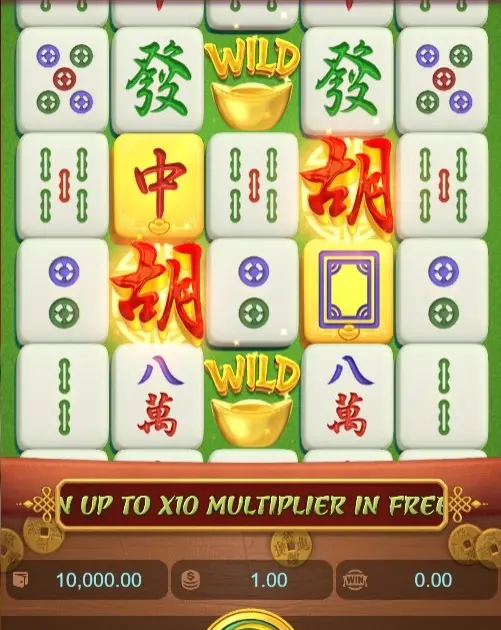
Mahjong Ways Slot by PG Soft sits at the 98th percentile of popularity across 378 ranked titles, so it has earned its audience. The 96.92% RTP is the headline figure, and it exceeds both PG Soft’s own average and the broader catalogue benchmark. What follows breaks down what that return rate means in practice and where genuine gaps in available data should temper your expectations.
Mahjong Ways Slot at a glance
Before you spin, here is the full picture in one place.
| Attribute | Value |
|---|---|
| Provider | PG Soft (Pocket Games Soft) |
| RTP | 96.92% |
| Reels | 5 |
| Theme | Asian |
| Popularity rank | 378 of corpus (98.1st percentile) |
| Free demo | Available |
The game falls into a category of 1,455 Asian-themed slots, so it competes in a crowded field. PG Soft maintains 150 titles in total, with an average RTP of 96.61% — meaning Mahjong Ways sits slightly above its own developer’s norm. If you prefer to explore the provider’s catalogue further, Mahjong Ways 2 offers a marginally higher return at 96.95% and a sequel format that retains the same reel count.
What a 96.92% RTP actually returns
RTP is a long-run theoretical average calculated across millions of spins. It does not describe any individual session, and no amount of playing can “reach” the advertised return in a single sitting.
To work the figure through a concrete example: imagine 1,000 spins at a unit stake of $0.25 per spin. Total wagered is $250. At 96.92% RTP, the expected return across that volume is $242.30, implying a theoretical loss of $7.70 over 1,000 spins. Double the volume to 10,000 spins at the same stake and the expected loss becomes $77. These are statistical averages — your actual session will produce a result somewhere in a wide band around these numbers.
The corpus average RTP across all games catalogued here is 95.71%. Mahjong Ways exceeds that by 1.21 percentage points. Over 10,000 spins at $0.25, that difference saves you roughly $30 in expected cost compared to an average slot. For more context on PG Soft’s broader output, Fortune Tiger returns 96.81% with a different visual identity, giving you a comparison point within the same provider.
Volatility and what your session will feel like
PG Soft has not published a volatility rating for Mahjong Ways, and that absence is worth understanding. Without it, you cannot predict whether your session will produce frequent small hits or longer stretches of dry spins punctuated by larger payouts.
As a general rule, high-volatility slots require larger bankrolls and longer sessions to see the theoretical RTP realised, because losses cluster before wins arrive. Low-volatility games return small amounts more consistently, keeping play smoother but capping the ceiling of any single spin. Medium-volatility games split the difference.
In the absence of an official rating, your best substitute is to spin the free demo for 100 to 200 rounds and track how often hits land and how large they are relative to your stake. That observation gives you a personal volatility profile — not a published one, but a practical guide for your own money. Keep in mind that a demo sample is small and may not represent the game’s true distribution.
The 5-reel layout and how wins are counted
Mahjong Ways uses a five-reel grid, which is the standard configuration across the majority of modern video slots. Five reels give the game enough columns to create multiple payline combinations or “ways” without overwhelming the visual field.
The title includes “Ways” in its name, which in slot terminology typically indicates a ways-based mechanic rather than fixed paylines. In ways games, matching symbols on consecutive reels from left to right register as a win regardless of their vertical position on each reel. This often produces more frequent hits than fixed-line equivalents on the same grid, because there are more possible winning combinations per spin.
PG Soft has not published the exact number of ways or the symbol set for this specific title in the data available here. That means you will need to open the in-game paytable during demo play to confirm how many matching symbols are needed and which tiles carry the highest values. The theme draws on mahjong tile aesthetics consistent with the broader Asian category of 1,455 related games, including Mystic Fortune Deluxe at 96.71% RTP, which uses a comparable reel structure.
Stake range and sizing a bankroll
No minimum or maximum stake figures are published for Mahjong Ways in the data available for this review. PG Soft generally designs its games for a wide stake range to serve both casual and high-limit players, but you should confirm the exact boundaries at whichever casino hosts the game, as operators can restrict ranges within the provider’s permitted window.
Once you know the minimum stake, bankroll sizing follows straightforward division. If the minimum is, say, $0.20 and you have a $100 session budget, that covers 500 spins before any wins are credited — a reasonable sample for assessing whether the hit pattern suits your patience. Multiply that spin count by the RTP shortfall (3.08% for this game) to estimate expected cost: roughly $3.08 on a $100 budget before variance is factored in.
The point of this calculation is not to predict your outcome but to set expectations about how long a session can last and what portion of your money is statistically destined for the house edge.
Playing the Mahjong Ways demo before you commit
A free demo version of Mahjong Ways is available. Use it to establish your own read on hit frequency and payout size, since the volatility figure is unpublished. Demo play carries no financial risk, so it is the cheapest way to learn the paytable, confirm how ways are counted, and decide whether the game’s rhythm matches your preferences before depositing.
Be clear-eyed about one limitation: demo play is randomised independently of real-money outcomes. Nothing you observe in the free version predicts whether your paid session will run hot or cold. The maths remains the same across both modes, but the variance in any short sample means the demo is informational, not predictive.
When you do move to real play, treat it as paid entertainment with a fixed cost. Set a loss limit before you deposit and stop when you reach it. Every spin is independent — no pattern, timing, or stake adjustment changes the expected value. You must be 18 or older to play for real money, and if gambling stops feeling like entertainment, that is a signal to step away.
Verdict: who should play Mahjong Ways
Mahjong Ways earns its popularity ranking on numbers that are straightforward to assess: a 96.92% RTP that beats both the catalogue average of 95.71% and PG Soft’s own provider average of 96.61%. The five-reel ways layout is a proven structure that tends to produce more frequent small wins than fixed-line equivalents, making it a comfortable choice if you prefer sessions with visible activity rather than long stretches of silence followed by one big hit.
The main caveat is what remains unknown. Without a published volatility rating or confirmed stake range, you cannot fully plan a session before playing. If that uncertainty bothers you, compare it against The Book of Amaterasu, another Asian-themed title at 95.0% RTP — lower return but potentially more transparent if its data fields are complete.
For a casual player who wants a solid return above average, enjoys tile-based aesthetics, and is willing to spend 15 minutes in demo mode filling the data gaps themselves, Mahjong Ways is a reasonable pick. It is not a game that demands specialist knowledge, but it rewards the player who checks the paytable before betting real money.
Frequently Asked Questions
Can you play Mahjong Ways for free without depositing?
Yes. PG Soft's Mahjong Ways is available in a free demo mode that uses no real money. You can spin without a deposit to study the paytable, test hit frequency, and decide whether the five-reel ways layout suits your taste before playing at any cost.
What is the RTP of Mahjong Ways and is it good?
Mahjong Ways carries a 96.92% RTP, which is 1.21 percentage points above the site-wide catalogue average of 95.71% and 0.31 points above PG Soft's own provider average of 96.61%. That positions it in the upper tier for return-to-player figures among modern online slots.
Is Mahjong Ways a high or low volatility slot?
PG Soft has not published an official volatility rating for Mahjong Ways in the data available here. The closest substitute is to run 100 to 200 spins in demo mode and note how frequently wins appear relative to their size, which gives you a practical read on the game's risk profile.
How does Mahjong Ways compare to Mahjong Ways 2?
Mahjong Ways 2 returns 96.95% RTP, three basis points higher than the original's 96.92%. Both are five-reel Asian-themed titles from PG Soft, so the sequel is a natural next comparison if you enjoy the original's structure and want marginally better theoretical return.
Does playing the Mahjong Ways demo predict real-money results?
No. Demo play and real-money play use independent random outcomes, so nothing you observe in free mode — winning streaks, dry spells, or bonus timing — carries forward to your paid session. Use the demo to learn the mechanics and paytable, not to forecast whether the game will be profitable for you.




