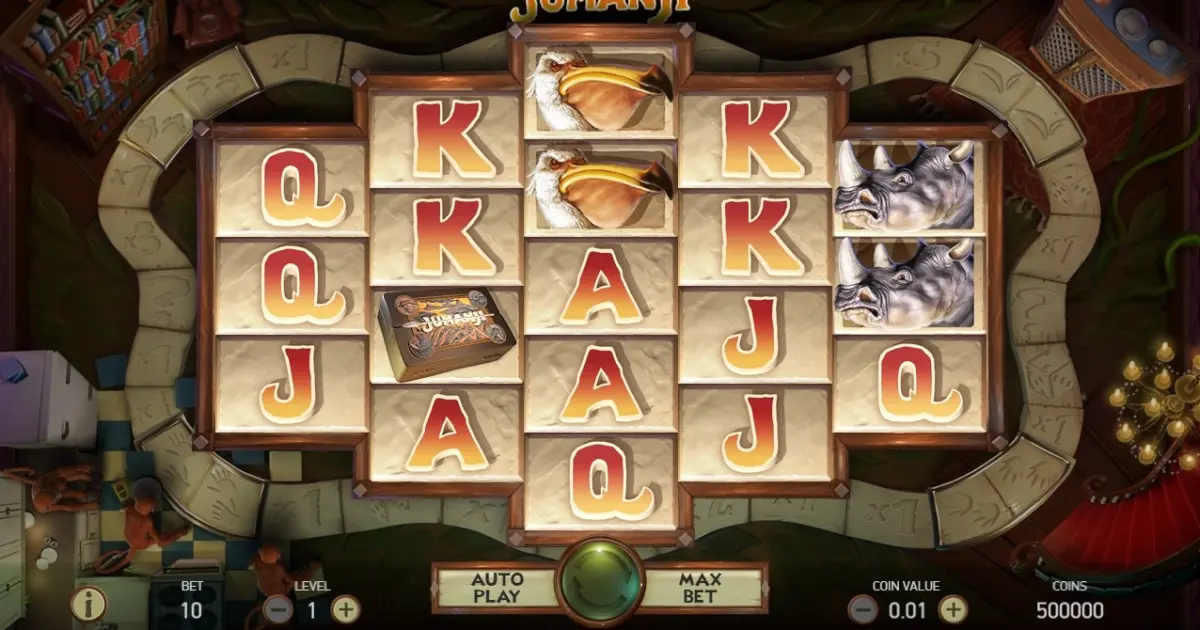
The jumanji slot sits above NetEnt’s average RTP but carries an unusual gap: no published volatility rating or reel configuration. That absence matters more than most readers expect, and this review explains exactly what the numbers do and do not tell you before you start a session.
Jumanji at a glance
Here is what NetEnt has confirmed about this title. Everything below is verifiable; what sits outside these figures is either unpublished or unreliable from third-party sources.
| Attribute | Value |
|---|---|
| Provider | NetEnt |
| Category | Slot Machine |
| RTP | 96.33% |
| Volatility | Not published |
| Reel layout | Not published |
| Stake range | Not published |
| Free demo | Available |
| Popularity rank | #966 (95.2nd percentile) |
NetEnt maintains 191 titles in their catalog, and this one ranks in the top 5% by player traffic — a figure that tells you real players are choosing it, but it does not tell you whether they are winning, losing faster, or simply spending more time per session than other players do elsewhere.
If you want a NetEnt title with fully published specs, Starburst remains the most transparent in the portfolio at 96.1% RTP with a documented 10-payline layout. Compare it with the Jumanji numbers below.
What a 96.33% RTP actually returns
RTP is a long-run statistical average calculated over millions of simulated spins. It does not predict any single session. A 96.33% RTP means that across an enormous sample, the game theoretically retains 3.67% of all money wagered. For you, the practical implication is this: if you spin at a fixed stake and your session happens to land on the theoretical average, you lose 3.67% of your total turnover.
Work through a concrete example. Suppose you manage 1,000 spins at a hypothetical £0.50 per spin — that is £500 total wagered. At the 96.33% theoretical return, the expected loss over that sample is £18.35. At 2,000 spins you would expect to lose approximately £36.70. These are averages across an astronomically large number of players and sessions, not a prediction of your evening. Individual sessions can land anywhere from a profit to a total loss of your budget, and the RTP figure tells you nothing about the distribution of outcomes between those extremes.
Against the corpus average of 95.71%, this game’s 96.33% RTP is 0.62 percentage points above the field, and 0.23 points above NetEnt’s own portfolio average of 96.1%. That places it in a favourable position relative to most slots, but the margin is thin — a real-money player at typical session lengths may never notice the difference between these three figures.
Unpublished volatility and what your session will feel like
NetEnt has not published a volatility rating for this game in any source available to this review. That is a genuine gap, not a stylistic choice. Volatility determines the shape of your session far more than RTP does: two games with identical RTP can feel completely different to play depending on whether wins land in frequent small clusters or rare large bursts.
Without a confirmed volatility band, you are choosing blind on one critical dimension. If this game behaves like a typical medium-to-high volatility title, expect longer dry stretches punctuated by larger hits, which demands a deeper bankroll per spin and tolerance for variance. If it is genuinely low volatility, wins arrive often but in amounts that barely offset losses between them. Both scenarios fit the same RTP figure.
Some third-party sites assign volatility labels to this game, but when the developer has not published one, those labels are editor guesses. Treat them as unreliable. The only safe approach is to start with the free demo and observe the pattern of wins yourself, then decide whether the variance suits your preferences before risking money.
NetEnt’s Pirates Party at 96.17% RTP shares a similar profile — slightly above portfolio average with documented medium volatility — giving you a comparable reference point if variance is your priority.
Reel layout and how wins are counted
No official reel configuration — whether this is a 5×3 grid, uses ways mechanics, or employs cluster pays — is published in the source data available here. This absence compounds the volatility gap: without knowing how many ways to win or how many symbols appear per reel, you cannot model your own hit frequency or predict how often the screen will reward you.
In general terms, a standard 5-reel slot with 20 to 25 paylines produces hit frequencies between 20% and 30% across most providers, meaning roughly one spin in four or five lands a win. A ways-based layout on the same 5-reel grid might hit far more frequently but in smaller amounts. A cluster-pay or cascading-reel design can produce chains of wins from a single trigger. These ranges describe how the mechanics work broadly — they do not describe this game specifically.
The demo is your best diagnostic tool here. Spin 200 times with no financial stake and count how often the reels reward you, how large the typical win looks relative to your stake, and whether bonus triggers appear at all. If after 200 spins you have seen no feature activation and your balance has drifted downward with no spikes, that is useful information you gathered from experience rather than guesswork.
For a contrast in transparency, Gonzo’s Quest from the same provider documents its 5-reel cascading layout and tumble multiplier structure publicly, removing the need for that kind of self-directed investigation.
Stake range and sizing a bankroll
The minimum and maximum stake per spin are not published in the available data for this game. NetEnt’s titles typically range from £0.10 to £100 or higher on the extremes, but without a confirmed figure for this specific slot, any bankroll calculation you perform is built on an assumption.
The practical rule that holds regardless of the exact stake range: size your session budget so that a full dry streak at your chosen stake still leaves you above zero. A rough guideline for a game whose volatility you have not yet mapped is to plan for at least 150 spins worth of stake in your budget. If the minimum is £0.20, that means a £30 reserve; at £0.50 it means £75. The longer the dry stretch a game can produce, the higher that multiplier needs to be. Until you can characterise this game’s variance from demo play or from a confirmed rating, 150 spins is the conservative floor.
Playing the Jumanji free demo before you commit
A free demo version is available, and for a game with this many undocumented parameters, it is not optional — it is the only way to gather reliable first-hand data before you spend anything. You can play Jumanji free through this site’s interface without registration or download, which removes the friction that might otherwise push you straight into real-money play before you have gathered the observations described in the sections above.
Use those demo sessions to answer three questions: How often do wins land? When they do, do they feel substantial or merely decorative? Is there a feature that triggers with any regularity, or does the base game appear to be a standalone experience? Your answers will be game-specific and grounded in direct experience rather than in the published or unpublished status of any field.
One responsible note: set a time limit before you start, not just a monetary one. Demos can run long because the absence of financial loss removes the natural stop signal that real play provides. And when you do move to real money, treat it as paid entertainment with a budget you can lose completely. You must be 18 or over to gamble, and if you find the boundary between entertainment and compulsion blurring, stop.
Verdict: who should play Jumanji
The 96.33% RTP is genuinely above average for the corpus and for NetEnt’s own portfolio, and the popularity percentile confirms that real players are finding something compelling here. Those are two facts in the game’s favour.
Against that, the complete absence of published volatility data, reel configuration, and stake range is a serious transparency deficit. You can make a mathematically reasonable decision about expected loss based on RTP alone, but you cannot make a reasonable decision about bankroll sizing, session length, or risk tolerance without the other variables. That places the burden of investigation on you, via the demo, before you commit.
If you are willing to invest twenty minutes in structured demo play to characterise the variance yourself, the RTP margin makes this a defensible choice. If you prefer knowing all session parameters before you start, a title like Starburst with fully documented mechanics is the lower-friction alternative from the same provider.
Frequently Asked Questions
Can I play Jumanji slot without downloading or registering?
Yes. A free demo version is available through this site's browser interface with no account creation or software download required. You can spin the reels immediately and observe hit patterns, feature triggers, and volatility behaviour without any financial commitment.
What is the Jumanji slot RTP and how does it compare to other NetEnt games?
NetEnt has published a 96.33% RTP for this title. That sits 0.23 percentage points above their own portfolio average of 96.1% and 0.62 points above the broader corpus average of 95.71%. It is a favourable position, but the absolute margin over NetEnt's house average is narrow.
Is the Jumanji slot high or low volatility?
NetEnt has not published a volatility rating for this game in any source available for this review. Without a confirmed band, you cannot predict whether wins will be frequent and small or rare and large. The free demo is the only reliable way to assess variance yourself before risking money.
How does Jumanji compare to Gonzo's Quest?
Both are NetEnt titles, but Jumanji's 96.33% RTP edges out Gonzo's Quest at 96.0%. More importantly, Gonzo's Quest publishes its 5-reel cascading layout and multiplier mechanics, while Jumanji's reel configuration and volatility remain undocumented — a significant transparency difference between the two.
Can playing the Jumanji demo predict real-money outcomes?
No. Demo play uses a random number generator and produces independent outcomes on each spin, just like real play. Observations from a demo session describe the game's structure — how often you see wins or features — but they carry no predictive power for whether your next real-money session will land above or below the 96.33% theoretical average.