Jekyllz Wild UltraNudge Slot sits at 96.0% RTP on a 5-reel layout from Yggdrasil Gaming, which puts it just above the average for both this provider and the wider market. That return figure is the single most useful filter if you are comparing games before you play, while the absence of other published mechanics tells you to treat third-party claims with caution. The free demo is available, so you can see the grid and pacing for yourself without staking, and this jekyllz wild ultranudge slot review stays strictly to what is published.
| Feature | Detail |
|---|---|
| Game | Jekyllz Wild UltraNudge |
| Provider | Yggdrasil Gaming (190 games tracked) |
| RTP | 96.0% |
| Reels | 5 |
| Subcategory | Slot Machine |
| Themes | 5-Reels |
| Popularity rank | 2584 (87th percentile) |
| Free demo | Available (no download) |
The 5-reel grid explained
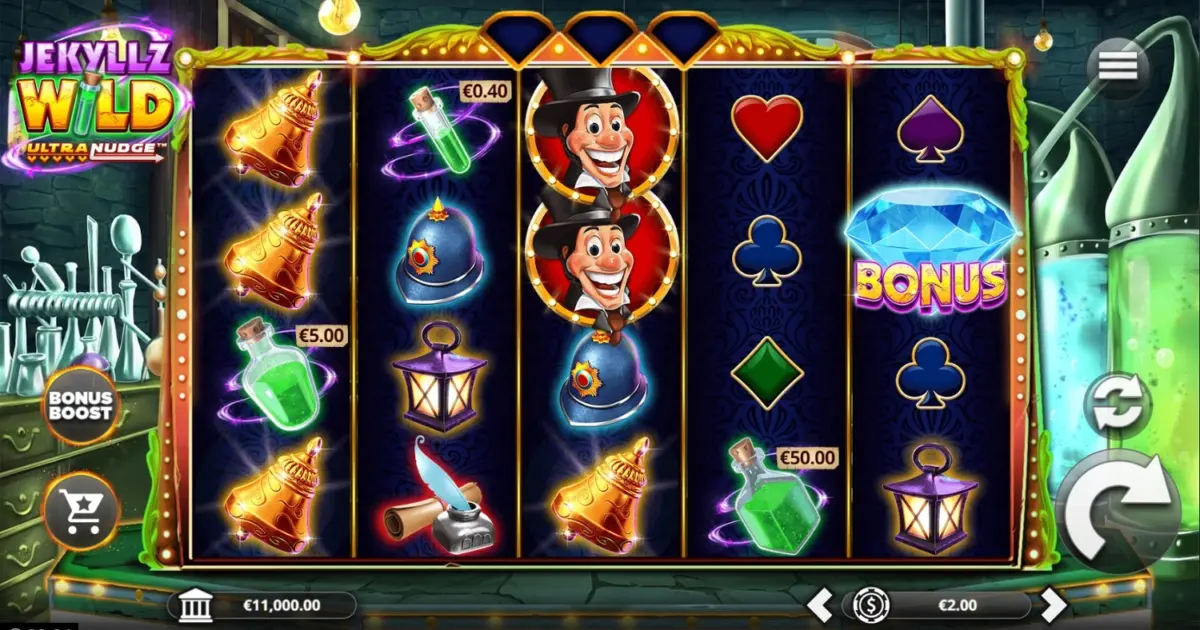
A 5-reel grid is the most common layout in modern video slots, and Jekyllz Wild UltraNudge uses that format. In general terms, five vertical reels spin and then stop to reveal a matrix of symbols; the number of rows determines how many symbols are visible on each reel per spin. The FACTS block for this title confirms the reel count as five but does not publish the row count, the total number of symbols on screen, or the height of each reel.
That matters because two 5-reel games can feel very different depending on grid size. A 5×3 grid shows 15 positions, while a 5×4 shows 20, and larger grids create more possible symbol combinations to evaluate on every spin. Without a confirmed row count for this game, you cannot calculate the symbol matrix or infer how crowded the screen will feel. What you can expect is the familiar left-to-right reading habit many players associate with 5-reel designs, but that is a convention of the format, not a confirmed rule for this title.
For session planning, the reel count alone does not change expected value or payback; it sets the stage on which pay evaluations happen. It also helps with comparison. When you look at other Yggdrasil Gaming slots, you will see the same 5-reel starting point used in many different ways, so the reel count is useful for sorting, not for predicting results. If you try the Jekyllz Wild UltraNudge free demo, use it to note how many positions actually appear and how the interface presents balance, stake and spin controls, rather than to guess at undisclosed mechanics.
Paylines, ways and how Jekyllz Wild UltraNudge pays
This is where FACTS is silent, so this section stays general and that silence is itself information. The FACTS block does not publish a payline count, a ways-to-win figure, or a paytable for Jekyllz Wild UltraNudge, and it lists no specific bonus mechanics, symbol names, multipliers or jackpot tiers. Without that, no review can honestly state how this game evaluates wins.
In general slot terminology, there are two common evaluation models. A payline model checks for matching symbols along predefined lines that run across the reels, often from left to right; the game may have 10, 20, 25 or another fixed number, or it may let lines be selectable. A ways-to-win model pays for matching symbols on adjacent reels regardless of their exact row, which is why you see figures like 243 or 1024 ways on a 5×3 or 5×4 grid. Many modern slots also use scatter pays or cluster concepts, where position matters less than count. These are well-established concepts across the market, not claims about this title.
Because pay structure is unpublished here, you should ignore any page that invents a line count or a ways figure for Jekyllz Wild UltraNudge. In practical terms, the pay evaluation method affects hit frequency and how often you see small returns, but it does not alter the long-run RTP on its own. If you want to understand this game’s specific rhythm, the only reliable check is the information screen inside the free demo or the provider’s official sheet, where any confirmed lines, ways or pay rules would be listed. Until Yggdrasil Gaming publishes those details in the data feed, the honest position is that they are not verified.
96% RTP put in context for jekyllz wild ultranudge slot
96.0% RTP means that, over a very large sample of spins, the game is designed to return £96.00 for every £100 wagered, with the remaining £4.00 representing the house edge in the long run. The figure is a statistical average, not a promise for any single session, and every spin is independent, so past results do not change the next outcome. Short samples can deviate sharply above or below that average, which is normal variance in random outcomes.
Against the wider market, 96.0% sits 0.29 percentage points above the corpus average RTP of 95.71% across tracked titles. In monetary terms, the long-run expectation is £96.00 returned per £100 wagered here versus £95.71 on the average game, a difference of £0.29 per £100 in theoretical return. That is a modest but real uplift in the maths, and it is the correct way to compare games rather than relying on theme or popularity alone.
It is also above Yggdrasil Gaming’s own average. The provider averages 95.81% across 190 games in the data set, so this title is 0.19 points above its studio average. To make the long-run idea concrete, consider scale: over 1,000 spins at £1, the total wagered is £1,000 and the theoretical return at 96.0% is £960, versus £958.10 at the provider average and £957.10 at the corpus average. Over 10,000 spins at the same stake, the expectations scale to £9,600 versus £9,581 and £9,571 respectively. Those gaps describe the engine’s average, not what you will see in an evening. If you compare within the studio, Trickstar Spins at 94.0% shows how much lower a published RTP can be in the same catalogue, while Syncronite at 96.0% matches this game point-for-point on headline return, which makes any choice between them about other preferences, not about RTP.
Volatility and hit patterns
Volatility is not published for Jekyllz Wild UltraNudge in the FACTS block, so no specific risk label can be attached honestly. In general terms, volatility describes how returns are distributed over time, not how much is returned overall. A low-volatility game tends to produce smaller, more frequent hits that stretch play time but rarely deviate far from the average in either direction. A high-volatility game tends to produce longer quiet spells punctuated by larger swings, which demands a larger bankroll for the same number of spins and a higher tolerance for drawdown. Medium volatility sits between those poles, but the label alone never tells you the exact hit frequency or the size of the largest swings.
Because volatility and hit frequency are missing here, you cannot infer session length, bankroll requirement or the shape of the pay distribution from the available data. That is worth stating plainly. Many review pages invent a volatility tag to fill space; without a provider-published figure, that would be speculation and unhelpful for planning. The RTP of 96.0% tells you the long-run average return, while volatility would tell you how bumpy the road to that average is likely to be — two separate ideas that should not be conflated.
What you can do is frame your expectations around what is not known. If you prefer steadier, longer sessions, you would normally look for a confirmed low or low-medium volatility label and a published hit frequency that supports it. If you prefer larger swings, you would look for confirmed high volatility. Here, neither is confirmed, so treat any claim you see elsewhere with caution and rely on the demo to observe pacing without extrapolating to real-money results. Yggdrasil Gaming has not published a max win figure for this title either, so any number quoting a ceiling should be treated as unverified until it appears in official materials.
Choosing a stake between published limits
The FACTS block does not publish a minimum or maximum stake for Jekyllz Wild UltraNudge, so this section explains how to think about stake once limits are known rather than inventing numbers. In any slot, stake and bankroll interact in straightforward maths. Your planned number of spins is bankroll divided by stake per spin, before considering any returns that recycle back into balance during play. A larger stake shortens the affordable runway; a smaller stake extends it.
In general, if a game later shows a published range such as £0.10 to £50, the practical read is this: at £0.10, a £20 budget buys 200 spins of runway before returns; at £1, the same £20 buys 20 spins of runway. That is not a strategy or a system, and changing stake does not alter the game’s RTP or make a win more likely on the next spin. Every spin is independent, and the expected value per £1 wagered remains driven by the 96.0% long-run average regardless of how you size your bets.
Until Yggdrasil Gaming publishes the stake limits for this title in the data feed, the most useful step is to open the free demo and check the stake controls directly in the game interface. Note the smallest increment, the largest available bet, and whether the controls use coin values, cash values, or both. Use those confirmed limits to set a budget for entertainment, not as a way to chase returns. The absence of published limits in the feed is not unusual; it simply means you should verify inside the game rather than relying on third-party pages that may list outdated or invented ranges.
Demo play versus real money
Free demo play for Jekyllz Wild UltraNudge is listed as available and no download is required to try it on this site. Demo mode loads the same grid and interface you would see in real-money play, but it uses play credits with no cash value. That makes it a straightforward way to check basic usability — how the 5-reel grid is presented, where stake and paytable controls sit, and how quickly you can understand the evaluation of wins once that information is published — without risking funds.
Demo play does not predict real-money results and it does not change the maths. The RTP remains 96.0% in the background as a long-run average, and short-term outcomes in demo are just as random as in paid play. Any hot or cold streak you see in a demo session is normal variance, not a signal about what will happen next. Treat the demo as a way to compare and to decide whether the presentation suits you, not as a trial that proves the game will behave a certain way later.
If you move from demo to real-money play, set a budget beforehand and treat it as the cost of entertainment. You must be 18+ to gamble. Decide on a time and money limit before you start, use deposit and session tools where available, and stop when you reach either limit. If you need support, contact a recognised help service in your jurisdiction. Keeping stakes at a level where a losing session remains affordable is the only sustainable way to play any slot, regardless of its headline RTP.
For quick comparison, you can also sample other titles from the same provider in demo. For example, Hillbilly Vegas gives you a different presentation from the same studio without a published RTP in this feed, which is a useful reminder to look for verified figures rather than assuming. Use demo breadth to compare interfaces and pacing, not to hunt for patterns.
Verdict on Jekyllz Wild UltraNudge
Jekyllz Wild UltraNudge is best judged on what is verifiable: a 5-reel Slot Machine from Yggdrasil Gaming with a 96.0% RTP that sits 0.29 points above the corpus average and 0.19 above the provider’s own average across 190 games. That is a clean, slightly above-average return figure and the strongest concrete positive in the data. The free demo is available with no download, so you can inspect the grid and controls without commitment.
The caveats are equally clear. With no published payline or ways count, no volatility label, no hit frequency, no stake range and no max win figure in the FACTS feed, there is not enough to model session variance or bankroll needs with precision. Popularity rank 2584 places it in the 87th percentile for visibility in the data set, which suggests it gets attention but is not among the most played titles; rank does not affect maths, but it helps calibrate how much independent, verified discussion you are likely to find.
The honest use case is narrow and practical. If you filter by RTP first, this game clears the market average and matches Syncronite at 96.0% within its own studio while beating Trickstar Spins at 94.0%, so it survives a numbers-first shortlist. Beyond that, use the demo to confirm any missing specifics in the official paytable before you decide. On published maths alone, it is a defensible choice to try for free; for paid play, set a modest entertainment budget and let any missing details be the reason to stay cautious rather than the reason to assume.
Frequently Asked Questions
Can I try Jekyllz Wild UltraNudge for free before I stake real money?
Free demo play is listed as available for Jekyllz Wild UltraNudge and no download is required on this site. Demo uses play credits with no cash value, so you can check the 5-reel layout and interface. Remember demo results are random and do not predict real-money outcomes, as every spin is independent.
What is the RTP of Jekyllz Wild UltraNudge and what does it mean in practice?
The published RTP is 96.0%, which means a theoretical return of £96.00 per £100 wagered over a very large sample. It is 0.29 points above the corpus average of 95.71% and 0.19 above Yggdrasil Gaming's average of 95.81%. Short sessions can vary widely from that long-run average.
What volatility is Jekyllz Wild UltraNudge and how bumpy will it feel?
Volatility is not published in the FACTS block, so no honest low, medium or high label can be given. In general, volatility describes the distribution of returns over time, not the average return. Without a confirmed figure or hit frequency, you cannot reliably estimate session length or bankroll swings for this title.
Who makes Jekyllz Wild UltraNudge and what else do they make?
Yggdrasil Gaming is the provider, with 190 games tracked and a provider-average RTP of 95.81%. This title at 96.0% sits slightly above that studio average. For comparison within the same catalogue, Trickstar Spins is listed at 94.0% RTP and Syncronite at 96.0% in the related games feed.
Can I win real money playing the Jekyllz Wild UltraNudge demo?
Demo play does not pay real money because it uses play credits only. It is useful for learning the 5-reel presentation and checking where information and stake controls appear. Real-money play requires staking funds, is 18+ only, and should be budgeted strictly as paid entertainment with independent spins.