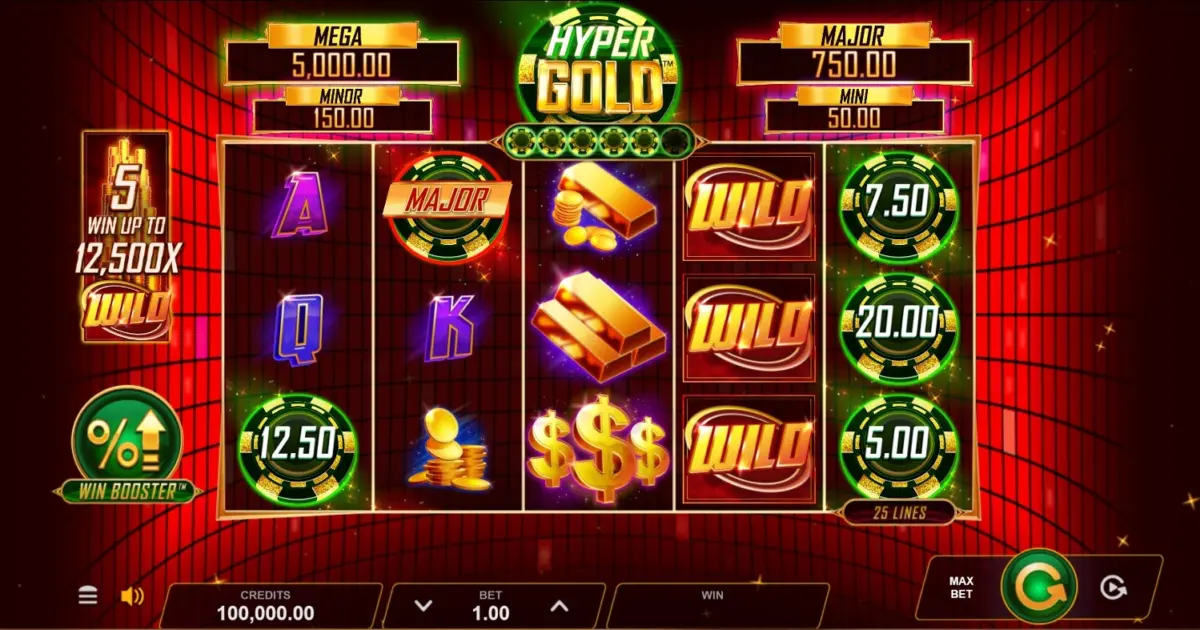
Hyper Gold is a five-reel slot from Gameburger Studios with a published return-to-player figure of 96.08%. That number sits above both the studio’s own average of 95.08% and the 95.71% average across the wider catalogue tracked here, which makes it one of the better-returning titles in its family. A free demo is available, so you can watch the reels behave before any money is involved.
What the published data does not tell you is the volatility rating, the stake range, or any max win figure. Those absences matter, and this review treats them as findings rather than glossing over them.
First look at Hyper Gold
The hyper gold slot runs on five reels and is filed under the money and wealth theme, one of the largest theme groups around with 549 titles sharing that label. The theme tag tells you the visual direction — gold, cash, prosperity imagery — and nothing more precise than that. Gameburger Studios has not published symbol names, animation detail or a soundtrack description in the data available here, so anything you read elsewhere describing specific characters or scenes is not something this review can confirm.
On popularity, the game ranks 1,705th and sits in the 91.5th percentile of titles tracked. That means roughly nine in ten slots in the database get less attention than this one. Popularity is a measure of traffic, not of quality or of payout behaviour, and it has no bearing on what any individual spin does. Still, a high percentile usually means a game is easy to find in demo form across review sites, which is useful if you want to try it without committing funds.
Gameburger Studios has 29 titles in the catalogue here. That is a mid-sized library, small enough that a studio house style tends to be recognisable across releases.
| Provider | Gameburger Studios |
|---|---|
| RTP | 96.08% |
| Reels | 5 |
| Theme | Money and wealth |
| Free demo | Yes |
How a round plays out
Here is where honesty is more useful than filler. The confirmed mechanical facts about this game are its five reels and its classification as a slot machine. Payline count, ways-to-win structure, wild behaviour, scatter behaviour, free-spin triggers, multiplier values and any buy-feature price are all absent from the published data. This review will not invent them.
What can be said generally: a five-reel layout is the standard modern grid, and studios build paylines, cluster pays or ways mechanics on top of it. Many slots use wilds that substitute for regular symbols and scatters that trigger a bonus round when enough land. Many also offer a feature-buy option. Whether any of that applies here is something the demo will answer in about two minutes of play, and the demo is the right place to find out.
One thing does hold regardless of the mechanics: every spin resolves independently. The reels carry no memory of what came before. A dry stretch does not build pressure toward a payout, and a run of wins does not exhaust anything. If a review tells you a game is warming up, that reviewer is describing a feeling, not the maths.
Reading the 96.08% return figure
96.08% RTP means the game is modelled to return £96.08 for every £100 wagered, measured across a sample far larger than any human session — millions of spins, not thousands. The remaining £3.92 per £100 is the house edge. Over a realistic 500-spin session at £1 a spin, £500 wagered, the modelled return is £480.40, but actual outcomes scatter widely around that figure in both directions. The average only asserts itself at scale.
The comparison is what makes 96.08% interesting. Gameburger Studios averages 95.08% across its 29 games, so this title returns a full percentage point more than the studio norm. Against the 95.71% corpus average, it is 0.37 points ahead. On £10,000 of lifetime wagering, one percentage point is £100 of expected difference — real, but slower-acting than most players assume.
Some stablemates go higher. Hyper Strike is set at 96.2%, and both 9 Pots of Gold and Hyper Strike HyperSpins reach 96.24%. If RTP alone drives your choice, those are the better numbers within the same studio.
Why unpublished volatility changes your bankroll maths
No volatility rating has been published for this game, and that gap has practical consequences. Volatility describes how returns are distributed, not how large they are. Two slots can share an identical 96.08% RTP while behaving nothing alike.
Low volatility pays small amounts often. Your balance drifts down gently, sessions last longer on a given budget, and the big single results never arrive. High volatility inverts that: long stretches of nothing punctuated by rare, larger hits, with much deeper swings around the average. A high-volatility game needs a noticeably bigger bankroll to survive the same number of spins as a low-volatility one at the same stake.
Without the rating, you cannot size a bankroll from the spec sheet. You can size it from the demo instead. Run a few hundred free spins and watch how frequently anything lands and how large the results are relative to your stake. Frequent small returns point to lower volatility; long droughts point to higher. That observation costs nothing and answers the question the data sheet leaves open.
Bet sizing from an unpublished minimum upwards
The minimum and maximum stakes for this game are not in the published data. Treat any specific figure quoted elsewhere with caution unless it comes from the game’s own paytable, which the demo displays.
The arithmetic is straightforward once you have the number. Decide the session budget first, then work backwards. If you set aside £40 and want 400 spins from it, your stake is 10p, and at 96.08% RTP the modelled return on that £40 turned over is £38.43. Want 800 spins from the same £40? That is 5p a spin, if the game allows it. Spin count is the real currency of a session, because it determines how long you stay entertained.
Stake stays flat, in one direction: no progression, no chasing, no adjusting after a loss or a win. Increasing your bet after a losing run does not improve your position, because the next spin has no relationship to the last one. The house edge is a fixed percentage of turnover, so the only lever you genuinely control is how much turnover you generate.
Where Hyper Gold sits among money and wealth slots
With 549 titles carrying the money and wealth tag, this is a crowded category and 96.08% is a respectable but not standout figure within it. Dogmasons MegaWOOF shares the theme and publishes 96.8%, comfortably the higher return of the two. Two other theme-mates, Money Coming and Pig Up, have no published RTP at all — which is worth knowing before you play either, since an unpublished return could sit anywhere.
Theme is a matter of taste and carries no mathematical weight. Two gold-themed slots with identical returns can feel completely different depending on volatility and feature design. Use the theme to narrow the shortlist, then compare on RTP, volatility and stake range. On the first of those three, this game’s 96.08% is defensible; on the other two, the data simply is not there yet.
The honest verdict
Hyper Gold is worth a demo session if you want a five-reel Gameburger Studios title with an above-average return. The 96.08% figure beats the studio’s 95.08% average by a full point and the 95.71% corpus average by 0.37 points, which is the strongest confirmed argument in its favour. The 91.5th-percentile popularity ranking suggests plenty of other players have found it too.
The reservations are about missing information rather than bad information. No volatility rating, no stake range and no max win figure have been published, so you cannot plan a bankroll from the spec sheet alone. If pure RTP is your priority, Hyper Strike at 96.2% and 9 Pots of Gold at 96.24% are higher within the same studio, and Dogmasons MegaWOOF reaches 96.8% within the same theme.
Slots are paid entertainment, not income. Play only if you are 18 or over, decide your budget before you open the game, and stop when it is gone rather than topping up. If it stops feeling like entertainment, close it.
Demo play is the right first step here precisely because so much is unpublished. Free spins show you hit frequency, swing size and the paytable in a way no spec sheet can. Just remember demo results do not forecast real-money outcomes — the sample is far too small, and each spin remains independent of the one before it.
Frequently Asked Questions
Can you play Hyper Gold for free?
A free demo is available for Hyper Gold, so you can spin it without depositing. This matters more than usual here, because the volatility rating and stake range are unpublished — a few hundred demo spins will show you hit frequency and swing size that the spec sheet does not cover. Demo outcomes do not predict real-money results.
What is the RTP of Hyper Gold and is it good?
The RTP is 96.08%, meaning £96.08 returned per £100 wagered across a very large sample. That beats Gameburger Studios' 95.08% average by a full point and the 95.71% corpus average by 0.37 points. Respectable, though stablemates Hyper Strike (96.2%) and 9 Pots of Gold (96.24%) return slightly more.
Is Hyper Gold high or low volatility?
Gameburger Studios has not published a volatility rating for this title, so treat any figure quoted elsewhere with caution. Volatility governs how returns are distributed rather than their size: high volatility means longer dry spells and deeper swings, needing a bigger bankroll for the same spin count. The demo is the practical way to gauge it.
Who is Gameburger Studios?
Gameburger Studios is the developer behind Hyper Gold and has 29 titles in the catalogue tracked here, averaging 95.08% RTP. Other Gameburger Studios slots include Hyper Strike at 96.2%, Hyper Strike HyperSpins at 96.24% and 9 Pots of Gold at 96.24%, all three returning slightly more than this release does.
How does Hyper Gold compare to Dogmasons MegaWOOF?
Dogmasons MegaWOOF publishes a higher return at 96.8% against Hyper Gold's 96.08%, and both carry the money and wealth theme shared by 549 titles. On RTP alone MegaWOOF is the stronger number. Volatility and stake range are unpublished for Hyper Gold, so a direct like-for-like comparison beyond return is not possible.