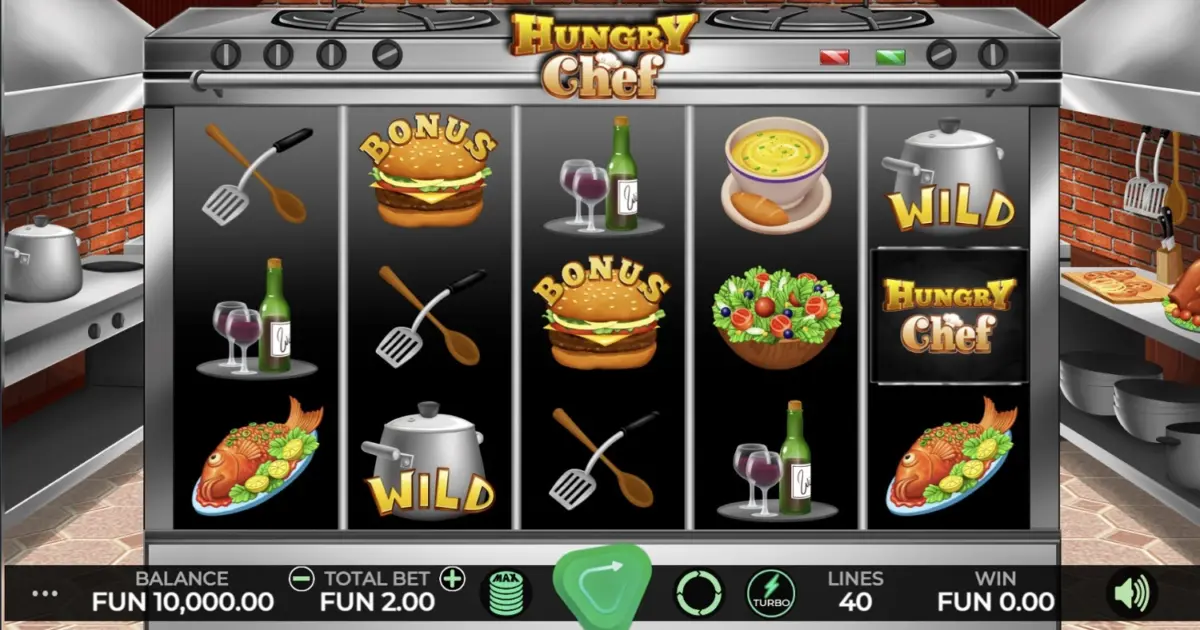
The headline number on the hungry chef slot is a 96.37% RTP, which sits a full percentage point above the 95.31% average across Caleta Gaming’s 62 titles and 0.66 points above the 95.71% average for every game covered here. A free demo is available, so you can look at it without staking anything. The catch is that the published specification sheet is thin: no volatility rating, no paylines count, no stake range and no maximum win figure, which means several of the things you would normally weigh up before a session simply are not on the table.
Is the Hungry Chef slot worth playing?
If you are picking games on return rate alone, yes, it earns a look. 96.37% is comfortably above what this studio usually publishes, and above the typical figure across the games catalogued here.
The reason that matters is simple. RTP is the only number in a slot’s spec sheet that has a direct, arithmetic relationship with what happens to your balance over a long run of play. Everything else, theme, animation quality, symbol design, changes how the session feels rather than what it costs. A game returning 96.37% costs you a theoretical 3.63% of every amount you wager, spread across an enormous sample of spins. A game returning 95.31%, the Caleta average, costs 4.69%. Over thousands of spins that gap is real money.
What you cannot judge from the available data is the shape of the ride. Two games can share an identical RTP and feel nothing alike, one paying small amounts often, the other going quiet for long stretches. Without a published volatility rating, the demo is the only way to get a feel for that, and even then a few hundred spins tells you far less than you might assume.
| Provider | Caleta Gaming |
|---|---|
| RTP | 96.37% |
| Reels | 5 |
| Theme | Food |
| Free demo | Yes |
| Site-wide average RTP | 95.71% |
What 96.37% RTP means over 1,000 spins
Take a flat 1 unit stake and 1,000 spins. That is 1,000 units wagered. At 96.37% the theoretical return is 963.70 units, an expected loss of 36.30 units, or 3.63 units per 100 spins.
Now the important qualification: almost nobody actually lands on that number. RTP is a long-run average calculated across millions of simulated spins, and 1,000 spins is a rounding error by comparison. Real 1,000-spin sessions scatter widely around the expected value. Some finish ahead. Many finish further behind than 36 units. The published figure describes the shape of the distribution, not the outcome of your afternoon.
Compared with the corpus average of 95.71%, the same 1,000 units wagered carries an expected loss of 42.90 units. So choosing this title over a typical game saves roughly 6.60 units in expectation per 1,000 spins at 1 unit a go. Against a weaker Caleta release such as Cruise of Fortune at 92.90%, the gap widens to about 34.70 units per 1,000 spins. That is what a percentage point or three of RTP is worth in practice, and it is why the figure is worth checking before you open a game rather than after.
One more thing the maths insists on: every spin is independent. The result of the previous spin has no influence on the next. A run of dead spins does not build anything up, and a run of paying spins does not use anything up.
How volatile is Hungry Chef?
Caleta Gaming has not published a volatility rating for this game, so any low, medium or high label you see quoted elsewhere is somebody’s guess rather than studio data. Treat it accordingly.
Volatility describes how a game’s returns are distributed rather than how large they are in total. A low-volatility game pays small amounts frequently, so your balance drifts down gently with regular small recoveries and your session lasts a predictable length of time. A high-volatility game concentrates its return into rare, larger outcomes, which means long stretches of nothing punctuated by occasional bigger hits. The RTP can be identical in both cases.
The practical consequence is bankroll. A high-volatility game needs several times the bankroll of a low-volatility one at the same stake to survive the same number of spins, because the dry runs are longer and deeper. A low-volatility game lets you plan a session with reasonable confidence about how long it will run.
With no rating published, the honest answer is that you should size your bankroll as though the swings could be substantial, then use the free demo to form your own impression of how often the reels actually return something. That is not a perfect substitute for a studio figure, but it is better than trusting a number nobody sourced.
What the Food theme brings to the game
The theme is Food, one of 355 titles carrying that label here, on a five-reel layout. The name points at a kitchen setting and a chef character. Beyond that, the specification sheet does not describe symbols, soundtrack or animation, so nothing more detailed would be honest.
What a theme does and does not do is worth being clear about. It sets the tone of a session and it is a legitimate reason to prefer one game over another, particularly if you find bright, light-hearted subject matter easier to sit with than the grim end of the mythology and horror catalogue. What it does not do is touch the maths. A food-themed game and a mythology-themed game with the same RTP and the same volatility behave identically. No theme is more generous than another.
Food is a crowded category, which works in your favour. With 355 titles to choose from you can afford to filter on RTP first and pick a theme you enjoy second, rather than accepting a weak return rate because you like the artwork.
Stakes, session length and bankroll
No minimum or maximum stake has been published for this title, so check the betting range in the game window before you commit to a session plan. That is a quick look at the stake selector, and it is worth doing.
The reason stake range matters more than most players allow for is that it sets the resolution of your bankroll. A £50 bankroll at £0.20 a spin buys 250 spins. The same £50 at £1 a spin buys 50. Same game, same RTP, same expected percentage loss, wildly different session. If you want time at the reels, the stake is the lever, not anything else.
A workable approach is to decide the amount you are prepared to spend first, decide roughly how long you want to play, then divide to find your stake. Round down rather than up, because a thinner bankroll absorbs fewer bad runs. No stake pattern, progression or timing changes the expected value of what follows, so there is nothing to gain from varying it mid-session beyond managing your own pace.
Alternatives if Hungry Chef is not for you
Staying inside the Food category, Lucky Turkey publishes 97.17%, a clear 0.80 points better and the strongest return of the comparable titles here. BBQ Rush at 96.33% is effectively a coin-flip difference, so pick between them on presentation rather than pretending the RTP gap is meaningful.
If you want to stay with the same studio, Paradise Trippies at 96.00% is the closest of Caleta’s other releases on return rate, a little below this one but still well ahead of the 95.31% house average across their 62 games. Among Caleta Gaming slots, that spread from 92.90% to 96.37% is wide enough that checking the figure per title genuinely pays.
Ranked 2,325 and inside the top 12% for popularity here, this is a reasonably well-trafficked title rather than an obscure one, though popularity and return rate are unrelated.
Final take
A 96.37% RTP beats both the provider and corpus averages, and the Hungry Chef free demo lets you test the feel at no cost. The missing volatility, payline and stake data are a genuine gap, so go in without assumptions about swing size and check the stake selector yourself. Lucky Turkey’s 97.17% remains the better number if that is your only criterion.
Slots are paid entertainment, not income. Set a budget you are content to lose before you start, treat it as the price of the session, and stop when it is gone. Play is for over-18s only, and demo results tell you nothing about what real-money play would have done.
Frequently Asked Questions
Can you play Hungry Chef for free?
A free demo is available for this title, which means you can spin the five reels with virtual credits and no deposit or registration requirement. It is a reasonable way to judge pacing and presentation, particularly useful here given that Caleta Gaming has not published a volatility rating you could check instead.
What is the RTP of Hungry Chef?
The published RTP is 96.37%, meaning a theoretical return of £96.37 for every £100 wagered across a very large sample of spins. That is above the 95.31% average across Caleta Gaming's catalogue and 0.66 points above the 95.71% average for all games listed on this site.
Is Hungry Chef high or low volatility?
Caleta Gaming has not published a volatility rating for this game, so any figure quoted elsewhere is unverified. Size your bankroll as though swings could be significant, and use the demo to gauge how often the reels return something. Volatility affects session shape, not the 96.37% long-run return rate.
Who makes Hungry Chef and what else do they produce?
Caleta Gaming developed it. The studio has 62 titles catalogued here with an average RTP of 95.31%, and that average hides a wide spread, from Cruise of Fortune at 92.90% up to this game at 96.37%. Paradise Trippies sits between them at 96.00%.
How does Hungry Chef compare with BBQ Rush?
The two are near-identical on return rate: 96.37% here against 96.33% for BBQ Rush, a difference of 0.04 points that has no practical effect on your balance. Both sit in the 355-title Food category. Choose on theme execution and pacing rather than on that RTP gap.