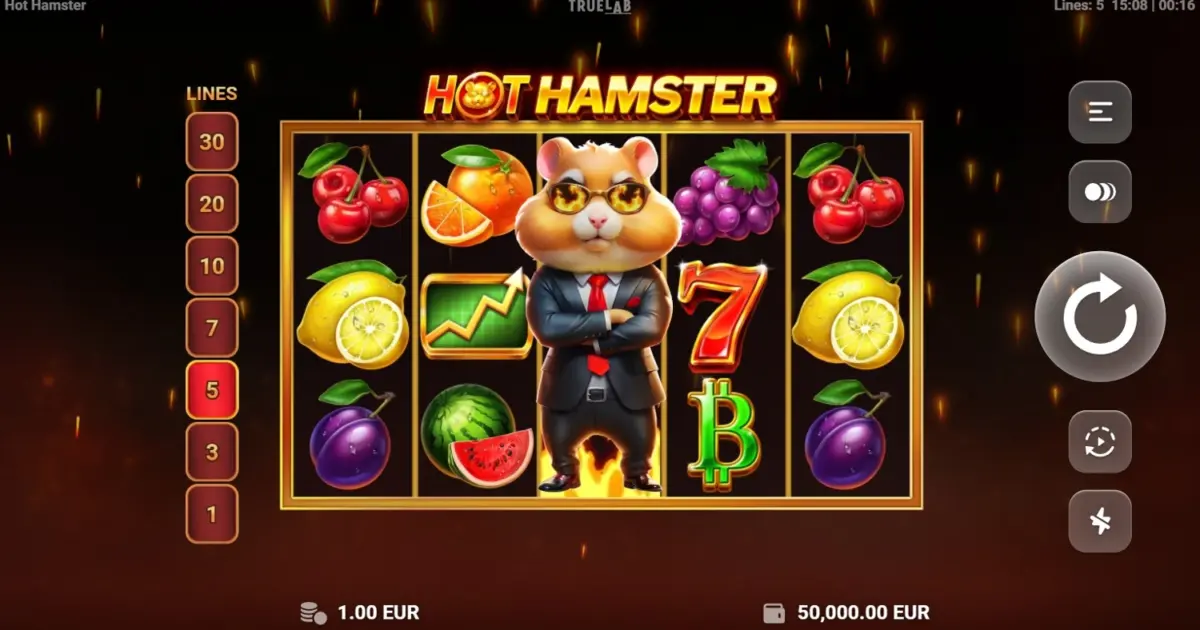
Hot Hamster is a five-reel fruit slot from TrueLab Games that returns 96.3% to players over the long run, placing it above both its provider’s average and the broader catalogue. The free demo is available, so you can evaluate the game without staking money. The catch: TrueLab has not published a volatility rating, a max-win figure, or a stake range for this title, which limits how precisely you can plan a session.
Is Hot Hamster worth playing?
If you are comparing fruit slots and want one that returns more than the catalogue average, Hot Hamster’s 96.3% RTP clears that bar. The game sits at rank 1311 overall but in the 93.4th popularity percentile, meaning more players seek it out than its rank suggests — likely because the demo is freely available and the format is familiar.
That said, the missing volatility and max-win data means you cannot predict how this game will feel during a single session. Some players need to know whether swings will be small and frequent or large and rare before committing real money. If you are one of those players, read the sections below to understand what you do and do not know about this slot.
What 96.3% RTP means over 1,000 spins
RTP is a long-run statistical average calculated across millions of simulated spins. At 96.3%, the game returns $96.30 for every $100 wagered across that enormous sample. Over 1,000 spins at $1 per spin, the mathematical expectation is a return of $96,300 against $100,000 wagered — a net theoretical loss of $3,700. That is the average, not your result in any individual session.
Hot Hamster’s RTP is 0.59 percentage points above the corpus average of 95.71%, and 0.42 points above TrueLab Games’ own average of 95.88%. Across 1,000 spins at $1 per spin, that 0.59-point edge over the corpus average translates to roughly $5.90 less expected loss per $1,000 staked. Over a single session that is a small difference, but it accumulates across thousands of spins and matters most to players who track their total wagers over months.
TrueLab Games has published 55 titles, and Hot Hamster’s 96.3% sits at the upper end of their catalogue. Their average of 95.88% pulls the provider below the corpus mean, so this game is one of the better-paying options within that group.
How volatile is Hot Hamster?
TrueLab Games has not published a volatility rating for this slot. That is the honest answer, and it is a meaningful gap in the information available to you as a player.
Volatility (or variance) describes how spread out a game’s returns are around its RTP. A low-volatility slot pays small amounts frequently, so your balance erodes gradually and sessions last longer per dollar staked. A high-volatility slot pays rarely but in larger chunks, producing long dry stretches punctuated by one or two significant hits that briefly restore or exceed your starting balance. The RTP stays the same across both profiles — volatility changes the path, not the destination.
Without a published rating, you can infer very little from a fruit theme or a five-reel layout. Many fruit slots are low-to-medium volatility because they lean on base-game payline wins, but plenty of five-reel fruit titles are high variance. You would need to track your own demo session data — counting wins per 100 spins, measuring the size of the largest win relative to your stake — to build a rough volatility picture yourself. The demo lets you do that at no cost.
What the Fruits theme brings to the game
Hot Hamster is tagged under three themes: Fruits, Animals, and 5-Reels. The fruit theme is the primary category, and with 2,560 games sharing that label across the catalogue, it is one of the most populated slots themes in existence. The animal label likely refers to the hamster in the title, and 5-Reels is a structural descriptor rather than a visual one.
What you get from a fruit slot is generally a clean, high-contrast symbol set: cherries, lemons, watermelons, bells, bars, and the classic seven. The appeal of this visual language is readability — you can identify symbols and assess a payline in a fraction of a second without hunting through a busy background. The downside is that 2,560 competitors share that exact visual vocabulary, so differentiation between fruit slots usually comes down to numbers rather than aesthetics.
TrueLab Games has not described specific visual or audio design elements for this title in the data available to me, so treat the theme labels as a broad category signal rather than a preview of what the game looks or sounds like.
Stakes, session length and bankroll
No stake range (minimum or maximum bet per spin) is published for Hot Hamster. Without that figure you cannot calculate how many spins your bankroll will survive. You can reason generically: at a $1 bet with a 96.3% RTP, your expected loss is $0.037 per spin, so a $100 budget covers roughly 2,700 spins before the theoretical expected balance reaches zero. At a $5 bet the same $100 lasts only about 540 spins. These are averages over millions of sessions, not predictions for yours.
| Parameter | Value |
|---|---|
| Provider | TrueLab Games |
| RTP | 96.3% |
| Reels | 5 |
| Themes | Fruits, Animals |
| Volatility | Not published |
| Max win | Not published |
| Stake range | Not published |
| Popularity percentile | 93.4th |
Play Hot Hamster free demo before depositing, and track how many spins your chosen stake lasts. That gives you a personal volatility proxy that no published number can match.
Alternatives if Hot Hamster is not for you
TrueLab Games slots include several fruit-adjacent titles worth comparing. Hot Devil Slot carries the identical 96.3% RTP, so if the hamster theme does not appeal, you get the same mathematical return from a different set of symbols. Christmas Tree edges higher at 96.4%, a marginal gain that compounds over very long sessions.
If you want a fruit slot with a measurably better return, Hot Hot Fruit delivers 96.84% — 0.54 points above Hot Hamster and 1.13 points above the corpus average. Over 1,000 spins at $1 per spin that difference means roughly $5.40 less expected loss, a small but consistent advantage for players who prefer fruit mechanics and want every statistical point they can get.
Final take
Hot Hamster is a competent entry in a crowded fruit-slot category. Its 96.3% RTP is genuinely above average for both its provider and the wider catalogue, and the free demo gives you a costless way to assess whether the gameplay rhythm suits you. The main weakness is informational: no volatility rating, no max-win figure, and no published stake range mean you are planning a real-money session with incomplete data. That does not make the game bad, but it does make it harder to slot into a structured bankroll plan.
If you decide to play for real money, treat it as paid entertainment, set a budget before you start, and stop when that budget is spent. This game is for players 18 and over.
Frequently Asked Questions
Can I play Hot Hamster for free?
Yes, the free demo is available without a deposit. TrueLab Games has made a no-download browser version accessible, so you can evaluate the five-reel layout and 96.3% RTP before deciding whether to stake real money.
What is the RTP of Hot Hamster?
Hot Hamster has a published RTP of 96.3%, which is 0.59 percentage points above the corpus average of 95.71% and 0.42 points above TrueLab Games' provider average of 95.88%. This means the theoretical long-run return is slightly better than most slots in the catalogue.
How volatile is the Hot Hamster slot?
TrueLab Games has not published a volatility rating for this title. Without that figure you cannot predict whether your balance will decline smoothly or swing sharply. The free demo lets you track win frequency and size yourself over a few hundred spins to build a personal estimate.
Who makes Hot Hamster and what else do they offer?
TrueLab Games produces Hot Hamster as one of 55 titles in their catalogue. Their average RTP across those games is 95.88%, making Hot Hamster one of their stronger-paying releases. Related titles include Hot Devil Slot at the same 96.3% and Christmas Tree at 96.4%.
Does the demo version pay real money?
No. The free demo runs on virtual credits and cannot produce real winnings. It exists so you can learn the game mechanics without financial risk. Results observed in demo play do not predict outcomes in real-money sessions, since each spin is independently random.