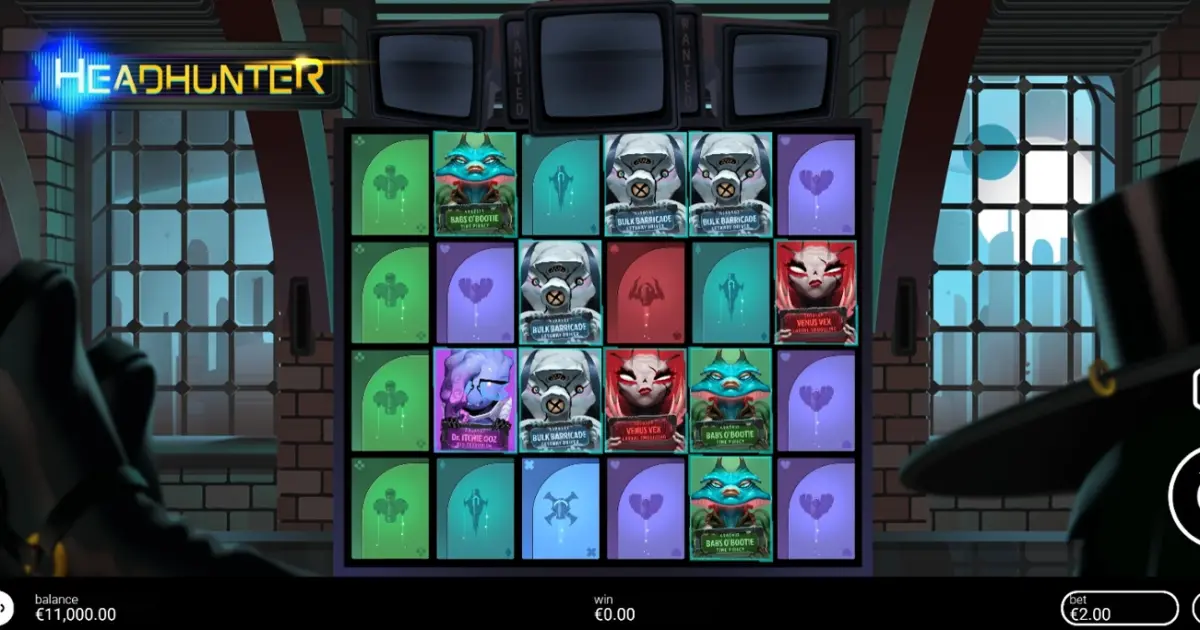
The headhunter slot is a six-reel, gangster-themed game from Bitpunch with a 94.0% RTP. Bitpunch has only eight titles in its catalogue, and every one of them clusters around 94.0–94.3%, so this is not an outlier — it is the house standard. If you are comparing this against games with 96% or higher RTP, the gap matters over long sessions. If you are looking for a crime-themed slot and you accept below-average returns, the theme execution and popularity (99.1st percentile) suggest enough players disagree with that math to keep spinning.
Headhunter slot at a glance
| Field | Value |
|---|---|
| Provider | Bitpunch |
| RTP | 94.0% |
| Reels | 6 |
| Theme | Gangsters, Crime |
| Volatility | Not published |
| Max win | Not published |
| Stake range | Not published |
| Free demo | Available |
| Popularity rank | 180 (99.1st percentile) |
Three rows above read “Not published.” That is a real gap. Bitpunch has not disclosed volatility, max win, or minimum/maximum stake for Headhunter. Without a volatility label, you cannot predict whether this game will feel like a slow drip or a violent swing machine. Without a max win, you have no ceiling to measure your session against. Those absences should lower your confidence before depositing, not raise it.
What a 94% RTP actually returns
RTP is a long-run statistical average calculated across millions of spins. A 94.0% figure means that across a sufficiently large sample, £94.00 is returned for every £100 wagered. On a single session of a few hundred spins, the actual return can deviate wildly in either direction — that is variance, not a contradiction of the RTP.
Work through a concrete example: 1,000 spins at £1.00 per spin means £1,000 total wagered. At the theoretical rate, you would get back £940, a net loss of £60. At the corpus average of 95.71%, the same 1,000 spins would return £957.10 — a net loss of £42.90. The 1.71-percentage-point gap between Headhunter and the corpus average costs you £17.10 over that thousand-spin stretch. Scale to 5,000 spins and the difference is £85.50. The figure is small per spin; it compounds with session length.
All three other Bitpunch games linked to Headhunter — Golden Triad, Killroad 66, and Lock’n Load — share the identical 94.0% RTP. This is a provider-wide ceiling, not a game-specific decision.
Volatility and what your session will feel like
Bitpunch has not published a volatility rating for Headhunter. In general terms, low-volatility slots pay small amounts frequently and produce short, predictable sessions. High-volatility slots pay rarely but produce larger single wins when they do hit, at the cost of long losing stretches that drain a bankroll quickly. Medium sits between.
Without a confirmed label, you should treat Headhunter as an unknown-risk game. If you are planning a session, budget for the worst case (high volatility) and treat a milder experience as a bonus. You can also observe the pattern across your first 100–200 free demo spins: if wins come every three to five spins at small multiples, the game likely behaves as low-to-medium volatility. If you go 40+ spins without a return, it is probably high.
The 6-reel layout and how wins are counted
Headhunter uses six reels. Six-reel layouts have become common across many providers and typically pair with either fixed paylines (often 10, 20, 40 or 50) or a ways-based system (ways to win calculated as the number of matching symbols that can appear on each reel). Bitpunch has not published the specific payline count or ways mechanic for this title.
The practical implication: with six reels and unknown line count, your effective per-spin wager may be higher than the “stake” figure suggests if the game multiplies your line bet by a large number of paylines. Check the stake display during demo play before assuming a £0.50 total bet means £0.50 per line.
Stake range and sizing a bankroll
No minimum or maximum stake is listed in the available data for Headhunter. Stake range determines how long a fixed bankroll lasts: at £0.10 per spin, a £100 budget gives you 1,000 spins before variance runs; at £1.00 per spin, you get 100. The shorter the session in spin-count terms, the less the RTP can assert itself and the more the outcome depends on a single lucky cluster.
Until you can see the actual range on the game screen, plan conservatively. Assume a minimum stake of £0.10–£0.20 and a maximum of £50–£100, which is typical for modern six-reel slots. A £100 session budget at £0.20 per spin yields 500 spins — still a short sample against 94% RTP, but enough to form an impression of the game’s rhythm.
Playing the Headhunter demo before you commit
A free demo is available for this game. Demo play lets you observe the reel structure, the frequency and size of wins, and the behaviour of any triggered features without wagering real money. It does not predict real-money results — the random number generator operates identically in both modes, but your perception differs because there is nothing at stake.
Use the demo to answer questions the missing data cannot: How often do wins land? What do the bonus triggers look like in practice? Does the game hold your attention over 200 spins? If the demo feels repetitive or the hit pattern is too sparse for your taste, you have saved yourself a deposit. Only play with money you can afford to lose entirely; set a budget before your first real spin and treat the session as paid entertainment, not an investment. You must be 18 or older.
Verdict: who should play Headhunter
Headhunter makes sense for you if two conditions hold: you want a crime/gangster theme on a six-reel layout, and you can accept a 94.0% RTP without discomfort. The theme space is crowded — 101 games carry a Gangsters tag — and several offer meaningfully better mathematics. Tombstone RIP delivers 96.08% RTP in a Western-crime setting, and Cred sits at 96.12%. Both give back roughly two additional percentage points over Headhunter’s theoretical rate, which is £20 per £1,000 wagered.
The game’s 99.1st-percentile popularity suggests the presentation earns attention despite the numbers. If you have played the demo, found it engaging, and set a strict loss limit, there is no mathematical prohibition against spinning it. Just know exactly what you are trading: theme enjoyment in exchange for a below-average return rate and undisclosed volatility.
Frequently Asked Questions
Is there a free demo of Headhunter available?
Yes, Bitpunch has made a free demo of Headhunter available. You can play it without registering or depositing, which lets you observe the game's rhythm, win frequency, and feature triggers before spending real money. Demo play does not predict real-money results.
What does the 94% RTP on Headhunter mean in practice?
Headhunter's 94.0% RTP means that across millions of spins, £94 is returned for every £100 wagered. Over a 1,000-spin session at £1 per spin, the theoretical return is £940. The 1.71-point gap versus the 95.71% corpus average costs roughly £17 per thousand spins.
Is Headhunter a high or low volatility slot?
Bitpunch has not published a volatility rating for Headhunter. Without that data, you cannot predict whether sessions will feel smooth or erratic. Observe the pattern across demo play — frequent small wins suggest low volatility, long dry stretches suggest high.
What other games does Bitpunch make besides Headhunter?
Bitpunch has eight titles in its catalogue. Related games include Golden Triad, Killroad 66, and Lock'n Load, all carrying the same 94.0% RTP. The provider's average is 94.29%, so Headhunter sits at the low end of an already narrow range.
Can I win real money playing the Headhunter demo?
No. The Headhunter free demo operates with a simulated balance and produces no real-money payouts. You must play the real-money version at a licensed casino to win actual funds. The demo exists purely so you can evaluate the game before depositing.