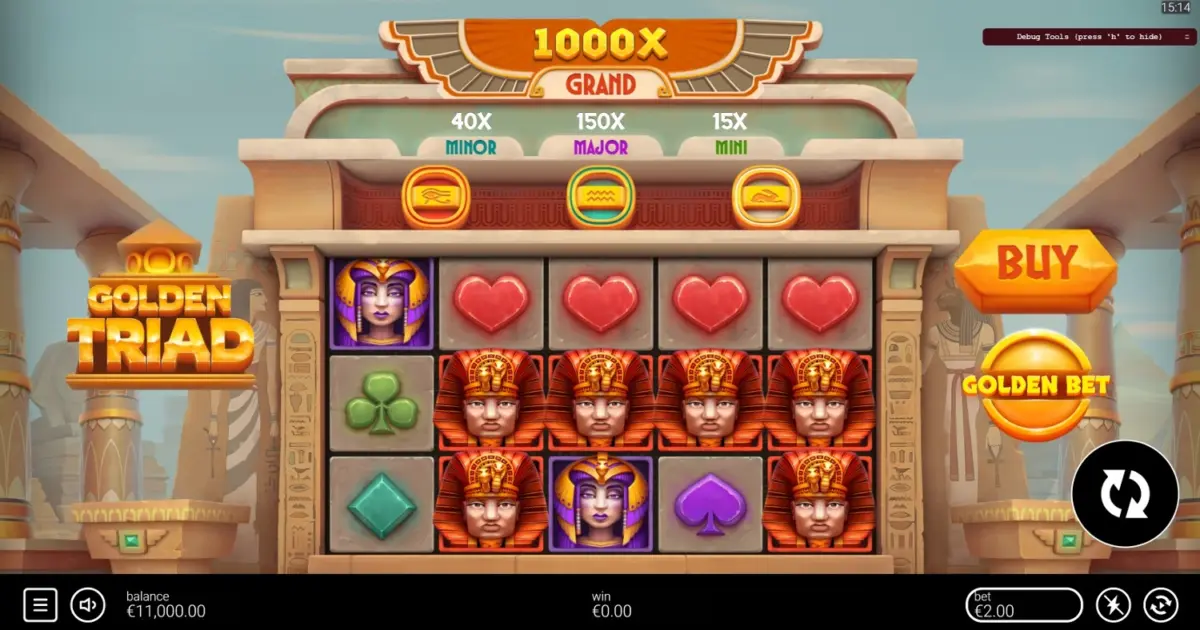
Bitpunch is a small provider with eight titles in this catalogue, and 94.0% RTP is the figure that defines Golden Triad. If you are comparing this golden triad slot against others before you spin, the RTP is the number that should drive your decision. It sits 1.71 percentage points below the corpus average of 95.71%, which translates to a faster expected drain on your balance over thousands of spins. Players who prioritise session length and value-for-money will find better options elsewhere. That said, the game ranks in the 98.7th popularity percentile, so it clearly resonates with a large audience despite its maths.
Golden Triad Slot at a glance
Before you read further, here are the figures that are published for this title. Everything absent from this table is information Bitpunch has not made available in the data this review is built on, and you should treat any number you see quoted elsewhere for those metrics with caution.
| Figure | Value |
|---|---|
| Provider | Bitpunch |
| RTP | 94.0% |
| Reels | 5 |
| Themes | Mythology, Egypt, Gods |
| Popularity rank | 270 (98.7th percentile) |
| Provider average RTP | 94.29% |
| Corpus average RTP | 95.71% |
| Free demo available | Yes |
Volatility, stake range, maximum win, bonus structure, and hit frequency are not published for this game. The absence of volatility data in particular means you cannot plan your bankroll around known swing behaviour, which is a meaningful gap for anyone sizing a session before they play.
What a 94.0% RTP actually returns
RTP is a long-run statistical average calculated over millions of simulated spins. A 94.0% RTP means that, across a very large sample, the game returns £94.00 for every £100 wagered. The remaining £6.00 per £100 is the house edge baked into the maths.
Put concretely: if you play 1,000 spins at £1.00 per spin, total stake is £1,000. The expected return across those spins is £940, with an expected loss of £60. On a median slot at 95.71% RTP, the same session would return roughly £957.10, an expected loss of about £42.90. The 1.71-point gap between Golden Triad and the corpus average costs you approximately £17.10 per £1,000 wagered over the long run.
Compare that to Gates of Olympus, which carries a 96.5% RTP. At the same £1,000 total stake, you would expect to lose £35 on that game versus £60 on Golden Triad — nearly double the drain. The difference is not a rounding error. It compounds every time you add spins.
Bitpunch’s own portfolio averages 94.29% RTP, so Golden Triad sits close to its provider’s typical figure. If you enjoy Bitpunch’s style, you are not getting a worse deal here than elsewhere in their catalogue — you are getting their standard deal. Games like Headhunter and Lock’n Load carry the identical 94.0% RTP.
Volatility and what your session will feel like
Bitpunch has not published a volatility rating for Golden Triad. This is the single most important missing number in this review, because volatility governs how wins arrive — not whether they arrive overall, but the rhythm and size of the swings between them.
As a general guide: low-volatility slots deliver frequent small wins, keeping your balance relatively stable. High-volatility slots deliver infrequent wins that can be large, with long dry stretches that drain a balance quickly. Medium volatility sits between the two.
Without a published rating, your best proxy is the demo. Play it at a stake you would actually use and observe how often you hit wins, how large they are relative to your stake, and how quickly your balance drops during a losing stretch. That observation will tell you more than any second-hand description. If you cannot find a published volatility figure from a reliable source, treat any claim you see with scepticism. The absence of data is itself useful information: it means the provider has not given you enough to plan responsibly.
The 5-reel layout and how wins are counted
Golden Triad uses a standard 5-reel grid, which is the most common format in online slots. Five reels typically support either a fixed payline system or a “ways” mechanic, and the theme labels (Mythology, Egypt, Gods) align with the broad visual direction you can expect. Bitpunch has not published a specific payline count or ways figure in the available data, so you should check the paytable inside the game before you commit real money.
On a 5-reel slot with, say, 20 fixed paylines, a winning symbol needs to land on consecutive reels starting from the left edge (in most implementations) along one of those defined lines. With a “ways” system, any matching symbol on adjacent reels contributes to a win, which increases the number of potential winning combinations per spin without changing the underlying RTP.
What matters for you as a player is not the reel count itself but how it interacts with the maths. Five-reel games in the corpus range from sub-94% to above 96% RTP, so the layout tells you nothing reliable about return quality. The RTP figure in the section above is what determines that.
Stake range and sizing a bankroll
Bitpunch has not published a minimum or maximum stake for Golden Triad. Without these figures, you cannot calculate how many spins your bankroll will sustain at a given RTP.
Here is the general principle: expected loss per spin equals your stake multiplied by the house edge. At 94.0% RTP, the house edge is 6%. If the minimum stake were £0.20, your expected loss per spin is £0.012. A £20 balance would sustain roughly 1,666 spins before being mathematically exhausted in expectation — though variance means you will finish sooner or much later than that in any actual session.
When you open the demo or a real-money version, check the stake range immediately. If the minimum is £0.10, you get more spins for your money than if it is £1.00. The RTP does not change with stake size (unless a provider explicitly states otherwise, which Bitpunch has not here), but your session length and the psychological experience of variance are heavily influenced by how much you are betting per spin relative to your total balance.
For mythology-themed slots at a comparable 94.0% RTP, 9 Arrows of Odysseus uses the same return figure but may differ in stake range and volatility. If session length is your priority, comparing the two in demo mode will give you a direct feel for which drains faster in practice.
Playing the Golden Triad demo before you commit
A free demo is available for Golden Triad. Use it to answer the questions this review cannot: how volatile does this feel, what is the stake range, how often do wins arrive, and what bonus features exist. Demo play is identical in mechanics to the real-money version — the same RNG, the same paytable, the same maths.
However, demo play does not predict real-money results. It lets you observe the game’s behaviour, not forecast your own outcome. You cannot tell whether a real session will go well or badly from a demo run. What you can do is understand the rhythm: whether wins feel frequent but small, or rare but potentially larger, and how the bonus rounds work if they exist.
Set a budget before you play with real money and treat every session as paid entertainment. You are paying the house edge for the experience of playing. 94.0% RTP means you are paying £6 per £100 wagered on average. That is the cost. If you cannot afford to pay it for the fun you get, do not play. The game is for adults aged 18 or over.
Verdict: who should play Golden Triad
Golden Triad suits players who are drawn to Egyptian mythology and want to try Bitpunch’s output, and who have read past the surface appeal of the theme to the maths underneath. At 94.0% RTP with a 6% house edge, you are wagering above the market median, and the missing volatility and stake data mean you cannot fully plan your bankroll from published information alone.
If value-per-wager is your priority, the corpus average of 95.71% exists for a reason — there are games that return more of what you put in. Golden Triad is not that. But Bitpunch has built something that appeals to a large audience (98.7th percentile), so the presentation clearly compensates for the maths gap in ways that matter to many players.
Play the demo first. Check the stake range and volatility in practice. Then decide whether 94.0% is a price you are willing to pay for the experience on offer.
Frequently Asked Questions
Is Golden Triad free to play in demo mode?
Yes. A free demo version of Golden Triad is available without registration or deposit. The demo uses the same maths as the real-money version, including the 94.0% RTP and 5-reel layout, so you can observe the game's behaviour before wagering anything. Note that demo outcomes do not predict real-money results.
What is the RTP of Golden Triad and how does it compare to other slots?
Golden Triad has a 94.0% RTP, which is 1.71 percentage points below the corpus average of 95.71%. In practical terms, for every £100 wagered over a long session, you can expect to lose £6.00 on this game compared to roughly £4.29 on an average slot. Bitpunch's own portfolio averages 94.29%.
What is the volatility of Golden Triad?
Bitpunch has not published a volatility rating for Golden Triad in the data available for this review. Without that figure, you cannot determine expected swing size or session-length requirements from published information. The most reliable approach is to observe win frequency and balance movement in the free demo at a representative stake.
Who makes Golden Triad and what else has this provider released?
Golden Triad is developed by Bitpunch, a small provider with 8 titles in this catalogue. Other Bitpunch games include Headhunter, Killroad 66, and Lock'n Load, all of which share the same 94.0% RTP. The provider's average return across its portfolio is 94.29%.
Does Golden Triad have a maximum win or stake range?
Neither a maximum win figure nor a minimum and maximum stake range has been published by Bitpunch for this title. You can check both inside the game's paytable or settings panel when you open the demo or real-money version. Until you have those numbers, avoid making assumptions about win ceiling or required bankroll.




