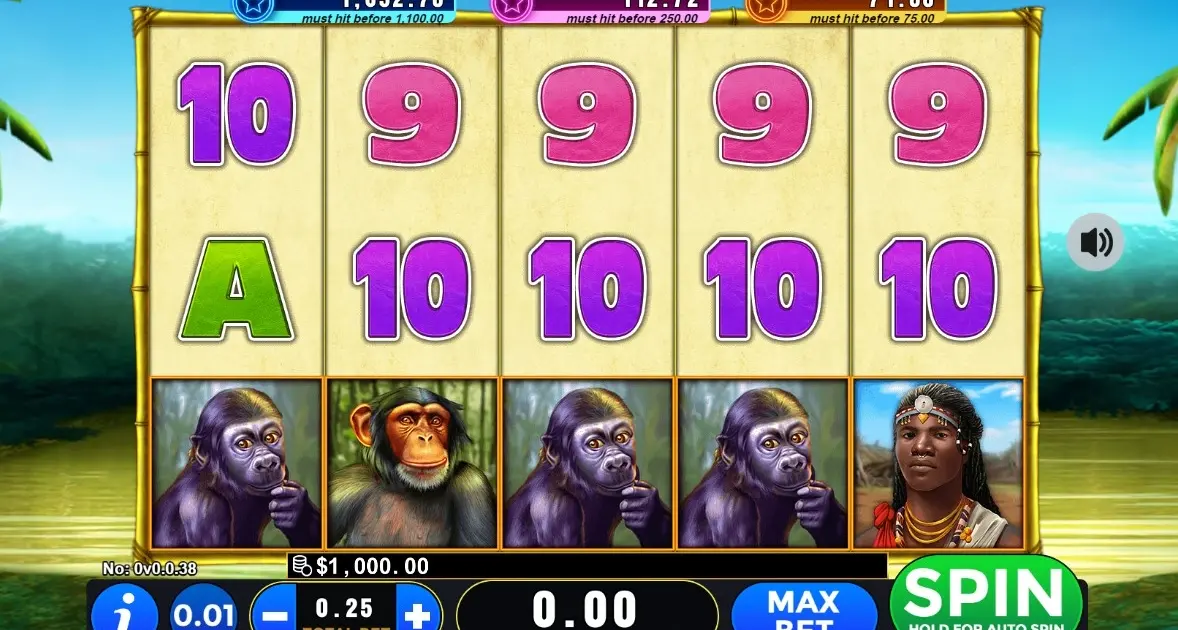
Great Apes is a 5-reel Animals slot from GMW (Game Media Works) that sits at rank 2916 for popularity, putting it outside the most-played tier. If you are comparing options rather than chasing a single title, the honest answer is that the lack of published RTP and volatility data makes it harder to plan than better-documented games, though the free demo lets you check the feel with no cost. The great apes slot is best approached as a try-first title until its core maths are published.
Great Apes slot at a glance
This is a 5-reel game in the Animals category, one of 1,788 Animals titles in the corpus and one of 152 games from GMW. The primary theme is Animals with a 5-Reels subcategory label, which tells you the reel structure but not the visual detail beyond that theme tag. No stake range, volatility rating, or RTP has been published for this specific title in the facts available, so you cannot model expected loss or swing size with the usual precision.
Popularity percentile is 85.4, and the overall rank is 2916. That pairing suggests it is not among the heavily discovered titles, even though the percentile reads higher than the rank might imply on its own. For you as a reader, low visibility plus missing maths means you should treat external claims about payouts with extra caution and lean on the demo.
Who it suits right now is straightforward: players who want to sample an Animals-themed 5-reel game without committing funds, and who are comfortable evaluating feel rather than figures. If you need a fully specified RTP and volatility sheet before you choose, better-documented alternatives will serve you better.
| Item | Detail |
|---|---|
| Game | Great Apes |
| Provider | GMW (Game Media Works) |
| Reels | 5 |
| Themes | Animals, 5-Reels |
| Provider games | 152 |
| Animals titles in corpus | 1,788 |
| Popularity rank | 2916 |
| Free demo | Yes |
| RTP published | Not published |
| Volatility published | Not published |
What RTP actually returns when no figure is published
Great Apes has no published RTP in the facts supplied, so there is no official percentage to work through a concrete example for this title specifically. That absence matters because RTP is the only figure that lets you estimate long-run expected return on a per-spin basis. Without it you cannot say whether 1,000 spins at a given stake would be expected to return £96 or £94 per £100 wagered, even as a statistical average.
What you can do is frame the maths in general terms. RTP is a long-run statistical average calculated over millions of spins, not a promise for a single session. Every spin is independent, and short samples can deviate sharply above or below the average. A stated RTP of 96% would mean £96 returned per £100 wagered across a very large sample, but it tells you little about the next 100 or 1,000 spins you personally play.
For context, the provider average across GMW’s 152 games is 95.61% and the corpus average is 95.71%. Those averages do not predict this game’s figure, but they show the neighbourhood in which many GMW titles sit. If Great Apes eventually publishes an RTP, compare it directly to those two benchmarks: above 95.71% would be above the corpus average, below it would be below. Until then, treat any RTP you see quoted elsewhere as unverified, and consider a comparable published alternative such as Hercules Power Wild at 96.2% if a documented percentage is important to your decision.
Volatility and what your session will feel like
No volatility rating has been published for Great Apes, so there is no official low, medium or high label to describe how its session might feel. Volatility, as a concept, describes the trade-off between how often wins might occur and how large the swings can be. It does not change expected value, but it does change the ride and the bankroll you need to stay comfortable.
In general, low volatility tends to produce more frequent but smaller results, which can stretch playtime and keep the balance steadier over shorter sessions. High volatility tends to produce longer quiet stretches punctuated by larger swings, which requires a larger buffer and a willingness to accept more variance. Medium volatility sits between those poles. Many slots state one of these labels so you can match the game to your session plan, but here you have to infer feel from play rather than from a sheet.
Because the rating is missing, keep your early sessions short and observational if you use the demo, and avoid extrapolating from a handful of outcomes. A better-documented Animals-adjacent option such as Apex Strike Megaways at 96.13% RTP gives you a published maths point for comparison, even though it uses a different mechanic. For Great Apes specifically, the responsible approach is to assume unknown variance until the provider publishes a figure.
The 5-reel layout and how wins are counted
Great Apes uses a 5-reel layout. In general terms, a 5-reel structure means five vertical columns spin and stop independently each round, with symbols landing in rows across those reels. Wins are then counted according to the game’s win mechanic, commonly either fixed paylines where symbols must line up on defined lines from left to right, or “ways” where any matching symbols on consecutive reels count without a fixed line.
The facts for this title do not specify the number of paylines, the number of ways, or how wilds and scatters behave here. Because those details are not in the available data, they should not be assumed for this game. As concepts, many slots use wilds to substitute for regular symbols and scatters to trigger features, but whether and how this game does so has not been published in the data set provided.
What the 5-reel label does tell you is the general shape of the grid and the baseline for comparison with other 5-reel games. It does not by itself tell you hit frequency, feature frequency, or payout distribution. Until line or ways count is published, treat the layout as confirmed and the counting method as undisclosed, and use demo play to see how the grid actually evaluates wins rather than relying on generic expectations.
Stake range and sizing a bankroll
No minimum stake, maximum stake, or default coin structure has been published for Great Apes in the data provided. Without those numbers you cannot calculate a precise session budget or spin count in currency terms. That is itself information: any budget plan you make for this title right now has to be provisional.
In general, stake range interacts with bankroll through simple division. Bankroll divided by stake equals the number of spins your funds can support before variance. For example, a £50 budget at £0.20 per spin supports 250 spins before any returns, while the same budget at £1 per spin supports 50 spins. That relationship holds regardless of provider or theme, and it is why knowing the minimum stake matters for session planning.
Where the range is undisclosed, the useful step is to decide your total entertainment budget first, then check the demo to see what stakes the interface actually offers before you consider real-money play. If you prefer a title where you can plan stake-to-bankroll from the specification sheet, a game from the same provider such as Sugar Bang with a published 95.0% RTP may be easier to evaluate, even though its theme differs. For Great Apes, keep stakes conservative if you later move beyond demo, and avoid any progression that claims to change expected value, because no staking pattern can alter the maths of independent spins.
Playing the Great Apes demo before you commit
Free demo play is available for Great Apes, which is the most practical way to assess it given the missing specification data. Demo mode lets you see the 5-reel layout in motion, how wins are evaluated on screen, and how the interface presents stake controls, without spending funds. It does not predict real-money outcomes, because both demo and real play rely on chance with independent results on each spin.
Use the demo as paid entertainment with no financial return, not as a trial that proves future results. Set a time limit rather than a win target, and treat what you see as feel rather than evidence of looseness or tightness. The game is never due to pay, and a short run of results in demo does not make real-money play more or less likely to return a particular amount.
Keep play responsible and within a clear budget you decide before you start. You must be 18+ to play. Set a budget, set a time limit, and treat slots as paid entertainment rather than a way to make money. If you need support, use a recognised help service in your jurisdiction. If the absence of published RTP and volatility for this title leaves you uncertain, that uncertainty is a valid reason to stay with free play or to choose a title with a fully published sheet.
Verdict: who should play Great Apes
Play Great Apes if you want to sample an Animals-themed 5-reel game from GMW with no cost via the free demo, and you are comfortable evaluating a title where the core maths sheet is currently unpublished. There is enough here to explore on feel, but not enough to plan a bankrolled session with precision.
Prefer a more documented option if you need a stated RTP and volatility label to size your session. Within the same provider stable, alternatives exist, though their published RTPs sit around the provider average of 95.61%, such as the examples noted earlier. For a theme-adjacent comparison with a higher published RTP, Strength of Hercules at 96.31% offers a clear maths reference point you can weigh against the unknown on Great Apes.
The bottom line is measured rather than promotional. Great Apes is worth a look in demo if the theme appeals, but until GMW publishes an RTP, volatility rating and stake details, it remains a try-before-you-decide game rather than a plan-around title. Use the demo to inform your preference, keep expectations tied to chance, and choose a fully specified game when numbers matter to your decision.
Frequently Asked Questions
Can I play Great Apes for free without downloading?
Free demo play is listed as available for Great Apes, so you can try the 5-reel Animals game in your browser without staking funds. Demo play uses the same chance-based spins but pays no real money, and results there do not predict real-money outcomes. Use it to check feel and interface.
What is the RTP of Great Apes and what does it mean?
No RTP has been published for Great Apes in the facts provided, so there is no official percentage to quote. RTP, when published, is a long-run average of amount returned per amount wagered over millions of spins. Without it you cannot model expected loss for a set number of spins.
What is the volatility of Great Apes and how will it affect my session?
No volatility rating has been published for Great Apes, so there is no official low, medium or high descriptor. Volatility describes how often and how large swings may feel, not expected value. Until a rating is published, keep demo sessions short and do not infer variance from a small sample.
Who makes Great Apes and what else do they make?
Great Apes is made by GMW (Game Media Works), which has 152 games in the data set with a provider average RTP of 95.61%. Related GMW titles in the facts include Sugar Bang at 95.0% RTP and Big 5 Baby 5, giving you other options from the same studio to compare.
How does Great Apes compare to Hercules Power Wild on RTP?
Great Apes has no published RTP, so a direct comparison is not possible. Hercules Power Wild, an Animals-adjacent title, has a published RTP of 96.2%, which is above both the corpus average of 95.71% and the GMW average of 95.61%. That makes Hercules Power Wild the more documentable choice if a stated percentage matters to you.