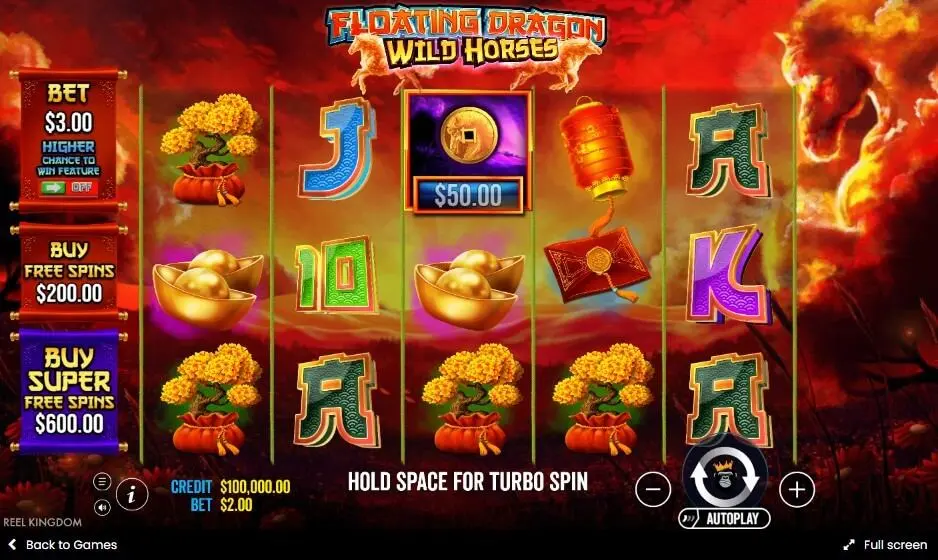
If you judge a game by its return figure, this one clears the bar: 96.5% sits above both the 96.32% Pragmatic Play average and the 95.71% average across the wider slot catalogue tracked here. What the published data does not tell you is how that return arrives — whether in frequent small increments or rare large ones. That single missing number is the main reason to try the floating dragon wild horses slot in demo mode before committing a real bankroll to it.
Is Floating Dragon Wild Horses worth playing?
For most readers, yes — as a demo session at minimum. The return percentage is competitive, the provider is one of the largest studios in the market with 739 titles tracked, and a free version is available, so the cost of finding out whether the game suits you is zero.
The case against is thinner but real. Pragmatic Play has not published a volatility rating, a maximum win figure, a hit frequency, or a stake range for this title in the data available here. That means you cannot plan a bankroll around it in advance the way you can with a game that states “high volatility, 5,000x max win”. You would be learning the risk profile as you go.
Popularity offers a partial signal. The title ranks 2,913 overall, placing it in roughly the 85th percentile — played more than most, but not a headline release. That is consistent with a solid mid-catalogue game rather than a flagship. If you want certainty about swing size before you stake money, look at a title with published volatility. If you are comfortable reading a game from its behaviour, this is a reasonable place to spend twenty minutes.
| Provider | Pragmatic Play |
|---|---|
| RTP | 96.5% |
| Reels | 5 |
| Theme | Asian |
| Free demo | Yes |
| Site-wide average RTP | 95.71% |
What 96.5% RTP means over 1,000 spins
RTP is a long-run average, calculated across millions of simulated spins. At 96.5%, the game is built to return £96.50 for every £100 wagered over a very large sample. The remaining £3.50 is the house margin.
Scale that to a session. A thousand spins at £0.20 each is £200 wagered. The mathematical expectation is a return of £193 and a loss of £7. That figure looks almost trivial, and over a thousand spins it genuinely is the smaller part of the story — your actual result will sit far away from it in either direction, because variance dominates at that sample size. You might finish £80 up or lose the full £200 without anything unusual having happened.
A thousand spins is not a large sample. It is a rounding error against the sample RTP is measured over. So treat 96.5% as a statement about the game’s construction, not a forecast for your afternoon. It tells you this title is marginally more generous by design than the 95.71% catalogue average — worth 0.79 percentage points, or £7.90 per £1,000 staked.
One more point worth stating plainly: every spin is independent. A run of dead spins does not build up a debt the game must repay, and a winning streak does not borrow against your future.
How volatile is the Floating Dragon Wild Horses slot?
Unknown, and that is the honest answer. No volatility rating appears in the published data for this game, so any site telling you it is low, medium or high is guessing or repeating a guess.
Here is why it matters more than RTP. Two games can both return 96.5% and feel nothing alike. A low-volatility build pays small amounts often, keeps your balance drifting gently downward, and stretches a small bankroll across a long session. A high-volatility build takes long stretches of nothing and repays in occasional larger hits, which means the same £50 can vanish in fifteen minutes or last an hour depending on timing. Same maths, completely different experience.
Without the rating, the demo is your instrument. Play a couple of hundred spins at a fixed stake and watch the shape of the balance line: shallow and steady points to lower variance, jagged with long flat runs points to higher variance. Two caveats. A few hundred spins is a small sample, so read it as an impression rather than a measurement, and demo results carry no predictive weight for real-money sessions — the maths is identical, but your particular outcomes are not repeatable.
What the Asian theme brings to the game
The theme label tells you the game draws on Asian iconography and visual tradition, which is one of the most heavily used categories in the market — 1,455 tracked titles share it. Beyond that label, the published data does not describe symbols, characters, animation or soundtrack, and this review will not invent them. The name references dragons and horses; what the reels actually depict is something you will see in the demo, not something any honest write-up can tell you in advance.
What theme density does affect is your choice. With well over a thousand alternatives in the same visual bracket, you are not short of options if the presentation does not land. Asian slots as a category tend to be well served at both ends of the volatility range, so a substitute with a published risk rating is usually easy to find.
The practical reading: theme is a preference filter, not a value signal. It has no bearing on return percentage or variance. Pick on the numbers, then let the artwork decide between games that are mathematically similar.
Stakes, session length and bankroll
No minimum or maximum stake is published for this title in the data here, so check the figures in the game panel itself before you decide what a session costs. Treat any stake range quoted elsewhere as unverified.
The planning method works regardless. Decide the total you are prepared to spend, then divide by the number of spins you want from it. Three hundred spins from a £30 budget means £0.10 per spin. A hundred spins from the same £30 means £0.30. That arithmetic, not the RTP, is what determines how long you sit there.
Because volatility is unpublished, add margin. If a game turns out to swing harder than expected, a stake sized for the average case empties faster than planned. Sizing at the lower end of what you would normally pick gives you room to discover the game’s temperament without the discovery costing your whole budget.
Avoid stake progressions — doubling after losses, raising after wins, any pattern at all. None of them change the 96.5% return or the independence of each spin. They only change how quickly you reach whatever the outcome was going to be.
Alternatives if Floating Dragon Wild Horses is not for you
Staying inside the Asian theme, Wong Choy returns 96.74%, the highest figure among the comparable titles here and a quarter of a point above this game. Mystic Fortune Deluxe is close behind at 96.71% if you want a similar visual bracket with a marginally better published return.
If the studio is the draw rather than the theme, Gates of Olympus matches this title’s 96.5% exactly and is far better documented, which makes it easier to plan a bankroll around. And Sweet Bonanza sits fractionally higher at 96.51% — a difference of one hundredth of a percentage point, which is to say no meaningful difference at all, but it is among the most played games in the Pragmatic Play catalogue if popularity matters to you.
All four are worth a demo run alongside this one. Comparing the same stake across two or three games for a couple of hundred spins each is the fastest way to work out which variance profile you actually enjoy.
Final take
A competitive return figure attached to an incomplete data sheet. The 96.5% RTP is a genuine, if modest, edge over the catalogue average, and Pragmatic Play’s scale means the underlying build quality is a reasonable assumption. The absence of a published volatility rating, max win and stake range is the real limitation, and it pushes the sensible route firmly towards the Floating Dragon Wild Horses free demo first.
Play it free, watch how the balance behaves over a couple of hundred spins, and decide from there. If you want your risk profile stated up front rather than discovered, one of the alternatives above will serve you better.
Slots are paid entertainment, not income. Play only if you are 18 or over, set a budget before you start, and treat whatever you stake as the price of the session rather than money you expect back. If tracking that budget stops feeling straightforward, stop and use the deposit limits and self-exclusion tools your operator provides.
Frequently Asked Questions
Can I play Floating Dragon Wild Horses for free?
A free demo version of this Pragmatic Play title is available, so you can run it in your browser at no cost and without registering. That lets you test the reels, the pace and the swing size before deciding whether to stake real money. Demo results use the same 96.5% RTP maths but never pay out cash.
What is the RTP of Floating Dragon Wild Horses?
The published RTP is 96.5%, meaning the game is designed to return £96.50 per £100 wagered across a very large sample of spins. That sits above the 95.71% catalogue average and slightly above Pragmatic Play's own 96.32% average. Over a short session, variance will outweigh this figure entirely.
Is Floating Dragon Wild Horses high or low volatility?
No volatility rating has been published for this game, so treat any low, medium or high claim you see elsewhere as unverified. The practical workaround is the demo: play a couple of hundred spins at a fixed stake and watch whether your balance drifts gently or moves in sharp jumps and long flat runs.
Who makes Floating Dragon Wild Horses?
Pragmatic Play develops it. The studio has 739 titles tracked here, with an average RTP of 96.32% across that range, so this game's 96.5% sits marginally above its maker's typical figure. Other well-known Pragmatic Play slots include Gates of Olympus, Sweet Bonanza and Joker's Jewels.
How does it compare to Wong Choy?
Wong Choy returns 96.74% against this game's 96.5%, so it holds a 0.24 percentage point advantage — worth about £2.40 per £1,000 wagered. Both sit in the Asian theme category, which covers 1,455 tracked titles. Neither game has a published volatility rating, so compare them in demo before choosing.