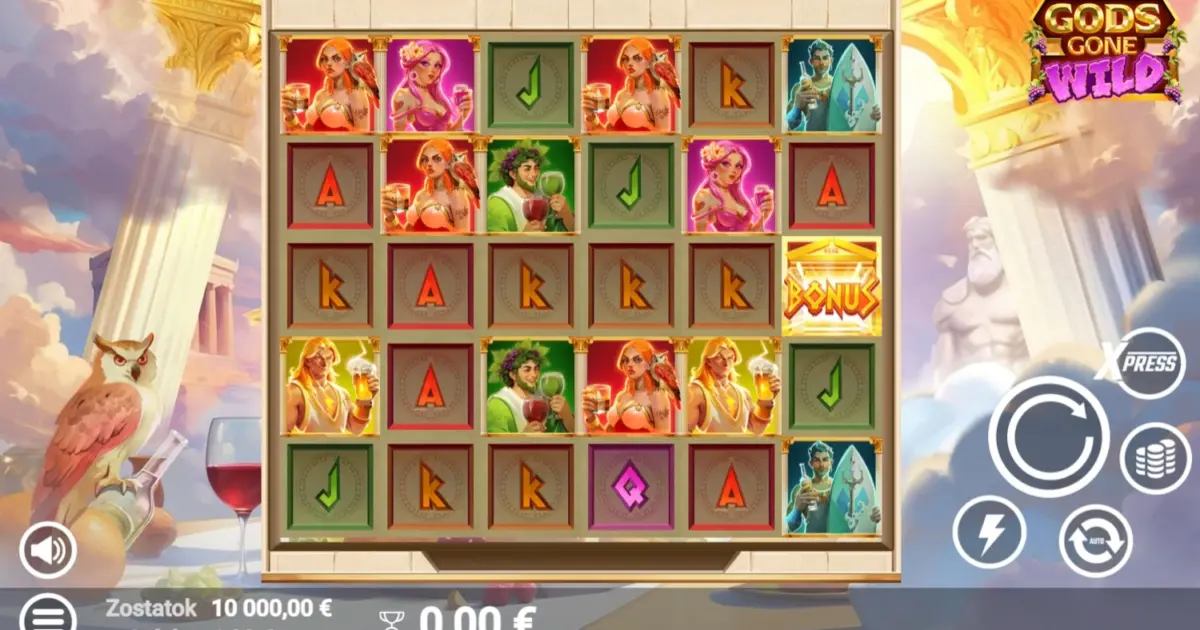
Gods Gone Wild Slot is a 6-reel title from AvatarUX that pairs a Food theme with a below-average return figure. If you compare on maths first and theme second, the headline here is the 94% RTP and what that means for session length, not the branding.
The 6-reel grid explained
Six reels change the feel of a session compared with the classic five-reel layout. You get a wider window on each spin, which usually means more symbols in view and more positions that must line up for a result. That extra column does not by itself make a game pay more or less; it simply changes how combinations are formed and how often near-misses appear.
In practical terms, a 6-reel grid often stretches the distribution of results. Small, frequent line hits can become slightly less common than on a compact 5×3 board, while the top combinations have even more room to vary. Without published payline or ways data for this title, you cannot assume a specific structure. Many modern 6-reel games use ways or cluster-style evaluation rather than fixed lines, but that is a general design trend, not a fact about this game.
For you, the grid size matters most for readability and pacing. More reels means a busier screen and a slightly longer visual evaluation on each spin. If you prefer a clean, quick read, filter your shortlist to familiar 5-reel formats; if you like a broader canvas, the six reels here are the core mechanical difference to test in the free demo. AvatarUX lists 39 titles in its catalogue, so this layout is one option among many from the same studio, not an outlier format.
Paylines, ways and how gods gone wild slot pays
Facts supplied for this title do not include a payline count, a ways count, or a paytable. That absence matters, because the number and direction of evaluated lines is what decides how often symbols connect. Without it, no review can credibly describe how this specific game pays, and you should be wary of any site that lists a payline figure without a source.
In general terms, slots pay in a few well-established ways. Traditional paylines evaluate left to right along fixed paths; you need matching symbols on consecutive reels along a lit line. Ways systems evaluate any matching symbols on consecutive reels regardless of exact row, which increases the number of possible paths. Cluster or scatter-pays systems look for groups or counts anywhere. Each approach changes hit frequency and variance, but the RTP stays the independent mathematical target across the chosen mechanic.
What you can do is treat the missing payline information as a prompt to check the in-game help screen before you assign any budget. Open the demo, look at the info or pays page, and note whether wins pay left to right only, both ways, or as scatters. Also note how wilds and scatters behave as concepts in many slots — wilds often substitute for standard symbols and scatters often relate to feature triggers — without assuming those behaviours are present here. If the rules are not clearly shown, that itself tells you how transparent the presentation is, and whether you want to spend time learning it.
94% RTP put in context
AvatarUX publishes 94% RTP for Gods Gone Wild. RTP is a long-run statistical average: the amount the game is designed to return across many millions of spins. At 94%, the model returns £94 per £100 wagered on average across that huge sample, which leaves a 6% house edge in theory. It does not predict your session, where variance dominates.
Context helps. The average RTP across the provider’s own catalogue is 95.78%, and the average across the wider corpus tracked here is 95.71%. At 94%, this title sits 1.71 points below the corpus average and 1.78 points below AvatarUX’s own average. Those gaps are material over volume. Over 10,000 spins at £1 a spin, the expected return at 94% is £9,400 versus £9,571 at the corpus average — a £171 difference in expectation. Over 1,000 spins the gap is £17.10. Again, these are averages, not guarantees for any block of play.
To see the opportunity cost, compare direct peers from the same provider and theme. Pop O Gold at 96% and 80sPop at 96.01% both sit two full points higher than Gods Gone Wild from the same studio, which means a lower theoretical cost per spin over time. In the Food theme, BBQ Rush at 96.33% also outpaces it. No single number makes a game good or bad, but RTP is the one figure that compounds every spin, so a lower number should raise your bar for what else the game offers to justify the extra theoretical cost.
| Figure | Value |
|---|---|
| Provider | AvatarUX |
| RTP | 94% |
| Reels | 6 |
| Primary theme | Food |
| Other themes | 6-Reels |
| Provider average RTP | 95.78% |
| Corpus average RTP | 95.71% |
| Popularity rank | 2530 |
| Provider game count | 39 |
Volatility and hit patterns
No volatility rating has been published in the facts for Gods Gone Wild, so there is no official low, medium or high label to use for planning. When volatility is undeclared, the most honest approach is to explain what the scale does in general and how you can infer feel without inventing a rating for this title.
Volatility describes the shape of returns. Low volatility tends to produce smaller swings, more frequent but smaller hits, and a steadier session that suits tighter budgets or longer play at low stakes. High volatility tends to produce larger swings, longer gaps between meaningful hits, and a higher chance of both extended downswings and occasional large upswings, which usually demands a larger bankroll for the same number of spins. Medium sits between, trading some steadiness for some swing. Importantly, volatility does not change RTP; a 94% game can be low or high volatility and still target the same long-run average.
Without a declared figure, two signals sometimes help, neither of which is available here: a published hit frequency percentage and the paytable balance between low and high symbols. Since neither is in facts, avoid any site that assigns this game a volatility label from thin air. Your best proxy is to run a structured demo sample: fix a stake, run 100–200 spins, and note how often any win lands and how deep the drawdowns get. That gives you a personal sense of tempo without assuming the maths, and keeps expectations tied to observed session texture rather than a guessed label.
Choosing a stake between undisclosed limits
The facts block for Gods Gone Wild does not include a minimum or maximum stake, so there is no published bet range to quote. That is common on aggregator pages that list RTP and reels but omit stake limits, which are often set per operator or jurisdiction. The lack of a figure is itself useful: you will need to check the in-game controls or the lobby before you plan a bankroll, rather than relying on a review.
In general, stake mapping is straightforward maths. Decide total entertainment budget for the session, decide how many spins you want, and divide the first by the second to get the per-spin stake that fits your plan. For example, £50 for 250 spins suggests £0.20 a spin; £100 for 500 spins also suggests £0.20. Keep stakes flat. No progression — martingale, up-after-loss, up-after-win — changes expected value, because each spin is independent and the RTP is fixed regardless of history.
On a 6-reel game, consider whether you want a slightly larger buffer than you would bring to a simpler 5×3. Not because six reels are automatically more volatile, but because any unfamiliar layout benefits from extra spins to learn pacing without pressuring decisions. If the operator shows a wide range, test the lower end in the Gods Gone Wild free demo first to see how spin count feels, then decide if the entertainment per pound matches peers with higher RTP. If the range is narrow, that also tells you who the game is built for.
Demo play versus real money
Free demo play is available for this title, which is the cleanest way to answer most pre-play questions without cost. In demo mode you spin with play credits, see the grid, read the info pages, and gauge speed and clarity. What demo play does not do is predict real-money results or change the maths; short-term outcomes remain random and independent in both modes, and a good run in demo does not make real money more likely to follow.
Use the demo as a checklist rather than a chase. Confirm the 6-reel layout and how it reads at your chosen screen size, check whether the paytable clarifies lines or ways, and note the tempo of hits over a couple of hundred spins at a flat stake. Treat those observations as comfort and usability checks. The only number you should trust for long-run cost is the published RTP, which applies equally to demo and real-money versions where the rules are the same.
18+; treat slots as paid entertainment, not a way to make money. Set a budget and a time limit before you start, and stop when either is reached. If you feel you are chasing or spending more than you planned, step away and use support tools or self-exclusion options where you play. Availability of the demo does not imply any advantage in real-money play.
Verdict on Gods Gone Wild
Gods Gone Wild is a 6-reel Food slot from AvatarUX slots with a published 94% RTP that sits below both the provider average of 95.78% and the corpus average of 95.71%. Its appeal rests on the six-reel canvas and theme rather than on the maths, which is straightforwardly below average on return. Popularity at rank 2530 around the 87th percentile suggests many players browse past it, so you are not missing a widely favoured staple by skipping it.
Missing facts also shape the verdict. No paylines or ways count, no volatility label, and no published max win or stake limits are in the data, which means you cannot model hit frequency or bankroll depth from a review alone and must check the game help pages directly. In a crowded Food theme and within AvatarUX’s own 39-game catalogue, higher-return alternatives with similar casual appeal exist and are easy to find.
Try the demo if the theme draws you in, but compare price. If you value long-run cost, favour titles at 96% or above; if you value the six-reel feel, confirm the rules in the demo and keep stakes flat while you learn it. Either way, judge this one on verified numbers rather than on branded excitement, and you will make a cleaner choice.
Frequently Asked Questions
Can I play Gods Gone Wild for free without risking real money?
Free demo play is listed as available for Gods Gone Wild, so you can spin with play credits to check the 6-reel layout and in-game help. Demo mode uses the same rules as real play where offered, but outcomes are still random and carry no real payouts. Use it to learn the interface, not to judge future results.
What is the RTP of Gods Gone Wild and what does it mean for my session?
The published RTP is 94%, meaning the game is designed to return £94 per £100 wagered across many millions of spins, leaving a 6% theoretical house edge. That figure is a long-run average, not a session promise. In practice, any 100 or 1,000-spin block can finish well above or below that line.
What is the volatility of Gods Gone Wild — is it low, medium or high?
No volatility rating is provided in the facts for Gods Gone Wild, so there is no official low, medium or high tag to quote. Volatility shapes swing size and hit pattern but does not change the 94% RTP. Until AvatarUX publishes a rating, rely on the in-game paytable balance and a flat-stake demo sample for feel.
Who makes Gods Gone Wild and what else do they offer?
Gods Gone Wild is made by AvatarUX, credited with 39 titles and an average provider RTP of 95.78%. The studio's other games include 80sPop at 96.01% and King of Samba at 96.16%, both higher than this title's 94%, giving you direct same-provider alternatives if RTP is your primary filter.
How does Gods Gone Wild compare with other Food-themed slots?
Gods Gone Wild is in the Food theme with a 6-reel grid and 94% RTP, which sits below Food peers like BBQ Rush at 96.33%, Lucky Turkey at 97.17% and Emotional Damage at 96.09%. If theme is your draw, those peers offer the same broad category with lower theoretical cost per spin over a large sample.