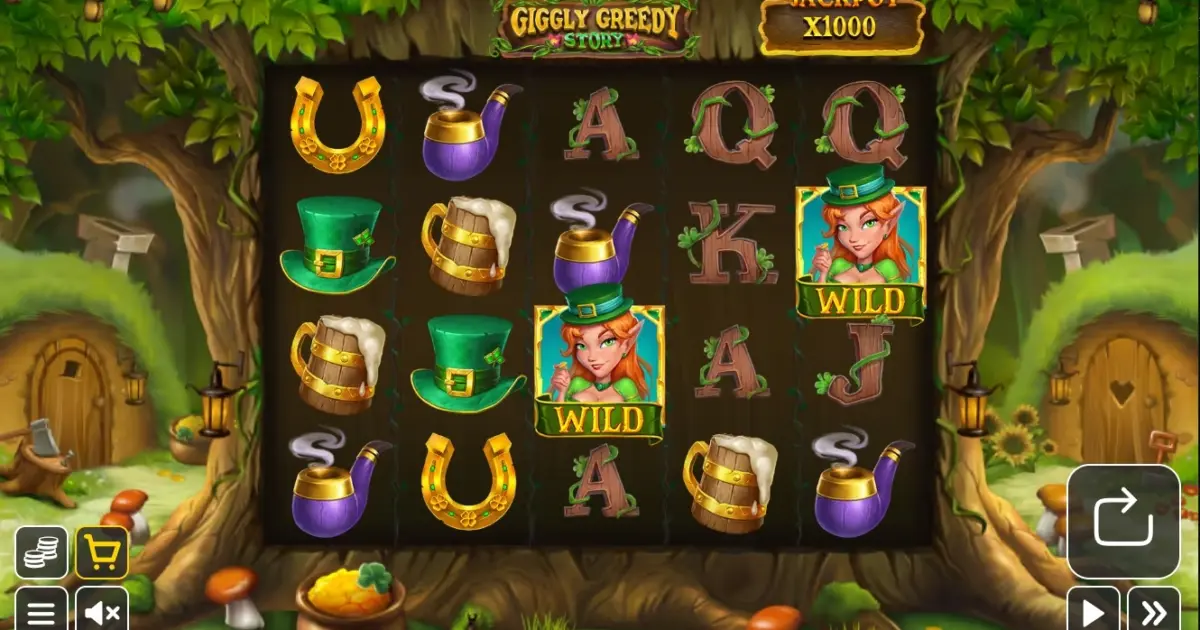
Gamebeat’s Giggly Greedy Story slot delivers 96.08% RTP on a five-reel grid with an Irish theme. It ranks inside the 96% bracket where most players will find a workable long-run return, but the game omits several figures that matter for session planning. The free demo is available if you want to test the feel before committing a deposit.
The 5-reel grid explained
Five reels is the standard configuration across the majority of modern online video slots, and Giggly Greedy Story follows that convention without deviation. The practical effect is a wide enough symbol field to support layered combinations, cascading pays or expanding symbols — though this specific title’s feature set has not been itemised in the available data.
The grid gives you between three and five rows depending on the title, and that row count directly determines how many symbols can land per spin. If this game uses four rows, for example, you are evaluating twenty symbol positions at once. Without a published paytable structure, you cannot confirm whether that layout favours left-to-right sequences or scattered cluster formations.
For comparison, Gamebeat’s own Fortune of Flint: Back for Gold runs the same five-reel framework at a marginally higher 96.23% RTP, so the provider is not reserving its best maths for one format alone.
| Provider | Gamebeat |
|---|---|
| RTP | 96.08% |
| Reels | 5 |
| Theme | Irish |
| Free demo | Yes |
Paylines, ways and how Giggly Greedy Story pays
Gamebeat has not published a payline count, ways configuration, or cluster mechanic for this title. That absence means you are reading a review of the maths layer without the structural layer — something that affects how you should weight the RTP figure below.
In general terms, a fixed-payline slot concentrates your probability mass onto a smaller number of predetermined paths. Fewer paylines mean fewer simultaneous chances to hit, but when a win lands it typically involves more matching symbols. Ways and cluster formats spread probability across dozens or hundreds of paths, producing more frequent but usually smaller individual returns.
The practical consequence for you is this: without knowing whether this game uses twenty lines or 243 ways, you cannot predict whether your sessions will feel like occasional larger hits or steady small payouts. The RTP stays the same either way, but the texture of your gameplay changes substantially. Demo play is the only way to determine that for yourself.
96.08% RTP put in context
At 96.08%, Giggly Greedy Story sits 0.37 percentage points above the corpus average of 95.71% but 0.10 points below Gamebeat’s provider average of 96.18%. The provider manages 64 titles, so this slot is essentially mid-pack within its own catalogue.
RTP is a long-run mathematical expectation: across roughly one hundred thousand spins or more, the game returns 96.08 units for every 100 wagered. Over a single 200-spin session, your actual return can deviate wildly from that figure in either direction. That is not a flaw — it is the nature of randomness in a game with no memory between spins.
Within the Irish-theme category, which contains 391 indexed games, the return here is neither exceptional nor poor. Leprechaun Wish offers 97.20% RTP on the same theme, which is a full 1.12 percentage points better. If theoretical return is your primary filter, that gap is worth noting before you commit.
Gold Party also sits above this game at 96.50%, so Giggly Greedy Story trails the top Irish-theme candidates on RTP. It is not the worst choice, but it is not the strongest either.
Volatility and hit patterns
No volatility rating has been published for this slot, and that is the most significant data gap in the review. Without it, you cannot determine how the 96.08% RTP will actually distribute across your sessions.
Volatility describes the variance of outcomes per unit time. A low-volatility game with this RTP would return small wins frequently, producing a slow, steady decline in your bankroll. A high-volatility game with the same RTP would stretch long dry spells between occasional larger payouts, requiring more patience and a deeper starting balance to survive the swings.
Hit frequency would also be relevant here — it tells you how often any winning combination lands per spin. That figure is absent too. You can infer that the demo lets you build your own rough impression, but a short sample of fifty or even two hundred spins cannot reliably distinguish medium from high variance.
Until Gamebeat publishes a rating, treat this as a game whose risk profile you must discover through play rather than reading. Plan conservatively.
Choosing a stake without published limits
Gamebeat has not listed a minimum or maximum bet range for this title. The absence of stake data means you cannot calculate a session duration from your bankroll before you open the game.
As a general framework: most online slots in this category operate within £0.10 to £100 per spin, but you must confirm the actual boundaries in-game. Once you know the minimum stake, divide your session budget by that figure to get a baseline number of spins. If your budget is £50 and the minimum is £0.20, that gives you 250 spins before the balance is exhausted even without any wins.
The practical advice is straightforward. Start at the lowest stake the game permits. Watch how the base game feels — its rhythm, its dead spins, its win sizes — before you consider increasing. Raising a stake mid-session does not change the RTP or the odds. Each spin is independent of the last, regardless of what came before it.
Demo play versus real money
The free demo of Giggly Greedy Story is available to play without a deposit, and that matters. You can test the reel mechanics, observe the win frequency with your own eyes, and determine whether the presentation holds your interest before risking anything.
Demo outcomes use the same random number generator as the real-money version, but the psychological experience is not equivalent. When no money is at stake, you will likely spin more freely, stay longer, and feel less pressure during losing streaks. None of that tells you how the game will actually behave on your budget with real balance at risk.
This game ranks 856th by volume, with a popularity percentile of 95.7 — it draws enough attention to appear in catalogues but is not among the most-played titles on this site. The Irish-slot niche is competitive, with hundreds of alternatives to compare.
If you decide to play for real money, set a session budget before you spin, treat the cost as entertainment spending, and stop when that budget is gone. This is a paid experience, not an income source. Players must be 18 or over.
Verdict on Giggly Greedy Story
The honest summary: 96.08% RTP is acceptable but unremarkable, and Gamebeat has not published the volatility, hit frequency, payline structure, or stake range that would let you plan a session with confidence. You are getting a five-reel Irish-theme slot in the middle of the pack on theoretical return, but missing most of the structural detail that separates informed play from guessing.
It plays in a crowded field. If you are choosing purely on published numbers, Leprechaun Wish offers 1.12 percentage points more return on the same theme, and Gold Party offers 0.42 more. Those gaps compound over long sessions.
What you should do: play the Giggly Greedy Story free demo for at least one hundred spins and build your own read on the rhythm. If the presentation and pacing work for you, the RTP is high enough that no responsible player would reject it outright. If it does not, the 391 other Irish-themed slots in the index give you plenty of alternatives to test.
Frequently Asked Questions
Can I play Giggly Greedy Story for free without signing up?
The free demo is confirmed available, so you can play without downloading or registering a deposit account. Demo mode uses the same underlying maths as the real-money version, letting you evaluate the five-reel layout and game rhythm before deciding whether to wager actual funds.
What does the 96.08% RTP mean for a 500-spin session?
Across 500 spins at a fixed £1 stake, 96.08% RTP predicts an aggregate return of £480.40, or a net loss of £19.60 — but that is the expected average over an enormous sample, not a prediction for your individual session. Real results over 500 spins can land far above or below that line due to variance.
Does Gamebeat publish a volatility rating for this slot?
No volatility rating has been released, which is a meaningful gap. Without it you cannot assess whether the 96.08% RTP will arrive as frequent small returns or rare large hits. You will need to build that understanding through your own demo sessions, keeping in mind that a few hundred spins provide limited statistical evidence.
How does Giggly Greedy Story compare to other Irish-theme slots?
Within the 391 games tagged to the Irish theme, this title sits below several stronger options. Leprechaun Wish delivers 97.20% RTP and Gold Party offers 96.50%, both meaningfully above the 96.08% figure here. If you prioritise theoretical return, those alternatives are worth comparing directly.
Can demo wins on Giggly Greedy Story be withdrawn as real money?
Demo credits carry no cash value and cannot be withdrawn. The demo exists to let you observe the gameplay mechanics and assess whether the 5-reel, Irish-themed presentation holds your attention. Any transition to real-money play requires a separate deposit with a licensed operator.




