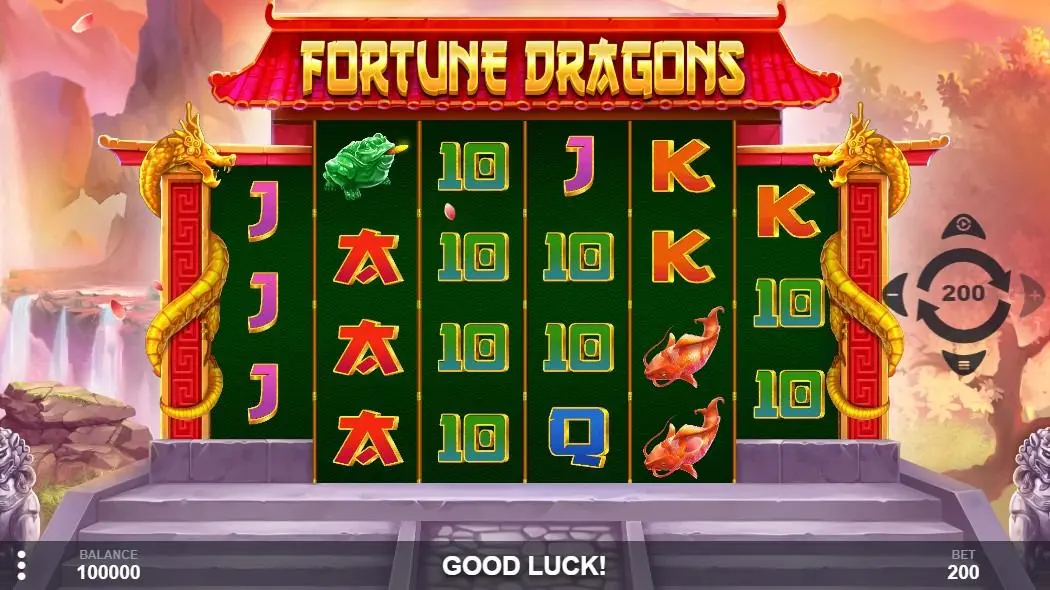
The headline figure on this game is a below-average one. At 94.56%, the published return sits 1.15 percentage points under the average across the games in our database, and just under a point below what PariPlay itself averages across its catalogue. That does not make the game unplayable, but it does mean the theoretical cost of a long session here is measurably higher than on a mid-90s alternative.
What follows is what the published numbers on the fortune dragons slot actually imply for a real bankroll, what PariPlay has and has not disclosed, and how it stacks up against comparable Fortune-themed titles. A free demo is available, so you can watch the reels behave before any money is involved.
Fortune Dragons versus the average slot
The gap is 1.15 percentage points. Expressed in money, the average slot in our corpus returns £95.71 per £100 wagered over a very large sample, while this one returns £94.56. The difference of £1.15 per £100 sounds trivial and is trivial on a handful of spins. It is not trivid over volume.
Work it through. Wager £1 per spin for 1,000 spins and you have staked £1,000. The long-run expectation on 94.56% is a return of £945.60, versus £957.10 at the corpus average — a spread of £11.50 on identical action. Push that to 10,000 spins and the gap becomes £115. Nothing about any individual session will follow that curve, because RTP is an average measured across enormous samples and every spin is an independent event with no memory of the last one. But when you are choosing between games before you start, the RTP gap is the one variable you control entirely, and it is free to choose the better side of it.
Worth noting: PariPlay’s own catalogue average is 95.53%, so this title also sits below the studio’s own typical standard. It is not representative of what the provider usually ships.
RTP breakdown: 94.56% in context
Read 94.56% as a long-run statistical average, not a promise about your session. It is derived from the game’s maths model over millions of simulated spins. Across a very large sample, £100 wagered returns £94.56 and the house retains £5.44. Over 200 spins at £0.50, you will land somewhere on a wide distribution around that figure — possibly well above it, possibly at zero.
| Specification | Detail |
|---|---|
| Game name | Fortune Dragons |
| Provider | PariPlay |
| RTP | 94.56% |
| Reels | 6 |
| Theme | Fortune, 6-Reels |
| Type | Slot Machine |
| Popularity rank | 1664 (91.7th percentile) |
| Free demo | Available |
The table above is the complete set of published specifications. PariPlay has not released a max win figure, a hit frequency, a volatility rating or a paytable breakdown for this title, so treat any such numbers you see quoted elsewhere with real caution — they are not coming from the provider. The absence of a stated max win is itself informative: without it you cannot estimate how much of the 94.56% return is concentrated in rare outcomes versus spread across frequent small ones. Those two designs feel completely different to play at the same RTP.
Volatility profile
No volatility rating has been published for this game, so anyone telling you it is high or low is guessing. What can be said is what the reel count implies and what volatility does generally.
Volatility describes the shape of the distribution around the RTP figure, not its size. A low-volatility game pays small amounts often; your balance drifts down slowly with regular top-ups, sessions run long on a given budget, and the swings are shallow. A high-volatility game pays rarely and larger; balances can fall for hundreds of spins before anything meaningful lands, and the same budget buys far fewer spins of comfortable play. Both can share an identical 94.56% return.
Six reels is a wider grid than the traditional five. Many six-reel designs use expanded ways-to-win or cluster mechanics rather than fixed paylines, which tends to produce more frequent low-value combinations — but this game’s specific mechanic is not documented, so that is a general observation about the format, not a claim about this title. The practical takeaway: size your bankroll for the higher-variance case. If you plan a session assuming shallow swings and the game turns out to be spiky, you run out early. Twenty minutes in the demo will tell you more about the rhythm than any guess from the specs.
PariPlay as a studio
PariPlay has 59 games in our database with an average RTP of 95.53%. That puts the studio slightly below the 95.71% corpus average overall — a reasonably consistent mid-range operation rather than a high-RTP specialist. This particular release lands close to a full percentage point below the studio’s own mean, which makes it one of the weaker returns in the catalogue rather than a typical example of it.
If you like the provider but want better maths, the studio has stronger options. Bloodshot Rising Spirit runs at 96.23%, which is 1.67 percentage points above this game — worth £16.70 per £1,000 wagered in long-run expectation. Emeralds of Oz sits at 96.21%, effectively the same tier. Viking Glory at 95.97% is a smaller but still clear improvement.
None of that says the studio’s games play alike. It says that within one catalogue you can pick up nearly two points of theoretical return without leaving the provider, which is the cheapest edge available to any player.
Three Fortune alternatives worth comparing
The Fortune theme covers 542 titles in our database, so there is no shortage of comparison points. Three are worth a direct look.
Fortune Tiger publishes 96.81% — that is 2.25 percentage points above this game, the largest gap of the three, and the strongest theoretical return in this comparison set. Mystic Fortune Deluxe is close behind at 96.71%. Either would return roughly £22 more per £1,000 staked across a very large sample.
Maneki Fortunes is the odd one out: no RTP figure has been published for it. That is a genuine gap rather than a hidden strength, and an unpublished return is a reason for caution, not curiosity. Compare it in demo mode if the theme appeals, but you cannot assess its maths.
Ranked 1664 and inside the 91.7th percentile for popularity, this title gets played more than most. Popularity and player return are unrelated measures, though — a well-trafficked game with a 94.56% return is still a 94.56% return.
Getting the most out of the free demo
The Fortune Dragons free demo runs on play credits with no download and no deposit, which makes it the sensible first stop. Use it to answer the questions the spec sheet cannot: how often do wins land, how deep do the dry stretches run, does the six-reel grid produce frequent small hits or long gaps, and does the pace suit you at all.
One firm limit on what demos tell you. Demo results do not predict real-money outcomes. A hot streak in play credits is variance, not a signal, and the same is true of a cold one — each spin is independent and carries no information about the next.
This is 18+ entertainment you pay for, like a cinema ticket. Decide the amount before you open the game, treat it as spent the moment you do, and stop when it is gone rather than when it feels like something is about to change. Nothing is ever about to change; the maths is identical on every spin.
Should you play Fortune Dragons?
Play the demo, yes. Commit a real bankroll only if you have a specific reason to prefer this game over better-returning alternatives, because the numbers do not make the case on their own.
The case against is straightforward. A 94.56% return is 1.15 points below the corpus average and around a point below PariPlay’s own catalogue average, and there are Fortune-themed titles publishing over 96.7% and PariPlay titles above 96.2%. On top of that, no volatility rating, hit frequency or max win figure has been published, so you are choosing a below-average return without the disclosure that would let you judge how it plays.
The case for is preference. If the six-reel format and the theme click for you in the demo, that enjoyment is a legitimate reason to choose it — you are buying entertainment, and the 1.15-point gap costs about £11.50 per £1,000 wagered in long-run expectation. Just make it a choice you made with the number in front of you rather than one you made by accident.
Frequently Asked Questions
Can you play Fortune Dragons for free?
A free demo is available, running on play credits with no download and no deposit needed. It is the best way to judge the six-reel grid's pace and hit rhythm before staking anything. Bear in mind that demo results carry no predictive value for real-money play — every spin is independent, in demo mode and otherwise.
What is the RTP of Fortune Dragons?
PariPlay publishes 94.56%, meaning £94.56 returned per £100 wagered across a very large sample, with £5.44 retained by the house. That sits 1.15 percentage points below the 95.71% corpus average. Over 10,000 spins at £1, that gap represents roughly £115 in long-run expectation compared with an average-returning game.
Is Fortune Dragons high or low volatility?
No volatility rating has been published for this title, so any figure quoted elsewhere is not sourced from PariPlay. Six-reel grids often produce more frequent low-value combinations, but that is a general observation about the format rather than a documented feature here. Plan your bankroll for the higher-variance case and test the rhythm in the demo.
Who is PariPlay and what other slots do they make?
PariPlay is a studio with 59 games in our database, averaging 95.53% RTP — slightly below the 95.71% corpus average. Their stronger-returning titles include Bloodshot Rising Spirit at 96.23%, Emeralds of Oz at 96.21% and Viking Glory at 95.97%, all of which beat this game's 94.56% by a clear margin.
How does Fortune Dragons compare to Fortune Tiger?
Fortune Tiger publishes 96.81% against this game's 94.56% — a gap of 2.25 percentage points, or roughly £22.50 per £1,000 wagered in long-run expectation. Mystic Fortune Deluxe is similar at 96.71%. On published maths alone, both are the stronger picks within the Fortune theme, which spans 542 titles.