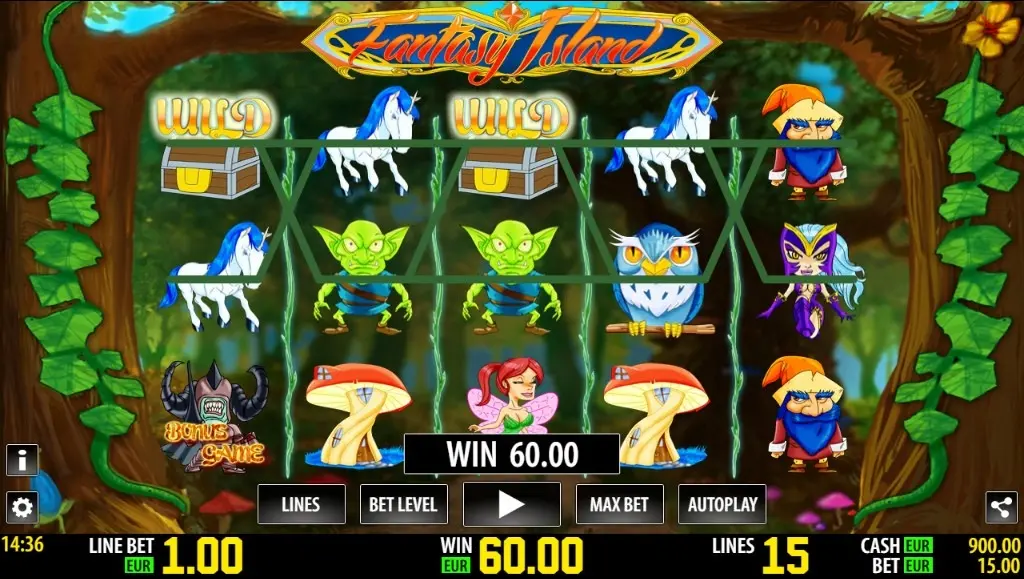
Fantasy Island is worth a look if return-to-player is high on your checklist, because its 97.49% figure is unusually strong for a modern 5-reel game. The fantasy island slot does not publish volatility or stake limits, so the decision comes down to whether a high theoretical return and free-demo access outweigh the lack of detail on risk and session behaviour. Try the demo first and compare the maths below before committing a bankroll.
Is Fantasy Island slot worth playing?
Fantasy Island makes its case almost entirely on the numbers. At 97.49% RTP it returns £97.49 per £100 wagered across a very large sample, which is 1.78 percentage points above the corpus average of 95.71% and 1.88 points above Worldmatch’s own average of 95.61% across 112 titles. That edge is meaningful when you compare hundreds or thousands of spins, even though any single session can still finish well above or below the average because each spin is independent.
Popularity is middling at rank 2,187, which puts it around the 89th percentile for visibility in a large catalogue — known enough to be found, but not a chart-topper. Worldmatch is an established provider with a broad catalogue, so availability and basic polish are not the concern here. The trade-off is transparency: without a published volatility rating, hit frequency, or max-win figure, you cannot model how choppy the ride will feel or what the ceiling looks like. If you prefer games where the risk profile and limits are spelled out up front, that gap matters.
The free demo is available, which is the practical way to answer the worth question for your own taste. Use it to see how often the 5-reel layout pays, how long a fixed bankroll lasts at a comfortable stake, and whether the pacing suits you. The high RTP does not promise profit in a short session, but it does mean the long-run theoretical cost per spin is lower than for most alternatives. For value-focused players who can tolerate some unknowns, that is a solid starting point.
What 97.49% RTP means over 1,000 spins
RTP is a long-run statistical average, not a forecast for your next session. A 97.49% RTP means that for every £100 wagered, the game is designed to return £97.49 over millions of spins, keeping £2.51 as the house margin. Over a smaller sample such as 1,000 spins the actual return will swing around that average, sometimes materially.
To make that concrete, take a stake of £1 per spin. Wagering £1,000 over 1,000 spins has a theoretical return of £974.90 at 97.49%, for a theoretical loss of £25.10. At £0.20 per spin the same 1,000 spins cost £200 in total wagers, with a theoretical return of £194.98 and a £5.02 theoretical loss. At £2 per spin the totals double to £2,000 wagered and £1,949.80 returned. These are averages, not guarantees; you could finish ahead or behind by a wide margin in any one set of 1,000 spins.
Context helps. The corpus average is 95.71%, which would return £957.10 per £1,000 wagered, so Fantasy Island’s 97.49% RTP is about £17.80 better per £1,000 wagered in theoretical terms. Against Worldmatch’s provider average of 95.61%, the advantage is about £18.80 per £1,000 wagered. The gap widens the longer you play, but it never turns a negative-expectation game into a positive one — the house margin remains, just smaller than usual.
Because every spin is independent, there is no pattern that changes expected value. Short-term variance dominates, which is why two players can each do 1,000 spins at the same stake and see very different results. Treat the RTP as a way to compare long-run cost, not as a predictor of the next 10 or 100 spins.
How volatile is Fantasy Island?
Worldmatch has not published a volatility rating for Fantasy Island, and no volatility figure appears in the available facts. That absence is itself useful information: you should not assume it is low, medium or high, and you should be cautious about any site that assigns it a label without a source.
Volatility as a concept describes the shape of returns, not the size of the RTP. Low volatility generally means more frequent but smaller wins and a smoother bankroll line, which can stretch session time on a fixed budget. High volatility generally means fewer winning spins, larger swings, and a greater chance of long losing runs punctuated by bigger payouts when they arrive. Medium sits between the two. Many slots use this spectrum to signal how much bankroll you may need to ride out dry spells, but without an official rating you cannot place Fantasy Island on that spectrum with confidence.
What you can do is frame your expectations around the unknown. If you prefer predictable session length, assume a wider range of outcomes until you have demo experience or a paytable that clarifies win distribution. If you prefer big swings, the same uncertainty applies — you cannot count on high-volatility behaviour being present. In either case, the 97.49% RTP tells you about long-run average return, not about how bumpy the path will be.
Other common volatility proxies are also unpublished here: hit frequency, average bonus trigger rate, and max win are not in the facts block. Without them, the most honest approach is to test the free demo at a single stake and note how often pays occur and how quickly balance moves, remembering that demo play shows mechanics but does not predict real-money results.
What the 5-Reels theme brings to the game
The theme tag for Fantasy Island is 5-Reels, which is a mechanical label rather than a narrative one. It tells you the game uses a five-reel layout, the standard format for most modern video slots, but it does not by itself describe characters, settings, or artwork. You can expect the familiar five vertical columns that spin and stop to form combinations, but specific symbols, backgrounds or story elements are not detailed in the facts provided.
In general terms, a 5-reel structure allows for a range of payline or ways configurations. Some 5-reel slots use a fixed number of paylines where wins follow defined lines from left to right; others use ways-to-win where matching symbols on adjacent reels count. Fantasy Island’s facts do not state its payline count or whether it uses ways, so you should check the in-game info panel for that detail rather than assuming one system or the other.
What a 5-reel tag does not tell you is how features work. Many slots include wilds that substitute for other symbols, scatters that pay or trigger regardless of paylines, or free spins found in many modern titles — these are common concepts, but they are not confirmed as features of this specific game in the data provided. Treat the 5-Reels label as a format indicator and look to the demo and help screens for anything beyond the reel count.
For comparison purposes, 5-reel games from the same provider can play very differently despite sharing the same reel count, so the label is a starting point for expectations, not a full description of behaviour.
Stakes, session length and bankroll
No minimum stake, maximum stake, or stake range has been published in the facts for Fantasy Island, so session planning has to stay at the level of principles rather than exact limits. When limits are known, you would normally divide your session budget by your chosen stake to estimate how many spins you can absorb, then adjust for volatility once that is known. Here, both the allowable stakes and the volatility are unpublished, so the best you can do is set a total budget first and use the demo to find a comfortable bet size within the game itself.
A practical starting point is to decide how many spins you want from a session and work backwards. For example, a £50 budget at £0.50 per spin funds 100 spins if every spin were a loss, while the same budget at £0.20 funds 250 spins — before accounting for any returns. Returns will extend play, but the starting division gives you a floor for how long entertainment can last. Because each spin is independent, no pattern of raising or lowering stakes changes the expected value; it only changes how quickly balance moves.
The high 97.49% RTP lowers theoretical cost per spin compared with average titles, but it does not remove variance. Over 1,000 spins at £1, the theoretical loss is about £25.10 as shown earlier, yet real outcomes cluster widely around that figure in the short term. Bankroll management in this context is about comfort, not edge: choose a stake where a run of non-winning spins would still feel acceptable as paid entertainment.
Until Worldmatch publishes stake limits and volatility, treat any numbers quoted elsewhere with caution and verify inside the game lobby. If you cannot see the limits before loading the demo, that is worth noting as a gap in pre-play information.
| Feature | Detail |
|---|---|
| Game name | Fantasy Island |
| Provider | Worldmatch (112 games, avg RTP 95.61%) |
| RTP | 97.49% (1.78 pp above corpus avg 95.71%) |
| Reels | 5 reels |
| Category | Slot Machine — 5-Reels |
| Popularity rank | 2,187 (89th percentile) |
| Free demo | Available |
| Volatility / Max win / Paylines | Not published in facts |
Alternatives if Fantasy Island is not for you
If the lack of published volatility or limits puts you off, staying within Worldmatch gives you options with more conventional RTP bands. Monte Carlo Jewels runs at 96.2% RTP, still above the provider average but a touch below Fantasy Island, which may suit players who prefer a known mid-range return with a different presentation. It keeps you in the same provider ecosystem while trading a little theoretical return for variety.
For a lower-RTP contrast that shows how much the 97.49% figure matters, Bloody West is also from Worldmatch at 94.64% RTP — about 2.85 points lower than Fantasy Island. Over 1,000 spins at £1 that difference is roughly £28.50 more in theoretical cost, which makes the cost-of-play comparison tangible if you are weighing long-run value over theme.
Another Worldmatch alternative is Blue Diamond (World Match) at 93.31% RTP, further below both the corpus and provider averages. Trying its demo alongside Fantasy Island can show how two 5-reel games from the same studio can feel different even when the reel count matches, and it highlights why checking the in-game help for paylines and features is worthwhile before choosing where to spend a session budget.
Final take
Fantasy Island’s headline is its 97.49% RTP on a standard 5-reel layout from a provider with a large catalogue. That return is well above both the corpus and Worldmatch averages, which lowers long-run theoretical cost per spin compared with most slots you will encounter. The counterweight is missing information: without published volatility, paylines, max win or stake limits, you are buying on RTP and format alone.
That makes the free demo more than a nice extra — it is the sensible way to fill the gaps. Load the demo, set one stake, and watch how often wins land and how the balance behaves over 100–200 spins. Use what you see to decide if the pacing fits your preference, but remember demo play does not predict real-money outcomes and every spin remains independent.
If you value high theoretical return and a straightforward 5-reel setup, Fantasy Island deserves a trial on the strength of the maths alone; if you need a fully documented risk profile before you play, wait until more details are published or pick an alternative where they are.
Play responsibly. You must be 18+ to gamble. Set a budget before you start, treat slots as paid entertainment not a way to make money, and stop when that budget is spent. If you need support, use a trusted help service in your country.
Frequently Asked Questions
Can I try Fantasy Island for free before I wager?
Yes, a free demo is listed as available for Fantasy Island. The demo lets you explore the 5-reel layout and check the paytable in your browser without staking real money. Demo play shows how the game flows but does not predict real-money results, as each spin is independent and random.
What is the RTP of Fantasy Island and what does it mean?
Fantasy Island has a 97.49% RTP, which is 1.78 points above the corpus average of 95.71% and above Worldmatch's average of 95.61%. It means a theoretical return of £97.49 per £100 wagered over a very large sample, with a £2.51 house margin. Short-term results will vary widely around that average.
How volatile is Fantasy Island and what does that mean for my session?
No volatility rating is published for Fantasy Island in the available facts, so its risk profile cannot be confirmed. Volatility describes how often and how large wins tend to be, affecting bankroll swings and session length. Without an official rating, use the free demo to gauge how choppy the balance feels and budget for a wide range of outcomes.
Who makes Fantasy Island and what else do they offer?
Fantasy Island is by Worldmatch, a provider with 112 games in the data set and an average RTP of 95.61% across those titles. Related Worldmatch slots include Monte Carlo Jewels at 96.2%, Bloody West at 94.64% and Blue Diamond (World Match) at 93.31%, giving you a spread of returns to compare.
What stake range does Fantasy Island support and how should I plan a bankroll?
The facts block does not publish a minimum or maximum stake for Fantasy Island, so limits must be checked inside the game lobby. As a guide, divide your session budget by your chosen stake to estimate spins funded before returns — for example £50 at £0.50 funds 100 spins. Every spin is independent, so no staking pattern alters expected value.