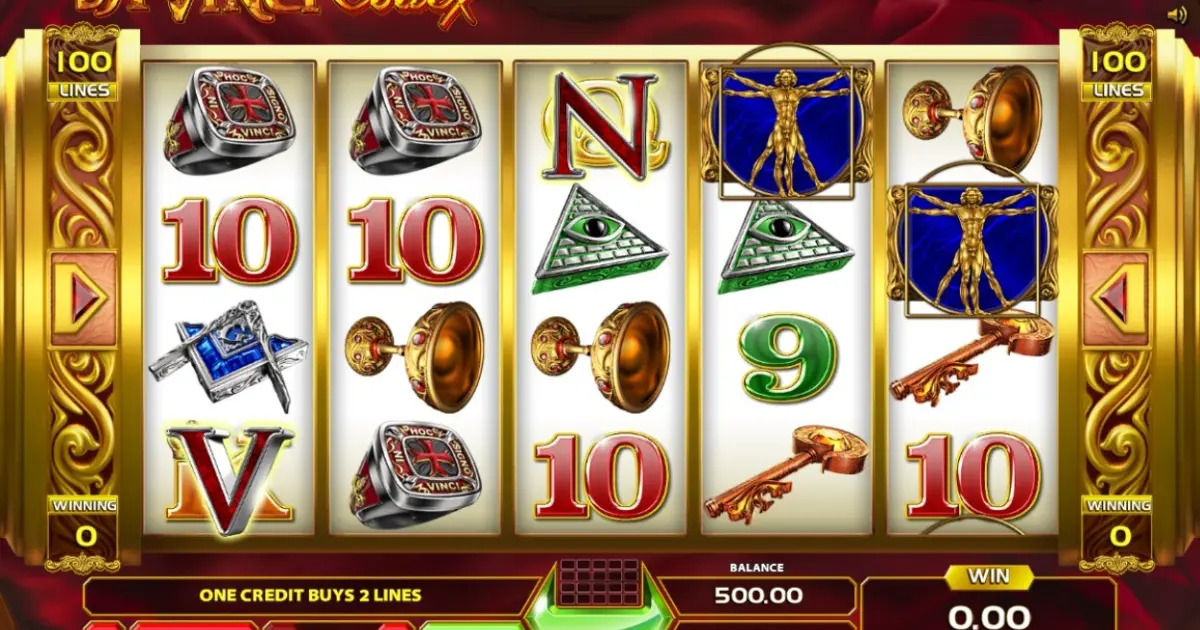
The number that matters most on this game is 94%. That is the theoretical return, and it sits 1.71 percentage points under the 95.71% average across the slots catalogued on this site, and 2.08 points under GameArt’s own average of 96.08% across their 178 titles. If you are comparing releases purely on published return, this is not the strongest option in the provider’s range — and a free demo is available, so you can spend time with it without committing money.
First look at Davinci Codex
Davinci Codex is a five-reel release from GameArt, filed here under the Slot Machine subcategory. It ranks 1873 in our popularity data, which places it in the 90.6th percentile — meaning it draws more attention than roughly nine in ten of the games we track. Popularity and payout percentage are separate things, and this game is a clear example of the gap between them.
What FACTS does not include is worth naming plainly. There is no published paylines or ways figure, no volatility rating, no stake range, no maximum win, and no release date. GameArt has not made those numbers available in the data behind this page, so you will not find them stated here. If you see a max win multiplier or a hit frequency percentage quoted for this title elsewhere, treat it as unverified until the provider publishes it. The theme label is simply “5-Reels”, which describes the layout rather than any setting or artwork, so there is nothing here to support a description of characters, symbols or soundtrack.
That leaves you with two solid facts to work from: five reels, and a 94% return. Both are useful. Neither tells you whether you will enjoy the game, which is what the demo is for.
| Provider | GameArt |
|---|---|
| RTP | 94.0% |
| Reels | 5 |
| Free demo | Yes |
How a round plays out
The mechanics available in FACTS are the reel count and nothing more. A five-reel layout is the standard modern arrangement, and it is the framework almost every feature set gets built on top of. Beyond that, describing what happens when you press spin on this specific game would mean inventing detail, so here is the general picture instead.
Most five-reel slots resolve a spin the same way. Symbols land, the game checks them against a fixed set of winning patterns — paylines running left to right, or a “ways” system that counts matching symbols in adjacent reels regardless of row — and pays whatever qualifies. Many titles layer wilds that substitute for other symbols, scatters that trigger free spins from anywhere on the grid, and multipliers that scale a win by a fixed factor. Some sell direct access to a bonus round for a set multiple of your stake.
Whether any of that appears in Davinci Codex is not something the published data answers. Load the demo and you will know inside a couple of minutes. What is certain is the underlying maths: each spin is generated independently, and the previous outcome has no bearing on the next one. There is no sequence, warm-up period or pattern to read.
Reading the 94% return figure
A 94% RTP means the game is built to return £94 for every £100 wagered, measured across a sample far larger than any individual will ever play. The house edge is the other 6%. That figure is a long-run average from millions of simulated spins, not a promise about your afternoon.
Scale it to something concrete. At £0.50 a spin, 1,000 spins puts £500 through the game. The mathematical expectation returns £470 of that, for an average cost of £30. Ten thousand spins at the same stake stakes £5,000 and expects to cost £300. Those are averages, not schedules — real sessions land above and below, sometimes by a wide margin, and short runs deviate heavily from the theoretical figure in both directions.
Now the comparison. Against the 95.71% corpus average, the difference is 1.71 points, or £1.71 more expected cost per £100 wagered. Against GameArt’s own 96.08% average, it is £2.08 per £100. Over a few dozen spins that gap is invisible. Over thousands, it compounds into a real difference in how long a fixed bankroll lasts. 94% is the single most decision-relevant fact on this page.
Why unstated volatility changes your bankroll maths
GameArt has not published a volatility rating for this title, so the risk profile is unknown going in. That is a genuine gap, because volatility affects your session far more visibly than RTP does.
Two games can share an identical 94% return and feel nothing alike. A low-volatility build pays small amounts often, so your balance drifts down in a fairly straight line and a modest bankroll stretches a long way. A high-volatility build pays rarely but larger, which means long dry stretches punctuated by occasional bigger hits — and it needs a deeper bankroll to survive those stretches without running out. Medium sits between the two.
Without a rating, the demo becomes your measuring instrument for feel rather than for outcomes. Run a few hundred spins at a fixed stake and watch the shape of the balance line. Frequent small returns point one way; long flat stretches point the other. That tells you what session length to plan for, but it says nothing about what money play will do — demo results carry no predictive weight for real-money outcomes. Treat the observation as a comfort check, not a forecast.
Bet sizing from an unpublished minimum upwards
The stake range is not in the published data either, so the minimum and maximum bet are unknown until you open the game. Check the betting panel before your first spin rather than after.
The arithmetic that matters does not depend on knowing the range in advance. Decide your total budget first, then divide by the number of spins you want from it. A £40 budget across 400 spins sets your stake at £0.10. Want 800 spins from the same £40? That halves it to £0.05. Working backwards from spins to stake keeps session length under your control, rather than letting the stake decide when the session ends.
One thing to be clear about: no staking pattern changes the 6% house edge. Raising your bet after losses, lowering it after wins, or switching stakes on a timer alters the size of the swings and nothing else. Expected value stays fixed because every spin is independent of the last. Pick a stake you are comfortable repeating several hundred times and leave it there.
Where Davinci Codex sits among 5-Reels slots
Within GameArt’s catalogue this is a below-average performer on published return, and the gap is easy to quantify. Sweet FTN runs at 96.55%, which is 2.55 points higher and works out at £2.55 less expected cost per £100 staked. Kukulkan’s Queen sits at 96.06%, effectively matching GameArt’s house average of 96.08%. Both are stronger picks on the return figure alone.
Dynamite Fruits Deluxe is another GameArt release, though no RTP has been published for it, so it cannot be compared on that basis at all. An unpublished figure is not a good one or a bad one — it is simply an unknown, and worth treating with the same caution as any other missing number.
Popularity tells a different story from payout here. This game’s 90.6th-percentile ranking shows genuine player interest despite the 94% return, which is a common pattern: presentation, familiarity and feature design pull players in regardless of the published percentage. If return is your primary filter, the two GameArt titles above are the better starting point. If something about this one appeals, the demo costs nothing to find out.
The honest verdict
Davinci Codex is a five-reel GameArt slot with a 94% published return and a thin public data sheet. No volatility rating, no stake range, no paylines figure, no max win. That combination makes it hard to recommend on numbers, because the one number you do have is the weakest of the three comparisons available: below GameArt’s 96.08% average, below the 95.71% corpus average, and clearly below both stablemates listed above.
Where it earns a look is the free demo. You can assess the pacing, the feature set and the general feel at no cost, which is exactly the right way to fill in the gaps the published data leaves open. Just keep the demo’s limits in mind — it shows you the game, not your results.
Slots are 18+ and priced entertainment, not a way to make money. Decide what the session is worth to you before you start, stake at a level that fits that figure, and stop when it is spent. If tracking the spend stops being straightforward, that is the moment to close the game.
Short version: a 6% house edge is 6% whatever the theme, and better-value GameArt options are one click away. Try the demo out of curiosity, and if you move to real money, go in knowing the return figure you accepted.
Frequently Asked Questions
Can you play Davinci Codex for free?
A free demo of Davinci Codex is available, so you can spin it without staking money. That matters here because the published data for this GameArt title is thin — no volatility rating, no stake range, no paylines count — and the demo is the quickest way to see the mechanics and pacing for yourself before deciding anything.
What is the RTP of Davinci Codex?
The RTP is 94%, meaning the game is designed to return £94 per £100 wagered across an extremely large sample of spins. The remaining 6% is the house edge. That is 1.71 points below the 95.71% average across the slots listed here and 2.08 points below GameArt's own 96.08% average.
Is Davinci Codex high or low volatility?
GameArt has not published a volatility rating for this title, so the risk profile is unknown before you play. That gap is worth noting, because volatility drives how quickly a bankroll moves. Running a few hundred demo spins at a fixed stake will show you the shape of the swings, though demo results never predict real-money outcomes.
Who is GameArt and what other slots do they make?
GameArt is the studio behind Davinci Codex, with 178 titles in our database and an average published RTP of 96.08%. Their range includes Sweet FTN at 96.55% and Kukulkan's Queen at 96.06%, both notably above this game's 94%. Dynamite Fruits Deluxe is another release, though no RTP figure has been published for it.
How much should I bet per spin on Davinci Codex?
The stake range is not in the published data, so check the betting panel when the game loads. Set your budget first, then divide by the spins you want: £40 across 400 spins means £0.10 per spin. No staking pattern alters the 6% house edge, since every spin is independent of the one before.