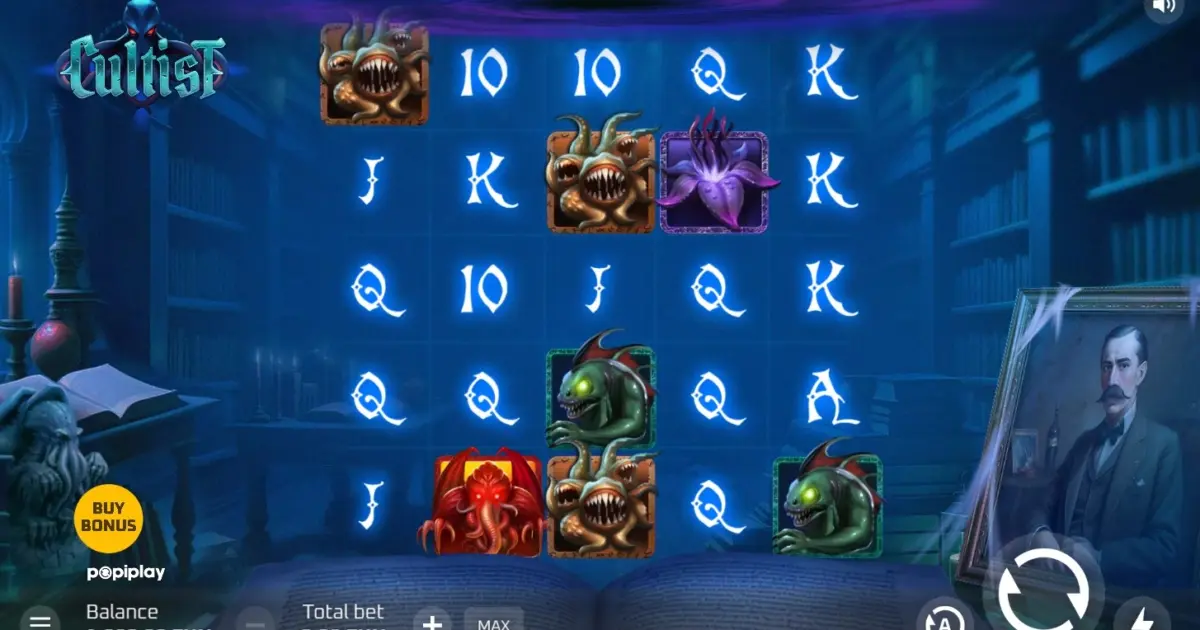
If you want a high-RTP option without chasing a top-100 chart hit, Cultist is worth a look. This cultist slot returns 97.14% across a very large sample, 1.43 points above the corpus average of 95.71% and a touch above Popiplay’s own average of 96.61%. You can try the Cultist free demo on this page with no download and see whether its 5-reel setup fits how you like to play.
Cultist at a glance
Cultist is a 5-reel Slot Machine from Popiplay, listed under an Ocean and sea primary theme with additional tags for Animals, Horror and scary, and 5-Reels. It sits at rank 2616 on the site, which puts it at the 86.9th percentile for popularity — played, but not crowded, which often means less recycled opinion and more room to judge the numbers for yourself.
The headline figure is 97.14% RTP from a provider catalogue of 76 games where the average is 96.61%. Against a site-wide corpus average of 95.71%, Cultist is meaningfully above the middle. That does not make it a guarantee on any single session; RTP is a long-run statistical average calculated over millions of spins, and your short sample can land well above or below it. What it does tell you is that, within Popiplay slots, this title keeps less of every £100 wagered on average than the provider mean.
What is not listed is volatility, stake range, hit frequency and max win. Popiplay has not published a volatility rating for this title in the FACTS supplied, and no minimum or maximum stake, jackpot tier or bonus structure is included. Missing data is itself a signal: treat any claim about a multiplier cap or “high volatility” label you see elsewhere as unverified until Popiplay confirms it. For comparison on RTP alone, Amazon City Of Gold at 97.04% sits just below Cultist within the same provider stable, while Big Bass Bonanza at 96.71% is a lower-RTP Ocean and sea alternative from the wider collection.
What a 97.14% RTP actually returns
RTP reads as pence returned per pound wagered, averaged over a very large number of spins. At 97.14%, the theoretical return is £97.14 for every £100 staked, with the house retaining £2.86. The corpus average of 95.71% would return £95.71 for the same £100, retaining £4.29. The gap looks small as a percentage, but over volume it compounds.
Put it through a concrete sample to see what the figure does and does not promise. Because FACTS does not list a minimum stake for Cultist, use a hypothetical £0.20 minimum to illustrate the maths only — this is not the game’s actual stake. Over 1,000 spins at £0.20 you would wager £200 in total. At the stated 97.14% RTP, the long-run expected return on that £200 is £194.28, for a theoretical net loss of £5.72. At the corpus average of 95.71%, the same £200 wagered would be expected to return £191.42, a £8.58 theoretical loss. That 1.43-point advantage trims the expected loss by £2.86 per £200 wagered in this example.
That is the average, not your session. Every spin is independent, so variance can swing you far from expectation in either direction over 1,000 spins, let alone over 100. A 97.14% RTP does not imply more frequent wins, larger wins, or a better chance of finishing ahead on the day; it describes the mean outcome if you could replay that 1,000-spin sample an enormous number of times. Where it helps your decision is in comparing like-for-like options: if you like Ocean and sea slots and you are choosing between two otherwise similar games, the one at 97.14% keeps £1.43 less per £100 wagered on average than a game at 95.71%. Over months of play, that difference matters more than any single bonus trigger. Also note that many providers publish multiple RTP configurations for the same title in different markets, so always check the version your casino loads; the 97.14% figure here is the one supplied for this review version.
Unlisted volatility and what your session will feel like
No volatility rating is provided for Cultist in the FACTS, so you cannot infer its risk profile from a label. That absence matters more than a generic definition, because volatility shapes how a session feels week to week, even when RTP is identical.
In general slot terms, low volatility tends to produce smaller, more frequent fluctuations and longer time on device for a given bankroll, while high volatility tends to produce wider swings, longer stretches without a notable return, and a greater bankroll requirement to weather the variance. Medium volatility sits between the two. Those are concepts, not claims about this game — many slots do use those patterns to tune experience, but without a published figure for Cultist you should not assume which pattern applies here.
What you can do is read the missing label as a prompt to be conservative in planning. If you go in expecting high volatility and the game is actually low, you will have over-budgeted time, which is harmless. If you expect low and it is high, you risk burning through a session early. Without a rating, size your bankroll for the wider swing and let the demo tell you how the pacing feels for you, while remembering that a short demo cannot map the full distribution of outcomes.
For context on how volatility interacts with RTP: two games can share the same 97.14% RTP and still feel very different. One might recycle small returns often, the other might cluster return into rarer larger events. Both average to the same long-run figure, but they demand different staking discipline. Until Popiplay publishes a volatility figure for Cultist, treat any third-party “high” or “low” badge as unverified.
The 5-reel layout and how wins are counted
Cultist uses 5 reels, the most common reel count for modern video slots. In general, five reels give providers room to offer either fixed paylines or “ways” systems, and to spread symbols across a grid that most players will find familiar to navigate. FACTS does not list a payline count, ways count, row count or reel height for this title, so you cannot assume a specific number of lines or a 243-ways structure.
How wins are counted always depends on that missing detail. Many slots pay left-to-right on adjacent reels starting from the leftmost reel, with some paying both ways or using cluster mechanics, but those are general possibilities, not facts about this game. Without a published paytable and line map, the only safe statement is that five reels determine how many vertical columns of symbols land per spin; everything else about line geometry is unconfirmed here.
What the 5-reel label does let you compare is catalogue fit: Cultist aligns with the bulk of Popiplay’s 76-title portfolio and with the 527 Ocean and sea slots tracked on site, so switching between this game and another 5-reel Ocean and sea slot like Pearls of Aphrodite at 96.81% will feel structurally familiar even if the maths differs. If reel layout is a key comfort factor for you, the demo is the quickest way to see how the grid size and symbol spacing read on your device.
| Item | Figure |
|---|---|
| Game | Cultist (Popiplay) |
| RTP | 97.14% |
| Provider average RTP | 96.61% (76 games) |
| Corpus average RTP | 95.71% |
| RTP vs corpus | +1.43 points |
| Reels | 5 |
| Primary theme | Ocean and sea |
| All themes | Ocean and sea, Animals, Horror and scary, 5-Reels |
| Popularity rank | 2616 (86.9th percentile) |
| Free demo | Available (no download) |
Stake range and sizing a bankroll
FACTS does not include a minimum or maximum stake, nor a default coin value or bet-level structure for Cultist, so concrete staking advice has to stay general. When no range is published, you cannot calculate minimum bankroll from pence-per-spin to duration without seeing the actual controls in the game client.
In general terms, stake range determines two things: how long a fixed bankroll lasts at a given spin count, and what percentage of your bankroll each spin represents. A useful way to frame any slot session — Cultist included — is to decide a total budget for the entertainment, then consider how many spins that budget buys at the smallest stake the game actually loads. If the game later reveals a £0.10 minimum, £20 buys 200 spins before variance; at £0.20, the same £20 buys 100 spins. Those are illustrations of how maths works, not claims about this title’s limits.
Until the range is confirmed, keep sizing cautious. Avoid stake progressions that claim to “recover” losses or change expected value; every spin is independent and the 97.14% RTP already embeds that independence over a large sample. If you prefer to compare on staking flexibility, Dogmasons MegaWOOF at 96.80% is another Popiplay title where you can check the published range side by side once Cultist’s controls are visible, but do not assume similar limits.
Playing the cultist slot demo before you commit
The free demo for Cultist is available with no download, which lets you check the 5-reel presentation, the Ocean and sea theming, and the basic pacing on your device before you stake anything. Demo play uses the same reel logic as the review version where the 97.14% RTP is quoted, but it is still play money — it cannot predict how a short real-money session will land, and it does not change the house edge.
Use the demo to answer practical questions: does the grid read clearly on mobile, do the controls suit you, and is the tempo comfortable for the length of session you prefer. You can also watch how often modest returns recycle versus longer quiet spells, while remembering that a few hundred demo spins are a tiny slice of the distribution that produces the long-run RTP.
Set a budget before you switch to real money and treat slots as paid entertainment, not a way to make money. You must be 18+ to gamble. Decide a fixed amount you are comfortable spending, use deposit or time limits if they help, and stop when the budget is gone. If you feel you are chasing losses or playing longer than planned, take a break and seek support if you need it.
Verdict: who should play Cultist
Cultist suits players who put RTP near the top of the list and like Ocean and sea theming on a familiar 5-reel frame. At 97.14% RTP it is a stronger-than-average return on paper, 1.43 points above the site corpus and above Popiplay’s own average, which is a clear, numbers-based reason to prefer it over lower-RTP peers if theme and layout are equal for you.
It is less suited to players who need a known volatility profile or a confirmed stake range before budgeting. Without those figures you are working with “unknown swing” and “unknown minimum,” which means sizing your bankroll for the wider variance and confirming limits in the client. That is workable, but it is not ideal if you want to plan session length precisely from the review alone.
Try the demo if the theme appeals and the RTP advantage matters to you. If you find the pacing comfortable and the controls fit your budget once loaded, Cultist earns a spot in a rotation where long-run return matters more than chasing a single headline feature. If volatility disclosure is essential to how you choose, keep it on a watchlist until Popiplay publishes that rating.
Frequently Asked Questions
Can I play Cultist for free before wagering real money?
Yes, the Cultist free demo is listed as available with no download on this page. Free play lets you check the 5-reel layout and Ocean and sea presentation on your device using play money. Demo spins do not predict real-money results, and every spin remains independent.
What is the RTP for Cultist and what does 97.14% mean?
Cultist is supplied at 97.14% RTP, which is a long-run average return of £97.14 per £100 wagered over millions of spins. It sits 1.43 points above the corpus average of 95.71% and above Popiplay's 76-game average of 96.61%, which trims expected loss per £100 compared with lower-RTP alternatives.
What volatility is Cultist and how risky is it?
FACTS does not list a volatility rating for Cultist, so risk profile is unconfirmed. In general, low volatility favours smaller frequent swings and longer time on device, while high volatility brings wider swings and larger bankroll needs. Without a published figure, size your budget for wider variance and use the demo to gauge pacing.
Who makes Cultist and what else does the provider offer?
Cultist is by Popiplay, a provider with 76 titles tracked and an average RTP of 96.61%. Related Popiplay games for RTP comparison include Amazon City Of Gold at 97.04% and Dogmasons MegaWOOF at 96.80%, both slightly below Cultist on the headline return figure supplied here.
Can you win real money playing the Cultist demo?
Demo play does not pay real money; it uses play funds and is for evaluation only. Real-money play requires a stake at a casino that hosts Cultist. The 97.14% RTP applies to the review version and describes long-run theoretical return, not the outcome of any single session or demo sample.