If you want the short answer: the city of sound slot carries a published RTP of 96.25%, runs on five reels, and comes from Play’n GO, a studio with 434 titles in our database. It sits at rank 2848 for popularity, which puts it in the top 15% of games people actually look up. A free demo is available, so you can see how it behaves before any money is involved.
The 5-reel grid explained
Five reels is the default shape of modern online slots, and it matters more than it sounds. A five-reel layout gives the maths room to spread wins across a wider set of symbol combinations than a three-reel machine, which is why five-reelers tend to produce more frequent, smaller outcomes interrupted by occasional larger ones rather than a flat drip of identical payouts.
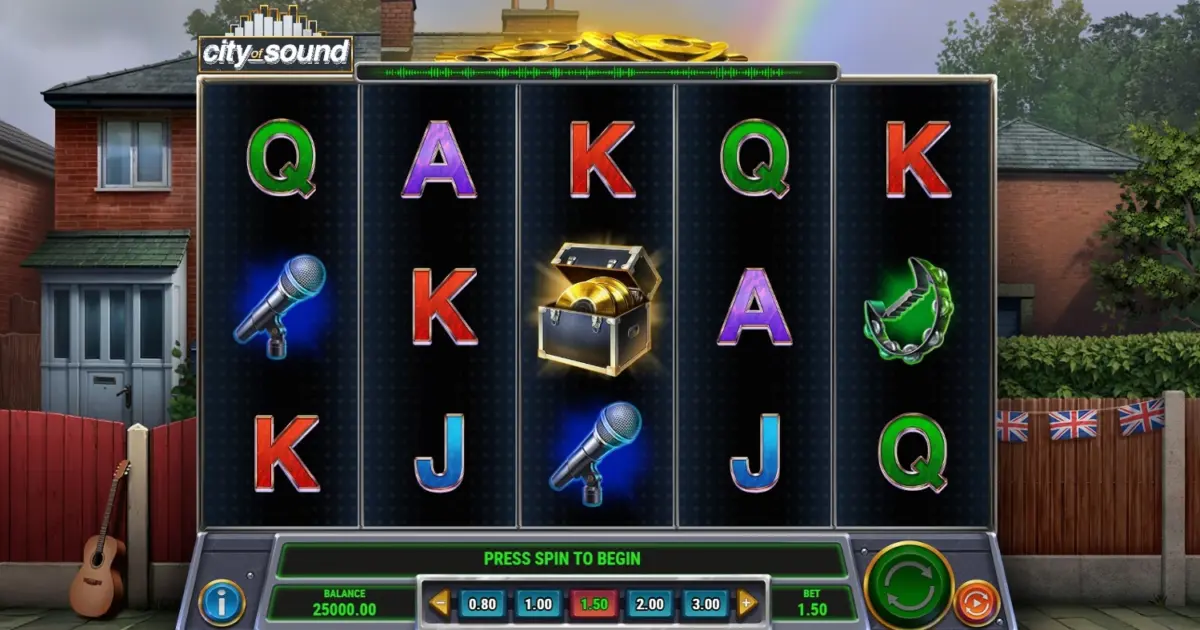
Play’n GO has not published a row count for this title in the data available here, and that gap is worth noting rather than guessing around. Row count changes the number of possible symbol positions, so a five-by-three grid and a five-by-four grid behave differently even at identical RTP. Load the demo and count the rows yourself; it takes one spin.
What five reels does not tell you is anything about win size. Reel count is geometry, not generosity. Two games with the same grid can differ enormously in how their returns are distributed, which is why the RTP and volatility figures further down carry far more weight for your session than the layout does.
Paylines, ways and how City of Sound pays
The payline or ways count for this game is not recorded in the data set, so treat any specific number you see quoted elsewhere as unverified. Here is what the general mechanics mean so you can read the paytable quickly when the demo loads.
Fixed-payline games award wins when matching symbols land on defined patterns, usually left to right. Many slots use 10, 20 or 25 lines. Others use an all-ways or cluster model, where any matching symbols on adjacent reels pay regardless of position, which produces more small hits and a different rhythm to the session. A third family uses expanding grids where the number of ways changes spin to spin.
Wilds, scatters and free-spin rounds are common across all three families, and buy-feature buttons appear in a growing number of releases. None of that is confirmed for this title, so check the in-game info screen rather than assuming. Whatever the structure turns out to be, it is already priced into the 96.25% figure: paylines change how returns arrive, not how much arrives over the long run.
96.25% RTP put in context
Return to player is a long-run statistical average, not a session promise. At 96.25%, the theoretical return is £96.25 for every £100 wagered across a very large number of spins, with the remaining £3.75 forming the house edge. Over 500 spins at £1, expect wide scatter around that figure in either direction.
| Figure | Value |
|---|---|
| Provider | Play’n GO |
| RTP | 96.25% |
| Reels | 5 |
| Primary theme | Music |
| Category | Slot Machine |
| Popularity rank | 2848 (top 14.3%) |
| Provider average RTP | 95.8% |
| Database average RTP | 95.71% |
| Free demo | Available |
That 96.25% is 0.54 points above the 95.71% average across every game in the database, and 0.45 above Play’n GO’s own 95.8% average. Half a point sounds trivial; on £2,000 of total wagering it is about £10 of expected difference. Inside the studio’s catalogue, Legacy of Dead edges ahead at 96.58%, while Book of Dead trails at 94.25% despite being the better-known name.
Volatility and hit patterns
No volatility rating is published for this game, which is a genuine information gap. Volatility describes how returns are distributed over time, and it affects your session far more directly than RTP does. Two games at 96.25% can feel like completely different products.
Low volatility means frequent small wins, slow bankroll movement and longer play for a given deposit. High volatility means long stretches returning nothing, punctuated by larger payouts, and it demands a bankroll several times deeper for the same number of spins. Medium sits between the two.
Without a stated figure, the demo is your best instrument. Play 200 or 300 spins at a fixed stake and watch how often the balance ticks up at all, and how deep the flat stretches run. That gives you a rough feel for hit frequency even though it proves nothing statistically.
One thing worth stating plainly: every spin is independent. A dry run does not make a payout more likely, and no game is ever due, hot or cold. The random number generator has no memory of what came before.
Choosing a stake between the game’s minimum and maximum
The bet range for this title is not listed in the data available, so confirm the minimum and maximum in the demo before depositing. Play’n GO titles typically span a broad range, but the specific limits here are unverified.
The arithmetic that matters is independent of the exact numbers. Decide your session budget first, then divide. A £50 budget at £0.20 a spin buys roughly 250 spins before variance is accounted for; the same £50 at £2 a spin buys 25. On a game with no published volatility rating, the shorter session carries far more uncertainty in outcome, because there are fewer spins for results to average out.
A practical approach is to pick a stake where your budget covers at least 100 spins, then leave it fixed. Changing stake size mid-session does not alter expected value in either direction, because each spin is priced at the same 3.75% house edge regardless of what came before it. Stake progression systems cannot change that maths.
Demo play versus real money
The City of Sound free demo runs the same game engine and the same RTP as the paid version, so it is an honest look at the mechanics, the paytable and the pace. What it cannot do is predict your real-money results. A lucky demo run and an unlucky one are both samples too small to mean anything, and the credits are not convertible.
Use the demo for the things it does well: confirming the grid layout, reading the feature rules, finding the bet range, and deciding whether the rhythm of the game suits you. If you find yourself bored in the demo, real stakes will not fix that.
Slots are paid entertainment for adults 18 and over, not a way to make money. Set a budget you are comfortable losing before you start, treat it as the cost of the session, and stop when it is gone rather than topping up. If the spending stops feeling like a choice, step away and use the deposit limits and self-exclusion tools your operator provides.
Verdict on City of Sound
This is a solid, slightly above-average pick on the numbers that are confirmed. The 96.25% return beats both the Play’n GO catalogue average of 95.8% and the 95.71% figure across every game here, and a popularity percentile of 85.7 suggests it has found a real audience rather than sinking without trace.
The reservations are about missing information rather than poor design. No published volatility rating, no payline count and no stated bet range means you are going in with less to plan around than usual, and you should verify all three in the demo before committing anything.
If the music theme is the draw, it is one of 266 titles in that category here, and Disco Beats offers a higher 96.62% return if RTP is your deciding factor. If you want the better return from the same studio without changing theme too drastically, Legacy of Dead remains the stronger mathematical choice. For a music-led five-reeler, though, this one holds up.
More from Play'n GO
- Legacy of Dead — 96.58% RTP
- Crystal Hall — 96.2% RTP
- Reactoonz — 96.51% RTP
- Fire Joker — 96.0% RTP
- Divine Divas — 96.25% RTP
- Moon Princess Origins — 96.2% RTP
- Rise of Olympus — 96.0% RTP
- Moon Princess — 96.0% RTP
Frequently Asked Questions
Can I play City of Sound for free without downloading anything?
A free demo is available for this title and runs in the browser, so no download or account is needed to try it. The demo uses the same engine and the same 96.25% RTP as the real-money version, which makes it a reliable way to check the paytable, grid layout and pace before you deposit.
What does the 96.25% RTP on City of Sound actually mean?
It means a theoretical return of £96.25 for every £100 wagered, measured across a very large number of spins. The remaining 3.75% is the house edge. Over a short session the real figure can land well above or well below that, because RTP describes long-run averages rather than any individual run of spins.
How volatile is City of Sound?
Play'n GO has not published a volatility rating for this game, so it cannot be stated here. Volatility governs how returns are spread over time: low means frequent small wins, high means long dry runs and occasional larger payouts. Running 200 or more demo spins at a fixed stake will give you a rough feel.
Who is Play'n GO and what else do they make?
Play'n GO is the studio behind this title and has 434 games in our database, averaging 95.8% RTP. Their best-known release is Book of Dead at 94.25%, while Legacy of Dead returns 96.58%. Divine Divas matches this game exactly at 96.25%, so the catalogue spans a fairly wide return range.
How does City of Sound compare with Disco Beats?
Disco Beats returns 96.62% against 96.25% here, so it holds a 0.37-point edge on paper, worth roughly £3.70 per £1,000 wagered. Both sit in the 266-game music category. RTP is only one input though, and neither game has a published volatility rating, so session feel may matter more than the gap.