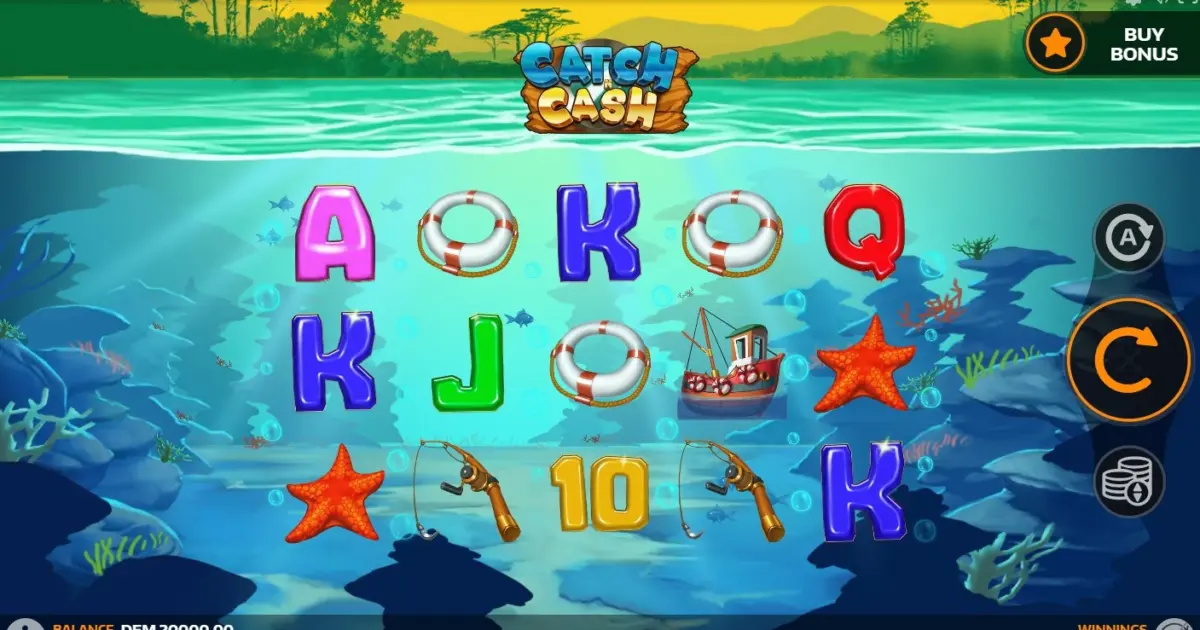
Catch N Cash is a 5-reel Fishing slot from Mancala Gaming with a 95% return to player and free demo available, so you can compare it without spending. That RTP sits 0.71 points below the corpus average, which matters more over thousands of spins than in a single session, but it is still the single most useful number for deciding if the maths suits you. If you want a straightforward Fishing-themed grid to sample for free before deciding, the catch n cash slot is worth a look — just know what the numbers do and do not promise.
The 5-reel grid explained
A 5-reel setup is the most common layout in modern video slots, and Catch N Cash uses it. In general terms, five vertical reels spin independently and then stop to reveal a grid of symbols, usually with three or four rows visible per reel. What matters for you is not the reel count alone but how it combines with paylines or ways to determine how often combinations can form and how the game feels to play.
Providers use the 5-reel format because it balances readability and variety. With five reels there is room for a clear paytable, for wilds and scatters to appear without crowding the screen, and for wins that require three, four or five matching symbols on adjacent reels. That structure does not by itself tell you whether wins will be frequent or rare — that depends on the volatility and hit frequency that the studio sets behind the scenes.
For session planning, the practical implication of a 5-reel grid is familiarity. If you have played other 5-reel games you will recognise how the grid resolves, how paylines are read left to right, and how your balance updates after each spin. Every spin remains independent, so the reels do not become more or less likely to pay after a run of wins or losses. Mancala Gaming has not published reel height, symbol distribution or hit frequency for this title, so treat any specific claim about how the grid behaves beyond the 5-reel count with caution.
Paylines, ways and how Catch N Cash pays
FACTS for this title confirms 5 reels and the Fishing theme but does not list a payline count, a ways count, or a paytable, so the exact way Catch N Cash forms wins has not been disclosed in the data available for this review. When that information is missing, the best approach is to understand the general mechanics and then check the in-game rules before you play for real.
Many slots use one of two systems. A payline system defines specific lines across the reels — for example 10, 20 or 25 fixed lines — and pays when matching symbols land on a line from left to right starting on reel one. A ways system, often labelled 243 or 1024 ways, pays for matching symbols on adjacent reels regardless of their row position, which typically increases the number of possible winning combinations per spin. Both systems still require you to read wins per the game’s own paytable, which sets which symbols pay and how much three, four or five of a kind returns for your chosen stake.
What you can do on any 5-reel game is open the paytable in demo mode and note three things: how many paylines or ways are active, whether wins pay left-to-right only or both ways, and whether wilds or scatters substitute or trigger features. Many slots include wilds that substitute for standard symbols and scatters that pay anywhere, but that is a general concept and not a confirmed feature of this specific game, so do not assume it applies here. Until payline or ways data is published for Catch N Cash, use the demo to see how wins are evaluated and how your stake relates to any win shown, rather than relying on claims made elsewhere.
95% RTP put in context — catch n cash slot
95% RTP is the long-run statistical average for Catch N Cash, and it needs to be read as an average over a very large sample, not as a promise for your session. Over millions of simulated spins, the game is designed to return £95 for every £100 wagered, keeping £5 as the house edge. Over 100 spins at £1 a stake, that long-run average would imply £95 returned, but in practice any short session can deviate far above or below that figure because each spin is independent and random.
Context helps you judge the figure. Mancala Gaming’s average across its 90 games in this corpus is 95.01%, so Catch N Cash at 95% is essentially in line with its own studio’s typical level, just 0.01 points lower. Against the broader corpus average of 95.71%, it sits 0.71 points below. That gap sounds small, but across volume it compounds: for every £1,000 wagered the expected return is about £7.10 less than the average game, and over 10,000 spins at £1 the difference in expected return would be around £71.
For comparison within the catalogue, Mustang Rush from the same provider is also listed at 95%, so on RTP alone there is no mathematical edge between them. On the Fishing theme, Big Bass Bonanza is listed at 96.71% and Big Catch Bonanza: Perfect Haul at 96.25%, both materially higher than Catch N Cash, which means their long-run house edge is 3.29% and 3.75% respectively versus 5% here. If return is your primary filter, those alternatives have a lower theoretical cost per £100 wagered over time, though they remain negative-expectation games and short-term variance will still dominate any single session.
| Figure | Value |
|---|---|
| Game | Catch N Cash (Mancala Gaming) |
| RTP | 95.0% |
| Reels | 5 |
| Theme | Fishing / 5-Reels |
| Provider average RTP | 95.01% (90 games) |
| Corpus average RTP | 95.71% |
| Difference vs corpus | -0.71% |
| Rank / percentile | 2,182 / 89.1st percentile |
| Free demo | Available |
Volatility and hit patterns
Volatility is not included in FACTS for Catch N Cash, and no hit frequency has been published, so there is no verified figure to describe how swingy this game is. When data is missing, it is important not to fill the gap with an assumption, because volatility shapes bankroll requirements more than any other single feature after RTP.
In general, low volatility tends to mean more frequent but smaller wins, which can extend session length on a fixed budget and produce a smoother balance curve. High volatility tends to mean longer gaps between wins with larger individual payouts when they do land, which requires a bigger bankroll or lower stake to weather the dry spells. Medium volatility sits between those extremes. Hit frequency, where published, tells you how often any win lands, while volatility tells you how large the swings around the RTP average are likely to be. The two are related but not identical.
Without a declared volatility for Catch N Cash, plan conservatively. Use the free demo to observe how the balance moves over at least a few hundred spins at the stake you would actually use, and note whether you see many small returns or long flat stretches punctuated by bigger hits. That observation is not predictive — spins remain random — but it gives you a feel for the variance your budget would need to absorb. If you prefer a known risk profile, choose a game where the provider does publish volatility and hit frequency, because missing data is itself a decision-relevant fact.
Choosing a stake between undisclosed limits
Mancala Gaming has not published a minimum or maximum stake, nor a default bet range, for Catch N Cash in the data available for this review. When stake limits are not disclosed, you cannot accurately model session length or max exposure from the review alone, so the in-game bet panel is the only reliable source.
In general, stake choice interacts with bankroll in a straightforward way. Your total exposure is stake multiplied by number of spins, while variance determines how quickly that exposure can translate into balance changes. A useful way to think about it is in spins, not money alone: divide your session budget by your stake to see how many spins that budget buys. For example, £50 at £0.20 is 250 spins, while the same £50 at £0.50 is 100 spins. More spins gives more time to experience the long-run average, but it does not change the expected return per £100 wagered, which remains 5% house edge at 95% RTP.
Because every spin is independent, no staking pattern — raising after losses, lowering after wins, or using a preset progression — alters expected value. Choose a stake where losing your planned number of spins in a row would still be affordable and would not prompt you to chase losses. When you load the demo or real-money version, confirm the minimum bet, the maximum bet, and the increment steps, and set a hard stop-loss and stop-win for the session before you start. If you cannot find clear bet limits in the game itself, that is a reason to pause and ask support rather than guessing.
Demo play versus real money
Free demo is listed as available for Catch N Cash, which is the most useful tool you have when paytable and volatility details are unpublished. Demo lets you open the paytable, see how wins are evaluated, check the actual bet range on the controls, and get a feel for pace and presentation without financial risk. It runs on the same maths as real-money play in most regulated implementations, but the outcome is still random and demo outcomes do not predict real-money results — a good run in demo does not make a real-money session more likely to pay.
There are practical differences beyond the money. Demo balances are resettable and carry no withdrawal, while real-money play involves deposits, withdrawals, verification and limits set by the operator. If you move from demo to real play, use the same stake you practised with and keep the same expectations: RTP remains 95% in both modes as a long-run average, and variance remains the same.
Play responsibly and treat slots as paid entertainment, not a way to make money. You must be 18+ to gamble in the UK. Set a budget before you spin, use deposit and time limits if you need them, and never chase losses. If you feel you are losing control, use self-exclusion tools or seek support from a recognised organisation. Stopping is always an option, whether you are in demo or playing with real funds.
Verdict on Catch N Cash
Catch N Cash offers a familiar 5-reel Fishing grid from a provider with a large catalogue, but the headline maths is a modest 95% RTP — in line with Mancala Gaming’s own average yet below the broader 95.71% average. For players who filter primarily on return, the related Fishing alternative Bigger Bass Bonanza at 96.71% has a lower theoretical cost per £100 wagered, and even Big Catch Bonanza: Perfect Haul at 96.25% sits higher than Catch N Cash on that single metric.
The bigger caveat is missing information: paylines or ways, volatility, hit frequency, stake range and max win are all unpublished in the available data, which limits how precisely you can plan. That does not make the game unplayable, but it does mean you should verify the paytable and bet panel in the Catch N Cash free demo before committing funds, and decide whether you are comfortable playing without a declared risk profile.
If you enjoy Fishing themes and want to sample a 5-reel Mancala Gaming slot without spend, the demo makes it easy to compare directly against higher-RTP peers. If published volatility and a detailed paytable are important to your decision, weight those gaps accordingly and favour titles where that data is transparent.
Frequently Asked Questions
Can I play Catch N Cash free demo without deposit?
Free demo is listed as available for Catch N Cash, so you can load it and explore the 5-reel grid without risk. Demo uses the same 95% RTP maths as real-money play over the long run, but every spin is independent and demo results do not predict what will happen when you play with real funds.
What does 95% RTP mean for Catch N Cash in practice?
95% RTP means the game is designed to return £95 for every £100 wagered across a very large sample, keeping 5% as house edge. That is 0.71 points below the corpus average of 95.71% and almost identical to Mancala Gaming's 95.01% average. Short sessions will still vary widely around that average.
What is the volatility of Catch N Cash?
Volatility and hit frequency have not been published for Catch N Cash in the available data, so there is no verified risk rating to quote. In general, low volatility favours frequent small wins and longer sessions, while high volatility favours rarer, larger swings. Use the demo to observe balance movement before choosing a stake.
Who makes Catch N Cash and what else do they offer?
Catch N Cash is made by Mancala Gaming, which has 90 games in this corpus with an average RTP of 95.01%. Related titles from the same provider at the same 95% RTP include Mustang Rush, Book of Wealth III and Majestic Wolf, giving you direct same-provider comparisons on the same return level.
How does Catch N Cash compare to Big Bass Bonanza for return?
Catch N Cash at 95% has a higher theoretical cost than Big Bass Bonanza at 96.71%, which returns £96.71 per £100 wagered over a very large sample versus £95 here. That 1.71-point gap means about £17.10 more expected return per £1,000 wagered on Big Bass Bonanza, though both remain negative-expectation games and short-term variance dominates.