Two numbers decide most of this: 96% RTP and six reels running a Megaways engine. That return is a fraction above the 95.71% average across the games in our database, and it matches Reel Play’s own 96.00% average across their 64 titles exactly, so there is no hidden bonus or penalty here relative to the studio’s usual standard. The castle cash megaways slot also ranks at the 89.9th popularity percentile, which tells you people keep opening it — though popularity is a measure of attention, not of how it will treat your balance.
Castle Cash Megaways slot at a glance
Here are the published figures, and only the published figures. Where a row is missing below, it is missing because Reel Play has not put that number into public circulation for this title.
| Figure | Value |
|---|---|
| Provider | Reel Play |
| RTP | 96.00% |
| Reels | 6 |
| Primary theme | Medieval |
| Other theme tags | Fantasy, Megaways, 6-Reels |
| Category | Slot machine |
| Provider average RTP | 96.00% across 64 games |
| Database average RTP | 95.71% |
| Popularity rank | 2,016 (89.9th percentile) |
| Free demo | Available |
No max win figure, no volatility rating, no stake range, no hit frequency and no release date have been published for this game. That absence matters. If you see a specific max-win multiplier or a “high volatility” badge quoted for this title elsewhere, it did not come from the provider, and you should treat it as decoration rather than data. Who does the game suit on the evidence available? Someone who wants a medieval theme, a variable-ways layout, and a return figure that is marginally better than average without being remarkable.
What a 96.0% RTP actually returns
RTP is a long-run statistical average, calculated over millions of simulated spins. It is not a promise about your session, your hour, or your afternoon. At 96%, the theoretical return is £96 for every £100 staked across a very large sample, leaving a 4% theoretical margin to the house.
Work it through. Suppose you place 1,000 spins at £0.20 each. That is £200 of total turnover. The theoretical return on that turnover is £192, implying an expected cost of £8 for those 1,000 spins. Now here is the part that actually shapes your experience: a thousand spins is a tiny sample against the millions used to certify the figure, so your real result could land well above or well below £192. The RTP does not narrow that range; it only tells you where the distribution is centred.
Against the 95.71% average across the games we cover, 96% is 0.29 percentage points better. On £200 of turnover that difference is roughly 58p of expected cost. Real, but small. If chasing the highest published return is your priority, Two Tribes carries 96.91%, which on the same £200 turnover implies about £1.82 less expected cost. Neither figure guarantees anything about a single session.
Volatility and what your session will feel like
Reel Play has not published a volatility rating for this game, so any confident claim about swing size is guesswork. What can be said is how the ranges behave in general, so you can recognise which one you are sitting in once you start spinning.
Low-volatility games pay small amounts often. Balances drift down gently, sessions last a long time on a given bankroll, and the biggest results are modest. High-volatility games do the opposite: long stretches with little back, punctuated by occasional larger returns, and a much wider range of outcomes at every sample size. Medium sits between the two. Critically, volatility has no effect on RTP. A 96% low-volatility game and a 96% high-volatility game return the same amount over the very long run; they simply take different routes there.
Many Megaways-style titles across the industry land in the higher end of the range, because a variable ways count naturally widens the spread of outcomes. That is a general pattern, not a statement about this game. The honest approach is to play the demo, watch how deep the quiet spells run, and judge for yourself.
The 6-reel layout and how wins are counted
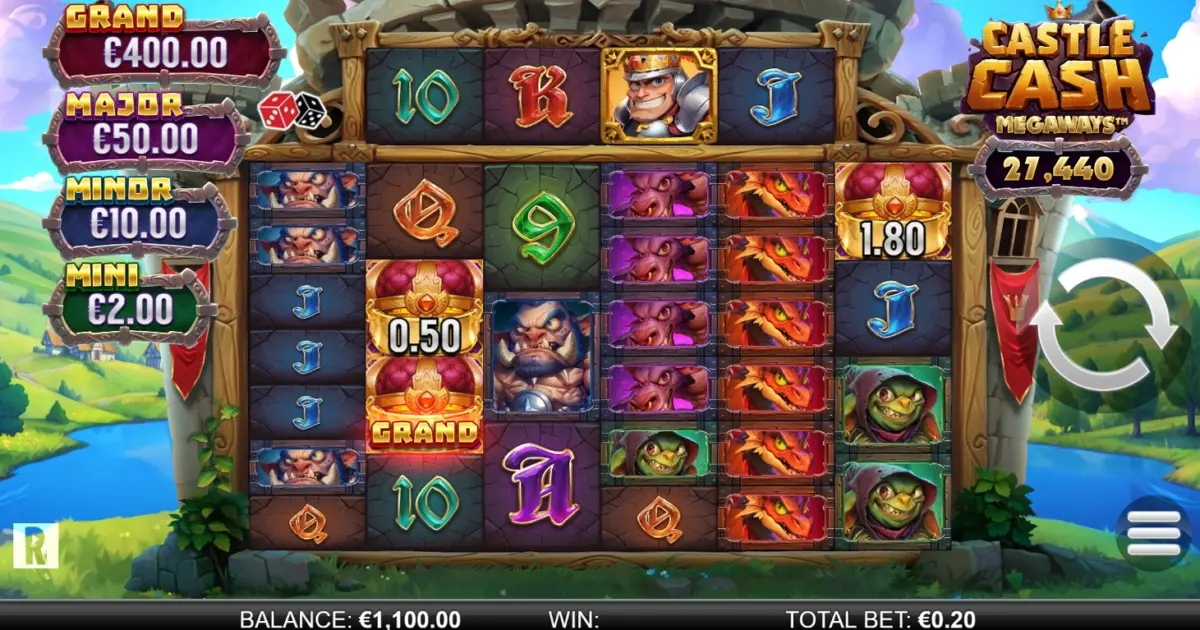
Six reels is the confirmed layout, and the game carries a Megaways tag. In a Megaways mechanic, each reel displays a variable number of symbols from spin to spin, and the number of ways to win is the product of the symbol counts across the reels. Two symbols on every one of six reels gives 64 ways; seven symbols on every reel gives 117,649. The count is recalculated on each spin, which is why the ways total shown on screen keeps changing.
What that means practically: wins are paid left to right by matching symbols in adjacent reel positions, and there are no fixed paylines to track. A large ways count is not the same as a large win, because per-way stakes are correspondingly small. A 50,000-way spin with no matching symbols pays nothing at all.
Beyond the reel count and the Megaways tag, no specific mechanics for this title have been published — no confirmed wild behaviour, scatter counts, free-spin totals or multiplier values. Symbol-by-symbol detail is something the paytable in the game itself will answer faster and more reliably than any review.
Stake range and sizing a bankroll
No minimum or maximum stake has been published for this game, and the figures vary by operator anyway. Check the bet selector in the game before you commit anything.
The sizing logic is the same whatever the range turns out to be. Decide your total budget first, then divide by the number of spins you want the session to last, and let that quotient set your stake. A £40 budget aimed at 400 spins means £0.10 per spin. If the game’s minimum is above that, the session you planned is not available at that budget, and the honest response is to lower the spin target or walk away — not to raise the budget mid-session.
One more point worth stating plainly: every spin is statistically independent of the last. Raising stakes after losses, lowering them after wins, or waiting for a “quiet” period to end changes nothing about the expected value of the next spin. Staking systems change the shape and speed of your outcomes, never the underlying maths. Flat staking simply makes your bankroll behave predictably.
Playing the Castle Cash Megaways demo before you commit
A Castle Cash Megaways free demo is available, and given how much is unpublished about this title, it is the sensible starting point. Ten minutes of demo play will tell you what no spec sheet can: how often the reels connect, how long the flat spells feel, and whether the medieval presentation holds your attention. Demo play runs on the same certified maths as the real-money version, so the RTP is identical — but demo results have no predictive value for a real-money session and no demo balance converts into cash.
Slots are 18+ and are paid entertainment, not a way to make money. Set a budget you would be comfortable spending on any other evening out, treat it as spent the moment you sit down, and stop when it is gone rather than topping it up.
Verdict: who should play Castle Cash Megaways
This is a competent, middle-of-the-road pick. The 96% return is a shade above the 95.71% database average and exactly matches Reel Play’s house standard, the six-reel Megaways layout is a familiar and legible format, and the demo removes any need to pay to find out whether you like it. The 89.9th-percentile popularity ranking says plenty of people keep returning to it.
The reservation is information, not quality. With no published volatility rating, stake range or max win, you are going in with less to plan around than better-documented releases give you. That is a real cost if you like knowing the shape of a game before you open it.
If you want a higher headline return from the same studio, Hypernova Infinity Reels publishes 96.2%. If the medieval and classical setting is the draw rather than the mechanic, Centurio sits at 96.08% among the 232 games sharing this theme grouping. Among Reel Play slots, this one is neither the outlier nor the weak link — it is the studio’s average, delivered honestly.
Frequently Asked Questions
Can I play Castle Cash Megaways for free?
A free demo of Castle Cash Megaways is available, so you can spin the six-reel layout without staking anything. The demo runs on the same certified 96% RTP as the real-money version, which makes it a useful way to judge pacing and presentation. No demo balance can be withdrawn or converted into cash.
What is the RTP of Castle Cash Megaways and is it good?
The RTP is 96.00%, meaning a theoretical return of £96 per £100 staked across a very large sample. That is 0.29 percentage points above the 95.71% average across the games we cover, and identical to Reel Play's 96.00% average across their 64 titles. Decent, not exceptional, and no guide to one session.
Is Castle Cash Megaways high volatility?
Reel Play has not published a volatility rating for this title, so no honest answer exists. Many Megaways-style games sit toward the higher end of the range because a variable ways count widens outcome spread, but that is an industry pattern rather than a fact about this game. The demo will show you how the swings feel.
Who makes Castle Cash Megaways?
Reel Play developed it, a studio with 64 titles in our database and an average RTP of 96.00% across them. Their catalogue leans on expanding-reel mechanics, including Hypernova Infinity Reels at 96.2% RTP, Money Mariachi Fiesta Infinity Reels at 96.16% and Age of Beasts Infinity Reels at 95.57%.
How much bankroll do I need for Castle Cash Megaways?
No stake range has been published for this game, and minimums vary by operator, so check the bet selector first. Size your bankroll by dividing your total budget by the spins you want: £40 across 400 spins means £0.10 each. Every spin is independent, so stake progressions change nothing.