The single number that matters here is 97.28%. That is the published return-to-player figure for the candy’s bonanza slot, and it sits 1.57 percentage points above the 95.71% average across the games in our database. Over a long enough sample, that gap is real money left in your balance rather than taken out of it.
What Expanse Studios has not published is a volatility rating, a max win figure, or a feature list. So this review covers what the numbers tell you and stops where the data stops.
Candy’s Bonanza versus the average slot
The +1.57 percentage point advantage over the corpus average is the headline. In practical terms: wager £1,000 on a 95.71% game and the long-run expectation is £957.10 returned. Wager the same £1,000 here and the expectation is £972.80. A £15.70 difference on £1,000 staked.
That sounds small, and over a single session it is invisible — swing from variance will dwarf it. RTP only asserts itself across hundreds of thousands of spins, far more than any individual player produces. What it does give you is a structural edge in game selection. If you are going to play slots anyway, choosing higher-RTP titles is the one decision that reliably reduces the house’s long-run take.
At rank 1,676, this title sits in the 91.6th percentile for popularity among the games we track. Popularity is not a quality signal and it says nothing about how the game will behave on your next spin, but it does mean enough people have found it that it is easy to locate a demo.
RTP breakdown: 97.28% in context
RTP is a theoretical average calculated across the full cycle of possible outcomes, usually millions of simulated spins. It is not a promise about your session, your hour, or your hundred spins. Every spin is independent and the RNG has no memory of what came before.
Here is what 97.28% looks like at different stakes, assuming long-run expectation only:
| Total wagered | Expected return at 97.28% | Expected cost |
|---|---|---|
| £100 | £97.28 | £2.72 |
| £500 | £486.40 | £13.60 |
| £2,000 | £1,945.60 | £54.40 |
Real sessions look nothing like that table. You will finish well up or well down; the expectation is a centre of gravity, not a forecast. Note also that £100 wagered is not £100 deposited — with a £0.20 spin, £100 of turnover is 500 spins, and a bankroll far smaller than £100 can generate it if the game returns money along the way.
Here are the figures Expanse Studios has confirmed:
| Specification | Detail |
|---|---|
| Provider | Expanse Studios |
| RTP | 97.28% |
| Reels | 6 |
| Primary theme | Sweets |
| Type | Slot Machine |
| Popularity rank | 1,676 (91.6th percentile) |
| Free demo | Available |
| Volatility | Not published |
| Max win | Not published |
| Stake range | Not published |
Volatility profile
Expanse Studios has not published a volatility rating for this title, so any figure you see quoted elsewhere is someone’s guess. Treat it that way.
The concept still matters for how you plan. Low-volatility slots pay small amounts often; sessions run long, the balance drifts rather than lurches, and a modest bankroll survives. High-volatility slots pay rarely and larger; long dry stretches are normal, and the same bankroll can vanish in a few dozen spins. Medium sits between the two.
Two games with identical 97.28% RTP can feel completely different because of this. RTP tells you the long-run return; volatility tells you the shape of the ride to get there. With no rating published, the demo is your measuring instrument. Run a few hundred spins at a fixed stake and watch how often the balance moves and how far it falls between returns. That gives you a rough feel, though it is a small sample and not a substitute for a published figure.
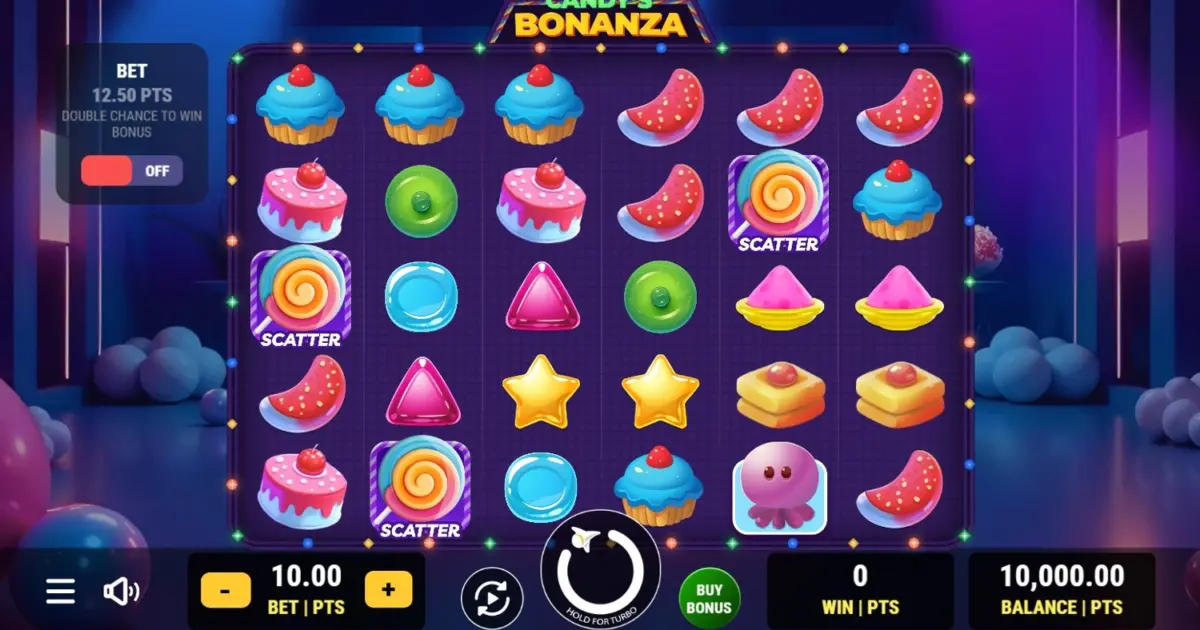
Six reels rather than the usual five widens the grid, which typically means more symbol positions in play per spin. What mechanic sits on top of that grid — paylines, ways, cluster pays, cascading symbols — is not stated in the available data, so check the in-game paytable before you commit anything.
Expanse Studios as a studio
Expanse Studios is a small operation: six games in our database, averaging 97.05% RTP. That average is 1.34 points above the corpus figure, which suggests a deliberate house style rather than one generous outlier. This title’s 97.28% sits slightly above their own average.
Their catalogue offers useful direct comparisons. Shaolin Crew matches this game exactly at 97.28%, so if the sweets theme does not appeal, the maths is identical elsewhere in the range. Leprechaun Wish is close behind at 97.20%, a difference of eight hundredths of a percentage point — statistically irrelevant for any realistic amount of play. Gates of Halloween is the outlier at 96.63%, still above the corpus average but 0.65 points below this release.
Six titles is a thin catalogue, and a small studio means less independent third-party auditing history to draw on than you would get from a major supplier.
Three Sweets alternatives worth comparing
The Sweets category runs to 313 games, so competition is heavy and RTP varies widely across it. The best-known rival is Sweet Bonanza at 96.51% — a full 0.77 points below this title, which on £1,000 wagered is £7.70 of extra long-run expected cost for the privilege of the more familiar name.
Lollipop Drop MultiMax is the cautionary comparison at 94.00%. That is 1.71 points below the corpus average and 3.28 below this game: £32.80 more expected cost per £1,000 staked. Same theme, materially worse maths.
For Sugar Land, no RTP figure has been published. An unpublished RTP is not automatically a bad one, but it removes your ability to compare, and some titles ship with configurable RTP that operators set lower than the headline. When a number is missing, assume nothing.
Getting the most out of the free demo
The Candy’s Bonanza free demo runs in a browser with no download and no account, and it is the sensible first step given how much is unpublished. Use it to read the paytable properly, learn what the six-reel grid actually does, and check whether the pacing suits you.
What the demo cannot do is predict real-money outcomes. Results in demo mode are independent random events, exactly as they would be with real stakes, and a good run proves nothing about the next session.
Slots are 18+ paid entertainment, not income. Decide what the session is worth to you before you start, stake only that, and stop when it is gone. No stake pattern, spin timing or progression changes the mathematics — the 97.28% figure is fixed regardless of how you bet.
Should you play Candy’s Bonanza?
On the numbers, yes, with a caveat. A 97.28% return is genuinely strong: above the corpus average by 1.57 points, above Expanse Studios’ own solid average, and comfortably ahead of the biggest name in its theme. If you rank slots by published RTP, this one earns its place.
The caveat is the missing data. No volatility rating, no max win, no stated stake range. You are buying good maths without knowing the shape of the experience, which makes the demo essential rather than optional. If session length and swing size matter to you, spend a few hundred free spins finding out before you stake anything.
If the theme leaves you cold, Shaolin Crew delivers the same 97.28% in a different setting. And if the numbers are what you came for, remember that a strong RTP reduces the long-run cost of playing — it does not turn the game into a positive-expectation bet.
Frequently Asked Questions
Can I play Candy's Bonanza for free without downloading anything?
A free demo is available and runs directly in your browser, so there is no download and no account required. It uses virtual credits rather than real money, and the same random number generator drives the outcomes. It is the best way to check how the six-reel grid behaves before staking anything.
What is the RTP of Candy's Bonanza and is that good?
The published RTP is 97.28%, which is 1.57 percentage points above the 95.71% average across the games we list. Over £1,000 of total turnover, the long-run expectation is £972.80 returned versus £957.10 on an average slot. That edge only shows up across very large samples, not single sessions.
Is Candy's Bonanza high or low volatility?
Expanse Studios has not published a volatility rating for this title, so treat any figure quoted elsewhere with caution. Volatility determines how often the game returns money and how large those returns are, which is separate from the 97.28% RTP. The demo lets you sample the pacing yourself over a few hundred spins.
Who is Expanse Studios and what else do they make?
Expanse Studios is a small developer with six titles in our database, averaging 97.05% RTP. Their catalogue includes Shaolin Crew, also at 97.28%, Leprechaun Wish at 97.20%, and Gates of Halloween at 96.63%. That consistency suggests high RTP is a deliberate design choice rather than a one-off.
How does it compare to Sweet Bonanza?
This title holds a clear RTP advantage: 97.28% against 96.51% for Sweet Bonanza, a gap of 0.77 percentage points, or roughly £7.70 of extra long-run expected cost per £1,000 wagered on the better-known game. Feature sets differ and neither studio has published volatility figures, so compare the demos directly.