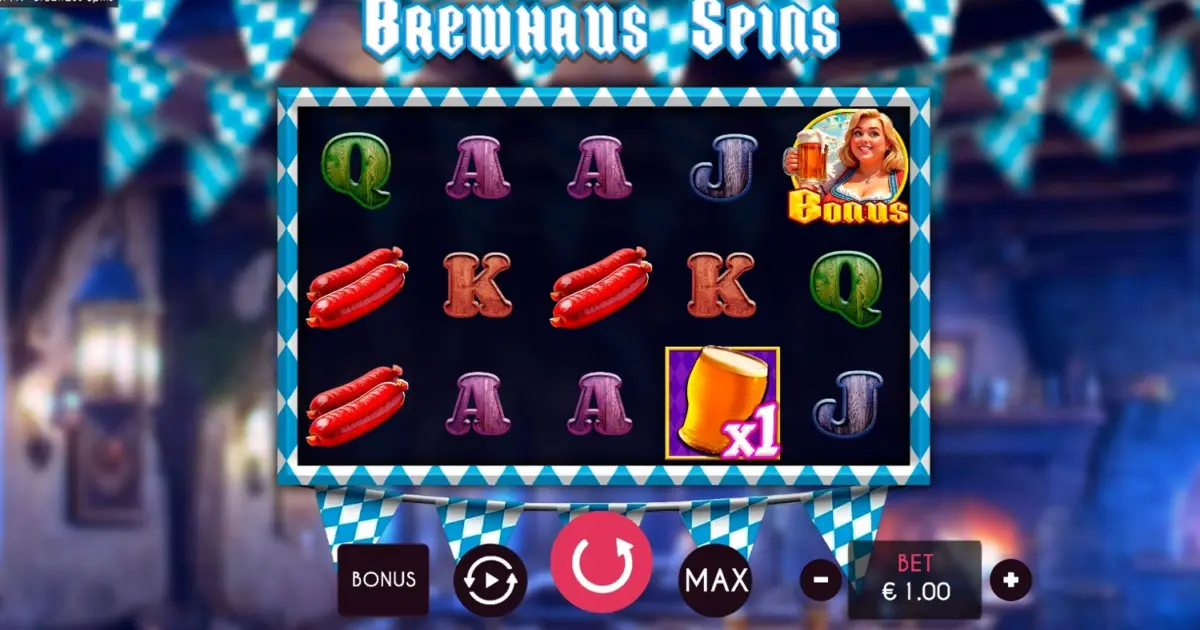
The number that matters on this game is 88.13%. That is the published return-to-player figure, and it sits 7.58 percentage points below the 95.71% average across the slots catalogue. Everything else about the game is secondary to that gap, because RTP is the one figure that directly describes how much of your wagered money the maths is designed to return over a very long run.
Is Brewhaus Spins worth playing?
For free play, yes, it is worth a few spins to see how it handles. For real money, the 88.13% return makes it hard to recommend when hundreds of alternatives sit above 96%. That is the whole argument, and the rest of this page is the supporting detail.
Triple Cherry built the game across five reels and files it under Food. It ranks 1923 in the catalogue, which puts it in the 90.4th popularity percentile — more visited than most titles, so plenty of people are looking it up. Popularity and mathematical value are different things, though, and the two point in opposite directions here.
Some context on the studio’s own range helps. Triple Cherry has 87 games listed, averaging 92.26% RTP. So this title is below par even by its maker’s standards, trailing the house average by more than four percentage points. When a game sits under both the wider market and its own provider’s mean, there is no reading of the figure that flatters it.
A free demo is available, and that changes the calculation. You can look at the reels, the pace and the interface without staking anything. If the presentation appeals to you, the demo is where that curiosity belongs.
What 88.13% RTP means over 1,000 spins
RTP is a long-run statistical average, not a session promise. At 88.13%, the design returns £88.13 for every £100 wagered across a sample large enough for the maths to settle — think millions of spins, not thousands.
Run the arithmetic on 1,000 spins at £0.20 a spin. That is £200 wagered. The theoretical return is £176.26, leaving an expected cost of £23.74. Put the same £200 through a 96% game and the expected cost drops to £8. The 88.13% figure costs you roughly three times as much per unit staked as a mainstream 96% slot.
Over 1,000 spins, though, variance still dominates. Actual results scatter widely around that theoretical line — you can finish well up or lose considerably more than £23.74. RTP does not become visible at that sample size; it just quietly sets the direction of travel.
Two things worth being clear about. Every spin is independent, resolved by its own random draw, so nothing you did earlier changes what comes next. And the figure applies identically at every stake — a bigger bet does not buy a better return percentage, it just scales both the wins and the expected cost.
How volatile is Brewhaus Spins?
Triple Cherry has not published a volatility rating for this title, so anyone quoting one is guessing. That is genuinely useful to know before you commit a bankroll: you cannot size your session properly without it.
Here is why the missing field matters. Volatility describes how returns are distributed. A low-volatility game pays small amounts often, so your balance drifts down gently and sessions run long on a modest bankroll. A high-volatility game pays rarely but larger, so the same balance can vanish in fifty spins or hold up for hundreds — the swings are much wider in both directions.
Both profiles can share an identical RTP. Volatility does not change what the game returns long-term; it changes how bumpy the ride is getting there. That is why the two numbers are quoted separately.
Without the rating, the practical move is to treat the game as unknown-risk and use the demo to observe it. Note how often paying combinations land across a couple of hundred free spins, and how far the balance swings between them. That gives you a rough read on the shape of the distribution, though a few hundred spins is a small sample and should not be mistaken for a measurement.
What the Food theme brings to the game
The theme is Food, one of 355 titles carrying that label in the catalogue. The name points at a brewery setting, and that is as far as the available information goes — no symbol list, no artwork description, no soundtrack notes have been published.
What a theme does and does not do is worth stating plainly. It sets the artwork, the symbol dressing and the audio. It has no effect on the return percentage, the volatility or the odds of any single spin. A brewery slot and a mythology slot built on the same maths pay identically.
Food is a well-populated category precisely because it travels well — the imagery is familiar and instantly readable, which suits a five-reel layout where symbols need to be recognised at a glance. Whether this particular execution appeals is a matter of taste, and taste is best settled in the free demo rather than described second-hand.
The reel count is confirmed at five. Payline or ways count is not published, so how wins are evaluated across those reels is unclear from the available data.
Stakes, session length and bankroll
The stake range for this game has not been published, so you will only see the minimum and maximum once the game loads. Check them before your first real-money spin, because the range sets everything else about session planning.
The arithmetic is straightforward once you have the numbers. Divide your budget by your chosen stake to get spins available before variance and the house edge take their share. A £50 budget at £0.20 a spin buys 250 spins on paper; at £2.00 a spin it buys 25. Same money, very different session.
Because the return here is 88.13%, that expected cost per spin is higher than on a mainstream title. If you want session length, that argues for the lower end of whatever range the game offers. Then decide your total budget in advance and stop when it is gone, rather than adjusting stakes mid-session.
One thing to rule out: no stake pattern, sequence or progression changes expected value. Raising bets after losses does not recover anything, because each spin is independent of the last. Stake size affects how fast your budget moves, nothing more.
| Figure | Value |
|---|---|
| Provider | Triple Cherry |
| RTP | 88.13% |
| Reels | 5 |
| Primary theme | Food |
| Subcategory | Slot Machine |
| Popularity rank | 1923 (90.4th percentile) |
| Provider average RTP | 92.26% across 87 games |
| Catalogue average RTP | 95.71% |
| Free demo | Available |
Alternatives if Brewhaus Spins is not for you
If the Food theme is what drew you here, the same category has far better numbers. Lucky Turkey runs 97.17% RTP, which is 9.04 percentage points higher and reduces the expected cost per £100 wagered from £11.87 to £2.83. BBQ Rush sits at 96.33%, also comfortably above the 95.71% catalogue average while keeping the food-and-cooking dressing.
If it is Triple Cherry’s style you want to stay with, Cursed Pirates is the studio’s strongest option among the related titles at 94.00% — still under the market average, but nearly six points ahead of this game and above the provider’s own 92.26% mean. Kitten’s Playroom returns 90.13%, a smaller improvement but an improvement nonetheless.
Worth flagging the outlier: Iron Rail Riches, another Triple Cherry title, is listed at 88.21% — effectively level with this one. Swapping between those two changes the artwork and nothing meaningful about the maths.
Final take
This is a five-reel food-themed slot from a studio with 87 titles, and its defining feature is an RTP of 88.13% against a catalogue average of 95.71%. It is popular — top 10% by traffic — but popularity is not value. On the numbers alone, the free demo is the sensible place to spend time with this game.
Volatility and stake range are both unpublished, which leaves two of the three figures you would normally use to plan a session unavailable. Combined with the low return, that is a thin basis for staking money.
Slots are paid entertainment, not a way to make money. Play only if you are 18 or over, decide your budget before you start and treat it as the cost of the entertainment rather than an investment you expect back. If it stops being fun, close the game.
Free demo play uses the same maths but no money, so it tells you nothing about what a real-money session would return. Use it to judge whether you like the game, not to forecast results.
Frequently Asked Questions
Can I play Brewhaus Spins for free?
A free demo is available for this title, so you can spin the five reels with no stake and no deposit. Demo mode runs the same underlying maths as the real-money version, including the 88.13% RTP, but the credits carry no cash value and results cannot be withdrawn. It is the practical way to judge the pace and presentation.
What is the RTP of Brewhaus Spins?
The published return-to-player figure is 88.13%, meaning the design theoretically returns £88.13 for every £100 wagered across a very large sample. That is 7.58 percentage points below the 95.71% catalogue average and also below Triple Cherry's own 92.26% average across 87 games. Short sessions will vary widely from that figure in both directions.
Is Brewhaus Spins high or low volatility?
Triple Cherry has not published a volatility rating for this game, so treat any figure quoted elsewhere with caution. Volatility describes how returns are spread out — frequent small payouts versus rare larger ones — and it is separate from the 88.13% RTP. Without it, use the free demo to observe how often paying combinations actually land.
Who makes Brewhaus Spins and what else do they produce?
Triple Cherry developed it. The studio has 87 games in the catalogue with an average RTP of 92.26%, below the 95.71% market average. Related titles include Cursed Pirates at 94.00%, Kitten's Playroom at 90.13% and Iron Rail Riches at 88.21%, so the range spans roughly six percentage points of return.
How does Brewhaus Spins compare with BBQ Rush?
BBQ Rush returns 96.33% against this game's 88.13%, a gap of 8.2 percentage points and the clearer choice on the numbers. Both sit in the Food category, which lists 355 titles. On a £200 turnover, the theoretical cost is about £7.34 on BBQ Rush versus roughly £23.74 here — same theme, very different maths.