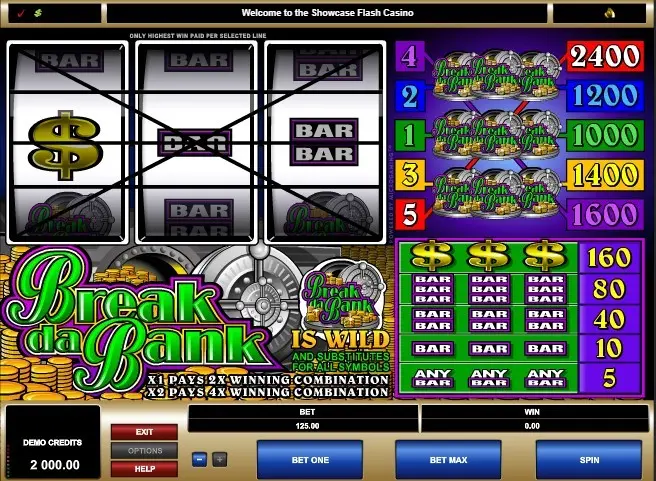
Break da Bank makes its case quickly: if you want a stripped-back, 3-reel arcade spin without complex features, the free demo gives you an immediate answer, but the lack of published numbers means you should treat any third-party stats with caution. This break da bank slot comes from Games Global and leans entirely on its Classics and retro appeal, so your decision comes down to whether you value simple reel play over detailed volatility and RTP disclosure. The sections below unpack what is known, what is not, and what that means for your session planning.
Is break da bank slot worth playing?
The honest answer is: it depends on what you compare it against and how much missing information you are comfortable with. Break da Bank is ranked 2079 in the corpus and sits at the 89.6th popularity percentile, which puts it in the more-played end of the catalogue without being a top-20 headline title. That popularity suggests a steady audience for its format, but it does not tell you anything about expected returns or risk.
What is verifiable is the provider and the format. Games Global is credited with 187 games, so this is a studio with a large catalogue and established distribution. The game is listed as a Slot Machine with 3 reels and themes of Arcade, Classics and retro, and 3-Reels. If that description appeals — short, fast spins on a small grid — you will know within a few demo spins whether the pacing suits you. If you prefer detailed disclosure before you commit time, the gaps noted below matter more than the theme.
There is no published RTP in the FACTS block for this specific title, and no volatility rating is supplied either. That absence is itself useful: you cannot calculate a long-run expectation for Break da Bank from verified data, and you cannot benchmark its swing size against the provider average of 95.48% or the corpus average of 95.71% on a like-for-like basis. A free demo lets you feel the rhythm without risk, but demo play does not predict real-money results — every spin remains independent.
What RTP means over 1,000 spins
No RTP figure has been published for Break da Bank in the data supplied here, so this section explains what that absence means and how RTP works in general. RTP — return to player — is a long-run statistical average calculated over millions of spins. A 96% RTP, for example, means the game is designed to return £96 for every £100 wagered across that very large sample, not across your next 100 or 1,000 spins.
To see why the sample size matters, consider the maths rather than this specific game. Over 1,000 spins at £1 a spin, you will have staked £1,000 in total. With a hypothetical 96% RTP, the expected return across that sample would be £960, for a theoretical loss of £40. But that is an average. In a 1,000-spin window, actual results can sit well above or below the average because wins and losses are not spread evenly.
Because Break da Bank has not published an RTP, you cannot do this calculation accurately for this title. You can still frame the comparison points that are available: Games Global titles in this dataset average 95.48% RTP, and the wider corpus averages 95.71%. Those figures describe the provider and the market, not this game. If you see an RTP quoted elsewhere for Break da Bank, treat it with caution until you can verify it against the provider’s own paytable or help screen. Until a verified figure appears, base any session plan on bankroll limits you set yourself, not on an assumed return.
How volatile is Break da Bank?
No volatility rating is supplied for Break da Bank, so you cannot state whether it is low, medium or high from FACTS alone. That limits what can be said specifically, but the general concepts still help you plan what to watch for in demo play.
In slots generally, low volatility tends to mean more frequent but smaller wins, which often stretches session length and smooths bankroll movement. High volatility tends to mean fewer hits with larger swings when wins do arrive, which usually requires a larger bankroll and a higher tolerance for dry spells to cover the gaps. Medium volatility sits between those two, trading some hit frequency for some swing size. None of those labels changes the expected value of a spin; they describe how results are distributed over time.
Without a published volatility for this title and without a hit-frequency figure, you should use the demo to observe the feel of the game rather than relying on a label. Note how often the reels return any win at all, how long losing runs last, and whether balances tend to drift gradually or jump. A 3-reel format often implies a simpler paytable than a 5-reel, many-ways game, but simplicity alone does not fix volatility — paytable values and reel weighting do. Since those details are not in FACTS, avoid assuming this game is low-risk simply because it has only three reels.
What the Arcade theme brings to the game
Break da Bank is tagged with a primary theme of Arcade and secondary themes of Classics and retro and 3-Reels. That tells you the design intent: it draws on arcade and retro slot traditions rather than on narrative-driven video-slot tropes. In practical terms, Arcade as a theme label suggests a focus on direct reel play, recognisable classic symbols and straightforward presentation, but FACTS does not describe specific characters, animations, or soundtrack elements, so no visual detail can be confirmed here.
The theme game count provides context. There are 79 games in the dataset sharing the Arcade theme, which means this is a well-populated category with plenty of points of comparison. If you enjoy that style, you are not choosing in isolation; you can compare pacing and simplicity across many similar titles and see which execution you prefer.
As a concept, theme does not alter maths. An Arcade label does not imply a particular RTP, volatility level, or feature set. Many slots across all themes use wilds, scatters or free spins as concepts, but FACTS does not list any such features for Break da Bank, so none can be asserted here. If features matter to your decision, the absence of feature data is itself a signal to check the in-game help screen or to rely on the free demo to see what, if anything, appears beyond base spins.
Stakes, session length and bankroll
No specific stake range is listed for Break da Bank in FACTS, so exact minimum and maximum bets cannot be stated here. That means session-length planning has to start from the structure you control: your total budget, your chosen stake, and how many spins you want that budget to cover.
A useful way to think about it is in spins, not minutes. If you bring £50 and play at £0.50 a spin, that is 100 spins if you never win. If you play at £0.20, the same £50 represents 250 spins. Wins recycle stake and extend play, losses shorten it, but the starting maths is always budget divided by stake. Deciding that number before you start is more effective than adjusting stakes mid-session to chase a result, because each spin is independent and changing your bet does not change expected value.
Reel count also shapes session feel in general terms. A 3-reel game has fewer positions per spin than a 5-reel game, which often means fewer paylines or ways and a more readable board. That can make bankroll movement easier to follow, but it does not guarantee longer or shorter sessions on its own. Without a published RTP or volatility for this title, the most reliable approach is to set a time or loss limit, use the free demo to gauge comfort with the pace, and treat real-money play as paid entertainment. 18+; set a budget and stick to it, and treat slots as paid entertainment, not a way to make money.
| Detail | Value |
|---|---|
| Game | Break da Bank |
| Provider | Games Global (187 games, avg RTP 95.48%) |
| Format | Slot Machine, 3 reels |
| Themes | Arcade (primary), Classics and retro, 3-Reels |
| Corpus average RTP | 95.71% |
| Popularity | Rank 2079, 89.6th percentile |
| Free demo | Available |
| RTP (this game) | Not published in supplied data |
| Volatility | Not published in supplied data |
Alternatives if Break da Bank is not for you
If the missing RTP or the bare 3-reel format gives you pause, the related games in FACTS give you verifiable alternatives with published figures. For a Games Global comparison with a disclosed return, Dr Watts Up shows an RTP of 96.61%, which is above both the provider average of 95.48% and the corpus average of 95.71%, and may suit you if a higher published RTP is part of your filter.
Within the same Arcade theme, Hip Hop Panda at 95.75% RTP keeps the theme constant while giving you a concrete number to work with, whereas DJ Rabbit at 96.54% offers a higher Arcade-themed return in the data supplied. Both let you compare like-for-like on theme while still seeing a verified figure.
A third angle is to stay with the provider but accept variation the other way: Jaws and Jewels Power Combo is listed at 94.25% RTP, which is below the provider average and illustrates how returns differ even within one studio. That contrast is useful when you are deciding how much weight to give a single RTP figure versus other factors like reel layout and personal taste. All of these alternatives are drawn from FACTS, so the numbers are traceable, unlike any unverified figure you might see quoted for Break da Bank elsewhere.
Final take
Break da Bank is best approached as a simple, 3-reel Arcade retro slot whose main virtue is speed and readability, not detailed disclosure. The verified facts are the format, the provider, and the theme grouping; the gaps are the RTP, volatility, stake range and feature list, none of which are supplied here and therefore none of which should be assumed.
If that trade-off works for you — you enjoy classic 3-reel pacing and are happy to let the free demo answer the feel question — this title is worth a short demo session to see whether you like the rhythm. If you need a published RTP and a volatility label before you spend time on a game, you will be better served by a title where those figures are disclosed, such as the higher-RTP Arcade options noted above.
As always, keep play within limits you set in advance. Decide on a budget that you can afford as entertainment, choose a stake that gives you the number of spins you want, and stop at the limit whether you are ahead or behind. If you ever feel your play is no longer fun, use deposit limits, time-outs or self-exclusion tools and seek support from a responsible-gambling organisation. Demo play is free and carries no real-money risk, but it does not predict real-money results.
Frequently Asked Questions
Can I play Break da Bank for free without downloading anything?
The data supplied shows a free demo is available for Break da Bank, so you can try the game without wagering real money. Break da Bank free demo play is the practical way to check its 3-reel arcade pacing before you decide anything else, and it helps you set a budget for any future real-money session.
What is the RTP of Break da Bank and what does it mean for me?
No RTP is published for Break da Bank in the supplied FACTS, so a verified figure cannot be quoted here. RTP is a long-run average — for example, a 96% RTP implies £96 returned per £100 wagered over millions of spins. Compare any number you see elsewhere to the provider average of 95.48% and corpus average of 95.71% with caution.
Is Break da Bank high volatility and how does that affect my bankroll?
No volatility rating is supplied for Break da Bank, so no level can be stated as fact. In general, high volatility means fewer but larger swings and usually needs a larger bankroll to weather dry spells, while low volatility stretches sessions with smaller, more frequent wins. Use the demo to observe swing behaviour directly.
Who makes Break da Bank and what else do they offer?
Break da Bank is by Games Global, a studio credited with 187 games and an average RTP of 95.48% across its titles in this dataset. Games Global slots span many themes and formats, including related titles like Dr Watts Up at 96.61% RTP, which gives a verifiable comparison point within the same provider.
Can I win real money playing the Break da Bank demo?
Demo play does not pay real money; it uses play credits with no cash value. Every spin is independent and demo outcomes do not predict real-money results. If you later play with real funds, set a budget beforehand and treat the session as paid entertainment, not as a way to earn income.