The hip hop panda slot is a 3-reel arcade title from PG Soft with a 95.75% RTP. It ranks inside the top 2% of catalogued slots by popularity, yet it carries no published volatility rating, no hit-frequency figure and no stated stake range. Those omissions matter more than the theme does when you are deciding whether this game deserves your budget.
The 3-reel grid explained
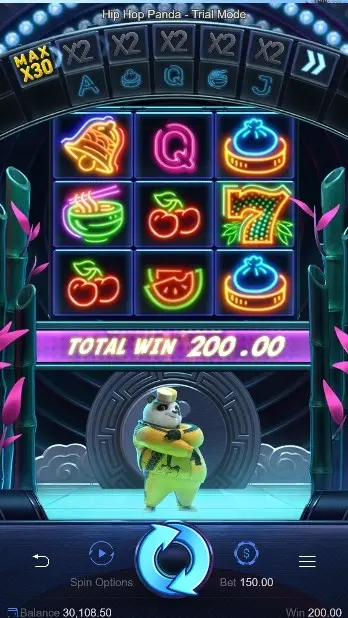
Three reels means a compact display. You see a small number of symbol positions per spin, which typically produces fewer simultaneous matching opportunities than a 5-reel layout. Fewer positions also means each individual spin resolves faster, so session length depends heavily on how quickly you trigger any bonus elements. PG Soft has not published a symbol count or reel-strip length for this title, so you cannot verify how densely matching symbols are packed on each reel.
The Arcade theme label sits alongside a “3-Reels” subcategory tag, confirming that the reel count is a deliberate design choice rather than a fallback. Many 3-reel slots are built to replicate the look of physical cabinet machines, where simplicity and fast cycling are the selling point. Whether Hip Hop Panda follows that logic, you can confirm for yourself in DJ Rabbit, another 3-reel arcade entry in the same 79-game theme category.
The practical consequence: you will see a lot of non-winning spins in quick succession if the game is tuned toward low hit frequency, or short bursts of frequent small returns if it is not. Without a published hit-rate figure, you cannot predict which pattern dominates.
Paylines, ways and how Hip Hop Panda pays
PG Soft has not disclosed a payline count or a “ways” mechanic for this title on the data available here. That absence is informative on its own. Many 3-reel slots use between 1 and 5 horizontal or diagonal paylines, meaning a winning combination must land on a fixed line rather than forming a cluster anywhere on the grid. Others use a “ways” system where matching symbols on adjacent reels pay regardless of vertical position.
Without knowing which model Hip Hop Panda uses, you cannot calculate an effective number of ways to win per spin. The safest assumption is that the game follows a conventional fixed-line structure, but treat that as an educated default, not a confirmed fact. If line count matters to your bankroll planning, compare with Fortune Tiger, where PG Soft’s published specifications make the payline structure transparent before you commit a single coin.
95.75% RTP put in context
RTP describes the long-run percentage of wagered money a game returns to players. A 95.75% figure means that, across a very large number of spins, the mathematical model returns £95.75 for every £100 staked. The remaining £4.25 is the house edge built into the game’s design.
Against the corpus average of 95.71%, Hip Hop Panda sits +0.04 percentage points higher, which is negligible. Against its own provider’s average of 96.61%, however, it trails by 0.86 points. That gap is meaningful: PG Soft’s typical game returns roughly £0.86 more per £100 wagered than this title does. Over 10,000 spins at £1 each, that difference accumulates to about £86 in expected returns.
For reference, Mahjong Ways 2 from the same provider runs at 96.95% RTP, a full 1.20 points above Hip Hop Panda. If theoretical return is your primary filter, that comparison alone may redirect your session.
Volatility and hit patterns
No volatility rating has been published for this title. That is a genuine gap in the information available to you before playing. Volatility determines how returns are distributed: a low-volatility game pays small amounts frequently, keeping your balance relatively steady. A high-volatility game pays rarely but in larger lump sums, producing wide swings that can drain a bankroll quickly between hits.
Without a stated volatility tier, you cannot plan session length or set realistic loss limits based on expected swing size. Some review sites label PG Soft titles as “medium” by default, but that is speculation, not data. The responsible approach is to treat an unrated game as potentially high-variance until you have observed at least several hundred spins in demo mode.
Choosing a stake between published minimum and maximum
PG Soft has not published a stake range for Hip Hop Panda in the dataset available here. Most PG Soft titles accept bets from around 0.20 to 50.00 credits per spin, but that is a general observation across the provider’s 150-game catalogue, not a confirmed specification for this game.
Stake selection interacts directly with your total budget and the number of spins you can sustain. If you allocate 100 credits for a session and the minimum stake is 0.20, you have 500 spins of play. If the minimum is 0.50, that drops to 200. At 95.75% RTP, you expect to retain roughly 47.88 credits after 500 spins at the lower end, before variance shifts the actual outcome in either direction.
Demo play versus real money
A free demo is available for Hip Hop Panda, which lets you observe spin frequency, bonus triggers and payout cadence without financial risk. Demo play does not predict real-money results, and it does not replicate the psychological pressure of playing with funds you cannot replace. Use it to learn the game’s rhythm, not to form a belief about your likelihood of winning.
You must be 18 or older to play for real money. Set a loss limit before you start and treat the cost of play as paid entertainment, not as an investment with an expected return. If you find yourself chasing losses or playing beyond your planned budget, stop and consider reaching out to a support service.
Verdict on Hip Hop Panda
This is a fast-cycling 3-reel arcade slot that delivers slightly above-corpus RTP but well below its own provider’s average, with no published volatility rating, no confirmed stake range and no disclosed payline structure. The information gap makes it harder to plan a session than with titles like Mahjong Ways 2 or Fortune Tiger, where specifications are transparent. Its popularity percentile of 98.3 means a large audience plays it, but audience size is not a proxy for value. If you want a quick, visually simple spin cycle and you can tolerate the unknowns, the demo costs nothing to try. If you need to know your expected swing size before committing funds, this title’s incomplete data sheet is a reason to look elsewhere.
| Attribute | Value |
|---|---|
| Provider | PG Soft (Pocket Games Soft) |
| RTP | 95.75% |
| Reels | 3 |
| Themes | Arcade, 3-Reels |
| Popularity rank | 346 (98.3rd percentile) |
| Provider average RTP | 96.61% |
| Corpus average RTP | 95.71% |
| Volatility | Not published |
| Stake range | Not published |
| Free demo | Yes |
Frequently Asked Questions
What is the RTP of the Hip Hop Panda slot?
The Hip Hop Panda slot has a published RTP of 95.75%. That figure sits 0.04 percentage points above the corpus average of 95.71% but 0.86 points below PG Soft's own provider average of 96.61%. Over a large sample of spins, expect roughly 4.25% of total wagers to be retained by the game's mathematical model.
Is there a free demo for Hip Hop Panda?
Yes, a free demo is available for Hip Hop Panda. You can play without depositing money to observe the game's pace, bonus triggers and payout cadence. Demo play does not predict real-money outcomes, but it removes financial risk while you evaluate whether the game suits your session preferences.
What volatility does Hip Hop Panda have?
PG Soft has not published a volatility rating for Hip Hop Panda in the available data. Without that figure, you cannot determine whether the game pays small amounts frequently or concentrates returns into rare larger hits. Treat an unrated slot as potentially high-variance and limit your stake accordingly until you observe enough demo spins to gauge the pattern yourself.
Who made Hip Hop Panda and what else does the provider offer?
Hip Hop Panda is made by PG Soft (Pocket Games Soft), a provider with 150 catalogued games and an average RTP of 96.61% across its portfolio. Notable titles from the same provider include Mahjong Ways 2 at 96.95% RTP and Fortune Tiger at 96.81%, both of which exceed Hip Hop Panda's theoretical return.
How does Hip Hop Panda compare to DJ Rabbit in the same arcade theme?
DJ Rabbit runs at 96.54% RTP, which is 0.79 percentage points higher than Hip Hop Panda's 95.75%. Both occupy the 3-reel arcade category. The RTP gap means DJ Rabbit returns roughly 79 pence more per £100 wagered over a very large sample, making it the marginally more favourable choice if theoretical return is your primary comparison criterion.