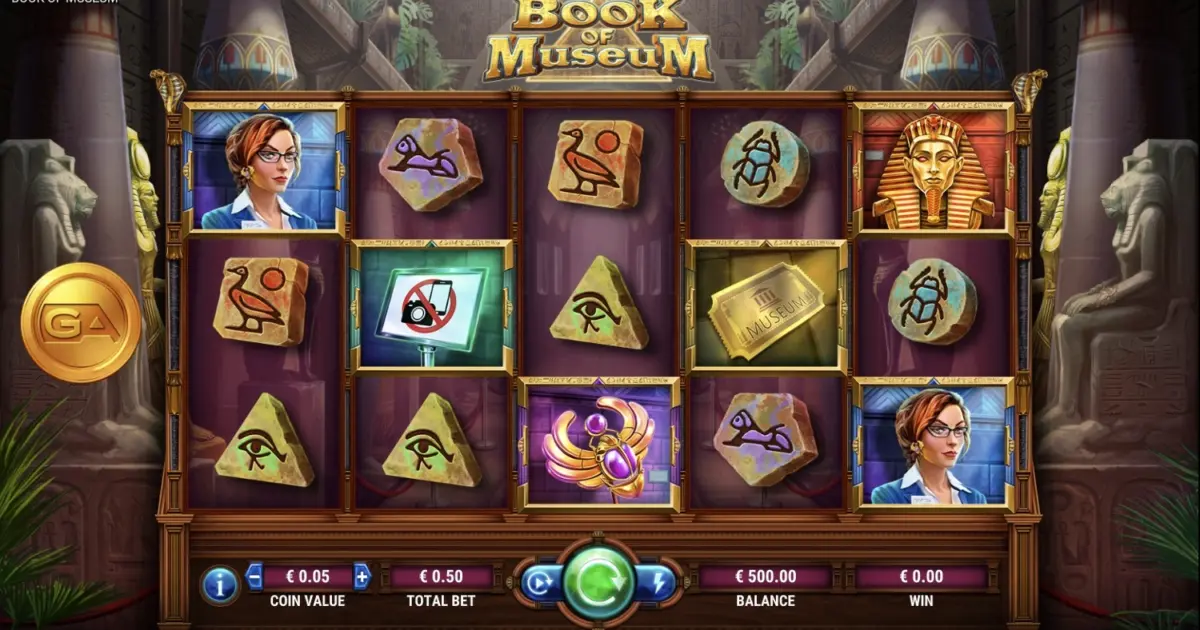
Book of Museum slot is a 5-reel Egypt game from GameArt that returns 96.51% RTP — 0.43 percentage points above the provider’s own catalogue average. The catch that matters before you spin: GameArt has not published a volatility rating, hit frequency, or maximum win figure for this title. You get a decent return percentage, but no published risk profile to guide your stake sizing.
Who makes Book of Museum
GameArt is the studio behind this title, and Book of Museum is one of 178 slots in their catalogue. That is a large portfolio, and it means GameArt ships a wide range of themes and mechanics — from fruit machines to adventure titles across multiple reel configurations.
Provider size matters for two reasons when you are evaluating a game you have not seen before. First, a studio with 178 titles has enough production volume that quality control and mathematical testing tend to be routine rather than ad hoc. Second, a big catalogue means there are many alternatives from the same provider if this particular theme does not hold your attention.
GameArt slots are distributed through licensed online casinos primarily in regulated European markets. The provider has been active since the early 2010s, so its games carry the kind of mathematical documentation you would expect from an established operation — even if some individual fields like volatility are left unpublished for certain titles.
Where Book of Museum sits in the GameArt catalogue
At a rank position of 977 across the full review corpus and a popularity percentile of 95.1, Book of Museum attracts more traffic than the typical slot. That does not tell you whether it is the best game for your session, but it does mean the numbers below are drawn from a game players actually open.
The provider’s average RTP across all 178 titles is 96.08%. Book of Museum’s 96.51% sits 0.43 points above that figure — a modest but real edge over the house style. For context, Sweet FTN from the same studio posts 96.55%, making it fractionally more generous to long-run players.
On the lower end, Kukulkan’s Queen returns 96.06%, slightly below the provider average. The spread between GameArt’s best and worst documented RTPs is narrow — roughly half a percentage point across the titles that have published figures. Dynamite Fruits Deluxe rounds out the related set but has no RTP listed, which is worth noting if you encounter it at a casino.
What this means practically: within GameArt’s catalogue, you are not choosing between wildly different return levels. Differences of 0.4–0.5% are real over long sessions but negligible over a typical 200-spin evening. The game you pick should be chosen on theme and structure, not on chasing decimal points.
RTP: 96.51% against a 96.08% house average
Return to player is a long-run statistical average calculated across millions of simulated spins. It does not describe any single session. A 96.51% RTP means that across a very large sample, GameArt expects to return £96.51 for every £100 wagered, retaining £3.49 as the house edge over that sample.
Over 500 spins at a £1 stake, you wager £500 total. The expected mathematical return is approximately £482.55, leaving an expected loss of about £17.45. That is an average, not a prediction. Your actual session will land somewhere in a wide distribution around that figure.
The 0.43-point gap between Book of Museum and the GameArt average of 96.08% translates to roughly £2.15 extra returned per £500 wagered over 500 spins. Over 5,000 spins at £1 stake (total wagered £5,000), that same gap is worth about £21.50. Meaningful across thousands of spins, negligible across a single evening.
Against the broader corpus average of 95.71%, Book of Museum’s advantage widens to 0.80 percentage points — which GameArt’s data confirms via the rtp_vs_corpus field. That places it comfortably in the upper tier of documented slots, though not in exceptional territory.
Missing data to flag: GameArt has not published a maximum win multiplier or a hit frequency for this title. Any figure you see quoted on another review site for those two metrics was either estimated or copied without verification. Treat those claims with caution.
Volatility and who it suits
GameArt has not assigned a volatility rating to Book of Museum. This absence is the single most important gap in the available data, because volatility determines the shape of your session far more than RTP does. RTP tells you what the game gives back over thousands of spins; volatility tells you whether those returns arrive as a steady drip or as infrequent large hits separated by long dry stretches.
Without a published volatility figure, you cannot reliably plan a bankroll for this game. A high-volatility slot might require 500+ spins at your chosen stake before a significant bonus hit materialises, while a low-volatility variant might return small wins every two or three spins. The same RTP percentage produces completely different session experiences depending on which profile sits behind it.
What you can do: spin the game in free-play mode for 200 to 300 rounds and observe the cadence of wins yourself. Note how many spins elapse between payouts and how those payouts compare to your stake. That empirical read is imperfect — demo sessions are short and subject to variance — but it is better than guessing. You can also start with a low stake until your own observation gives you a sense of the game’s rhythm.
Playing Book of Museum for free
GameArt has made a free demo of Book of Museum available, which you can play without registration or deposit. The Book of Museum free demo uses simulated credits and produces no real-money outcomes. Results in demo play have no predictive value for what happens when you switch to a funded session — each spin is independent of the last.
The demo is useful for two things. First, it lets you observe the game’s structure: how the reels stop, how wins are announced, how often symbols land. Second, it lets you count your own win cadence over a sample of spins to get a rough feel for the game’s behaviour, since the volatility rating is missing.
What the demo cannot do is tell you whether a real-money casino offering this game is reliable, or whether its terms are fair. Demo play only shows you the slot’s interface and mechanics.
One note on responsible play: set a budget before you spin for real, treat any money you put in as paid entertainment rather than an investment, and stop when that budget is spent. Slots are designed to be enjoyed in short, bounded sessions. The 18+ rule exists for a reason — this content is for adults who make deliberate choices about their entertainment spending.
Similar picks
Book of Museum belongs to the Egypt theme category, which spans 908 titles across the review corpus. That is an enormous category, so narrowing by mechanic and return makes sense.
The most recognisable comparison in this space is Book of Dead by Play’n GO, which shares both the Egyptian subject matter and the book-symbol expansion mechanic that the genre popularised. Its published RTP of 94.25% is 2.26 points below Book of Museum — a substantial gap over long sessions. If you enjoy the theme and are comparing return rates, that difference is the clearest reason to look at Book of Museum first.
Book of the Sun offers a similar setting at 96.23% RTP — just 0.28 points below this title, making the two nearly interchangeable from a pure return standpoint. Crazy Mummy sits at 96.00%, closer to the GameArt average and less differentiated.
If the Egypt theme is fixed and you want the highest published return among these options, Book of Museum’s 96.51% edges out all three comparison titles.
Verdict
Book of Museum slot is a solid pick within the Egypt genre on the one metric that has been verified: its 96.51% RTP beats both the provider average and every related Egypt title with a published figure. The 0.80-point advantage over the corpus average is real.
The missing volatility rating is the main drawback. Without it, you are choosing a game whose session texture is undefined, and any bankroll plan you build is guesswork. The free demo lets you do some of that guessing at no cost — 200 spins is enough to form a preliminary read.
| Metric | Value |
|---|---|
| RTP | 96.51% |
| Provider average RTP | 96.08% |
| Corpus average RTP | 95.71% |
| Reels | 5 |
| Theme | Egypt |
| Provider | GameArt |
| Volatility | Not published |
| Max win | Not published |
| Hit frequency | Not published |
| Free demo | Available |
Bottom line: try the free demo to get a feel for the game’s rhythm, and if you move to real money, keep stakes conservative until you have observed enough spins to judge the variance for yourself.
Frequently Asked Questions
Is Book of Museum slot available to play for free?
Yes. GameArt has made a Book of Museum free demo available that requires no registration or deposit. The demo runs on simulated credits and does not produce real-money wins. You can spin as many rounds as the demo allows to observe the game's win cadence before deciding whether to play with real funds.
What is the RTP of Book of Museum?
Book of Museum has an RTP of 96.51%, which is 0.43 percentage points above GameArt's provider average of 96.08% and 0.80 points above the broader corpus average of 95.71%. That means across a very large sample of spins, the game returns £96.51 for every £100 wagered, retaining a 3.49% house edge.
What is the volatility of Book of Museum?
GameArt has not published a volatility rating for Book of Museum. Without that figure you cannot plan a bankroll with confidence, because volatility determines whether wins arrive frequently in small amounts or rarely in larger bursts. The free demo lets you observe the game's rhythm yourself over a sample of 200 to 300 spins.
How does Book of Museum compare to Book of Dead?
Book of Dead has a published RTP of 94.25%, which is 2.26 percentage points below Book of Museum's 96.51%. Over 5,000 spins at £1 stake, that gap is worth roughly £113 more returned by Book of Museum. Both titles share the Egypt theme, but Book of Museum offers a measurably better return on the data available.
Does free demo play predict real-money results?
No. Each spin is independent, and demo play uses the same random number generator but with simulated credits. The outcome distribution over a short demo sample tells you nothing reliable about what your funded session will produce. Demo play is useful for understanding game structure and observing win cadence, not for predicting results.