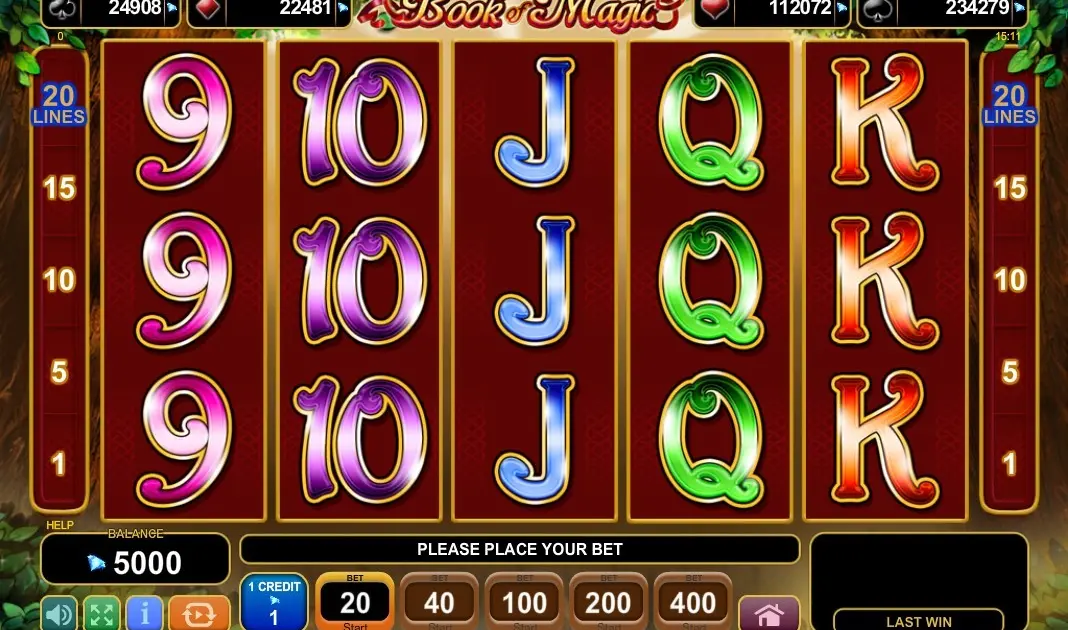
The Book of Magic slot is a five-reel machine from Amusnet, and the single most useful thing to say about it up front is that the published data is thin. There is no RTP figure attached to this title, no volatility rating, and no stake range on record. That does not make it a bad game, but it does mean you cannot do the arithmetic you would normally do before committing money, which pushes the free demo from “nice to have” to “the sensible first step”.
Who makes the Book of Magic slot
Amusnet is the developer, and this is one of 199 Amusnet titles catalogued here. That is a large library by any measure, and it tells you something about the studio’s approach: a broad catalogue built at volume, with recognisable mechanics reused across many machines rather than a handful of heavily marketed flagship releases.
Across those 199 games, the average RTP on record is 95.99%. That is a useful anchor even when an individual game’s figure is missing, because studios tend to cluster their return settings within a fairly narrow band. It is not a substitute for a confirmed number, though. Two games from the same developer can sit two or three percentage points apart, and over a long session that difference is the difference between a slow bleed and a fast one.
What Amusnet has not disclosed for this game is worth stating plainly: no max win figure, no hit frequency, no feature description. If you see a max win or a multiplier cap quoted for this title somewhere else, treat it as unsourced until the developer publishes it.
Where Book of Magic sits in the Amusnet catalogue
By traffic, this one sits at rank 2951 overall, which places it in roughly the top 15% of the games tracked here. So it gets played. It is not a headline release, but it is not obscure either.
Within the same catalogue there are stablemates with figures you can actually work with, and that matters if you are comparing before you spin. Burning Hot carries a 96.45% RTP, and 20 Power Hot Dice is close behind at 96.44%. Both are documented; this game is not. On a pure numbers basis, a confirmed 96.45% return is a better-informed choice than an unknown that may sit anywhere around the studio’s 95.99% average.
That is not an argument for avoiding this title. Plenty of people pick a machine because they like how it plays, not because it wins a decimal-point contest, and the demo lets you test exactly that at no cost. It is an argument for knowing which of the two things you are doing.
RTP: unpublished, against a 95.99% Amusnet average
Return to player is a long-run statistical average, not a session forecast. A 96% RTP means that across a very large number of spins — millions, not hundreds — the game returns about £96 for every £100 staked. Your own hour on the reels can land anywhere either side of that, because every spin is an independent event with no memory of the ones before it.
Here, the figure is absent. The two reference points you do have are the 95.99% Amusnet average and the 95.71% average across the wider catalogue tracked here. Both sit slightly below the 96.5% or so that a well-rated modern slot tends to advertise. To put that in session terms: at 96% RTP and £0.50 a spin, 500 spins puts £250 through the machine, and the theoretical cost of that is around £10 — with real outcomes swinging widely around it. At 95% the theoretical cost of the same 500 spins is £12.50. Small on paper, compounding over time.
| Figure | Value |
|---|---|
| Provider | Amusnet |
| Reels | 5 |
| Type | Slot machine |
| RTP | Not published |
| Volatility | Not published |
| Stake range | Not published |
| Amusnet catalogue average RTP | 95.99% |
| Site-wide average RTP | 95.71% |
| Popularity rank | 2951 (top 15%) |
| Free demo | Available |
Volatility and who it suits
No volatility rating has been published for this game, so the honest answer is that you will learn its rhythm by playing the demo rather than by reading a label. What the label would tell you, if it existed, is how the same RTP gets delivered.
Low volatility means frequent small returns. Sessions run longer on the same bankroll, the graph wobbles rather than cliffs, and a modest balance survives a lot of spins. High volatility means the opposite: long stretches of nothing punctuated by rarer, larger returns. Same theoretical return over an enormous sample, wildly different experience over 300 spins. Medium sits between the two and is where most five-reel machines land.
The practical consequence is bankroll sizing. On a high-variance game you want a stake small enough that a dry run of 100 or 200 spins does not end your session, which in practice means betting a fraction of what you might on a low-variance title. Because that rating is missing here, the cautious approach is to assume more variance than you expect and size your stake accordingly. Watching a few hundred demo spins will tell you more than any guess.
Playing Book of Magic for free
A Book of Magic free demo is available, and given how little published data exists for this game, it is the most informative thing you can do. Demo mode runs the same reels with play-money credits: you can sit through a few hundred spins, see how often the reels return something, and get a feel for whether the swings suit your patience. What it cannot do is predict real-money outcomes. Results are random, and a warm demo session tells you nothing about the next real spin.
Free play is also the only way to check the practical stuff nobody documents: how fast the base game moves, whether the interface suits your screen, how the stake steps are laid out.
If you do move to real money, keep it in proportion. This is paid entertainment, not income. Set a budget before you open the game, decide what you are willing to spend the way you would for a cinema ticket, and stop at that number rather than at a feeling. Play only if you are 18 or over, and if the spending stops feeling like a choice, step away and use the deposit limits and self-exclusion tools your operator provides.
Similar picks
This title is filed under the broad 5-Reels category, which is a format rather than a theme, and no other games are grouped under it here. So there is no tidy theme shelf to browse. The closer comparisons come from the same studio.
If you want the unknown-quantity experience with a different machine, Rich World is another Amusnet title with no published RTP — useful mainly as a reminder of how common these gaps are across large catalogues. If you would rather trade novelty for documented numbers, the two Amusnet games mentioned earlier both publish returns above 96.4%, comfortably clear of the studio’s 95.99% average and of the 95.71% site-wide figure.
Neither route is wrong. One is a preference; the other is arithmetic.
Verdict
This is a five-reel Amusnet machine with a genuine audience — top 15% by popularity — and a documentation gap you should factor in. No RTP, no volatility rating and no stake range have been published, which means you cannot assess its cost per spin or plan a bankroll around it the way you can with better-documented titles.
What that leaves is the demo, and the demo is free. Play a few hundred spins, decide whether the pace and the swings appeal, and go in with a fixed budget if you move on to real stakes. If the numbers matter more to you than the particular game, the higher-RTP Amusnet alternatives above are the more rational pick. Either way, treat any figure quoted for this title elsewhere with scepticism until the developer confirms it.
Frequently Asked Questions
Can you play Book of Magic for free?
Free demo play is available for this Amusnet title, and it is the most sensible starting point given that no RTP, volatility or stake-range figure has been published. Demo mode uses play-money credits on the same reels, so you can watch a few hundred spins and judge the pace before deciding whether to stake real money.
What is the RTP of Book of Magic?
Amusnet has not published an RTP for this game, so any figure you see quoted elsewhere should be treated as unverified. The only reliable reference points are the studio's catalogue average of 95.99% and the site-wide average of 95.71%, both a little below the 96.5% a well-rated modern slot tends to advertise.
Is Book of Magic high or low volatility?
No volatility rating has been published, so you will have to judge it from demo play. Low volatility delivers frequent small returns and longer sessions on the same balance; high volatility means dry stretches broken by rarer, larger hits. With the rating missing, assume more variance than you expect and size your stake down accordingly.
Who is Amusnet and what else do they make?
Amusnet is the developer behind this five-reel machine and 199 other titles catalogued here, giving it one of the larger libraries on the site. Its published returns average 95.99%. Documented examples include Burning Hot at 96.45% RTP and 20 Power Hot Dice at 96.44%, both above that studio average.
How does Book of Magic compare to Burning Hot?
Burning Hot has a published 96.45% RTP, while this game has no published figure at all, so Burning Hot is the better-informed choice on numbers alone. Across 500 spins at £0.50, a 96.45% return implies a theoretical cost near £8.90 on £250 staked, though real results swing widely either side.