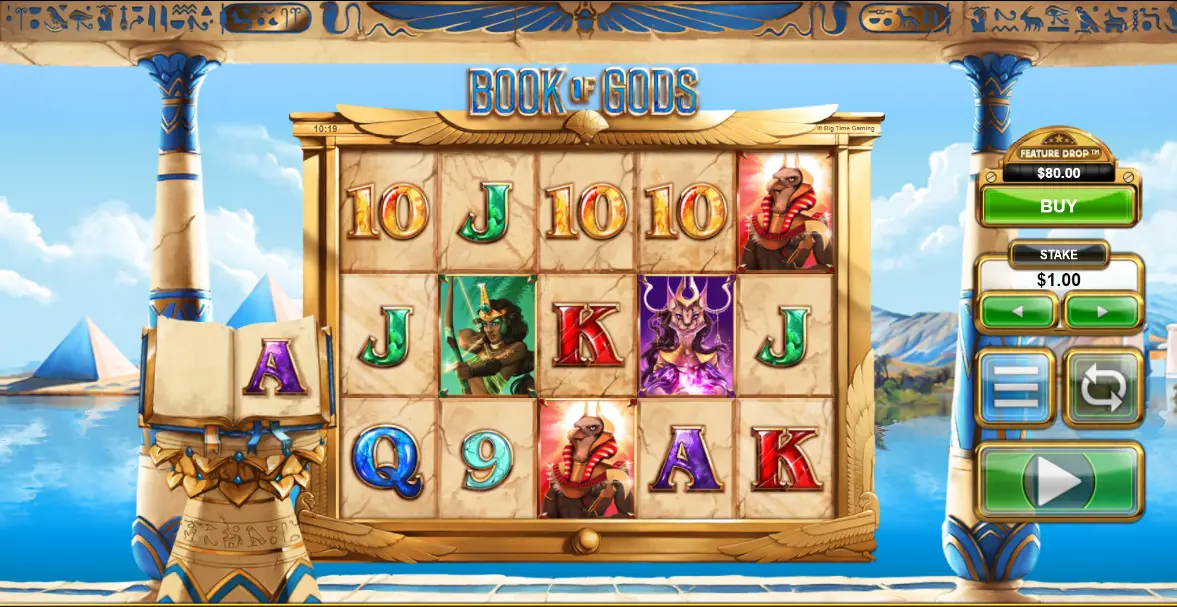
Book of Gods is a five-reel mythology game from Big Time Gaming with a published return to player of 96.35%. That is 0.64 percentage points above the 95.71% average across the games catalogued here, and marginally below the studio’s own 96.39% average across 82 titles. If you came to this book of gods slot review for numbers, the ones that exist are below, and the ones that do not exist are flagged just as clearly.
The 5-reel grid explained
Five reels is the default shape of the modern video slot, and it matters more than it sounds. Each reel is an independent column of symbols, and a result is produced by a random number generator the moment you press spin. Nothing about the previous spin carries into the next one.
A five-reel layout gives a designer enough columns to build combinations of three, four and five matching symbols, which is why five-of-a-kind payouts are usually the headline on a paytable and three-of-a-kind hits are usually the ones that actually keep a balance moving. The row count is not published for this game, and that genuinely changes what you can conclude: a 5×3 grid and a 5×4 grid produce different symbol densities and different combination counts even at identical RTP.
What you can take from the reel count alone is limited but real. Five columns means a conventional left-to-right reading of wins in most designs, and it means the game sits in the same structural family as the vast majority of slots released in the past two decades. Everything beyond that — symbol set, special reels, expanding mechanics — would be invention on my part, so load the demo and read the in-game paytable.
| Provider | Big Time Gaming |
|---|---|
| RTP | 96.35% |
| Reels | 5 |
| Theme | Mythology |
| Free demo | Yes |
| Site-wide average RTP | 95.71% |
Paylines, ways and how Book of Gods pays
No payline or ways count has been published for this title, so treat any specific figure you see quoted elsewhere as unverified. Here is what the general vocabulary means, so the paytable makes sense when you open it.
A payline is a fixed path across the reels; a win is registered when matching symbols land on that path. A ways game drops fixed paths entirely and counts any combination of matching symbols in adjacent columns, which is why ways totals run into the hundreds or thousands. Big Time Gaming is best known for the ways-style approach, and several of its titles carry it in the name, such as Extra Chilli Megaways, which publishes a higher 96.82% RTP. Book of Gods does not carry that label, so do not assume the mechanic.
Many slots also use wilds that substitute for other symbols, scatters that pay from anywhere on the grid, and free-spin rounds triggered by a set number of scatters. Those are industry-standard building blocks, not confirmed features here. The paytable inside the demo is the authority, and it is free to read.
96.35% RTP put in context
RTP is a long-run statistical average, not a session promise. 96.35% means a theoretical return of £96.35 for every £100 wagered, measured across a sample far larger than any individual will ever play — typically millions of spins. Over 1,000 spins at £1 a spin, £1,000 staked has an expected return of £963.50, but the actual distribution of outcomes around that figure is wide, and the house edge of 3.65% is what remains after everything else.
Comparison is where the figure becomes useful. At 96.35%, this game returns 64p more per £100 than the 95.71% average across the catalogue here, and 4p less than the 96.39% average for Big Time Gaming’s 82 titles. Within mythology, it clears 9 Arrows of Odysseus at 94.00% by a wide 2.35 points, while Gates of Olympus edges ahead at 96.50%.
Those gaps are small in absolute terms and only express themselves over very high volumes. A 0.15-point difference costs 15p per £100 staked on average. It is a reason to prefer one game over another when everything else is equal, not a reason to expect a different afternoon.
Volatility and hit patterns
No volatility rating and no hit frequency figure have been published for Book of Gods, which is a meaningful gap. RTP tells you the average return; volatility tells you how that return arrives, and two games at identical RTP can feel entirely different.
Low volatility generally means frequent small wins, a slowly drifting balance and long sessions from a modest bankroll. High volatility means long stretches with little back, punctuated by larger and rarer hits, which demands a bigger bankroll relative to your stake if you want the session to last. Medium sits between the two. None of this changes expected value — the RTP is the RTP — it only changes the shape of the ride.
Because the rating is absent, the practical move is to treat the game as unknown-risk and observe it yourself in the demo. Count how many spins pass between wins that actually exceed your stake, and watch how far the balance can fall before recovering. A few hundred demo spins will not give you a statistically valid answer, but it will tell you whether the rhythm suits you. A game is never due, hot or cold; each spin is independent.
Choosing a stake between the game’s own limits
Minimum and maximum bet figures have not been published for this title, so the stake range has to be read off the in-game bet selector rather than promised in advance. That is a small annoyance, not a dealbreaker, and the demo shows you the range before any money is involved.
The useful arithmetic works regardless of the numbers. Divide the money you have decided to spend by the number of spins you want from it, and that is your stake. A £50 budget aimed at 500 spins means 10p a spin. The same £50 at £1 a spin is 50 spins, and with unknown volatility that could be over in a couple of minutes. Shorter sessions expose you to more variance relative to the average, which cuts both ways.
Whatever you pick, keep it flat. Raising or lowering stakes in response to recent results does not alter the 3.65% house edge on any future spin, because the outcomes are independent. Stake sizing controls how long your money lasts and how large the swings feel — nothing more, and nothing less.
Demo play versus real money
A free demo is available, which means you can load the reels with virtual credits, read the paytable and confirm the reel layout, bet range and feature set for yourself before committing anything. Given how much is unpublished here, the Book of Gods free demo is doing real work: it fills in the volatility feel, the row count and the stake limits that the data sheet leaves blank.
What the demo cannot do is forecast results. Demo credits and real balances run on the same RTP, but a short demo run is a tiny sample, and a good or bad stretch in practice mode carries no information about what a real-money session will produce.
Slots are paid entertainment, not income. Play only if you are 18 or over, decide the amount you are willing to lose before you start, and stop when it is gone rather than topping up. If the spending has stopped feeling like a cost you chose, that is the point to step away and use the deposit limits and self-exclusion tools your operator provides.
Verdict on Book of Gods
The case for this one rests on a single solid number. 96.35% RTP is above the 95.71% catalogue average and within four hundredths of a point of Big Time Gaming’s house standard, so on pure return it is a reasonable choice among mythology titles and comfortably ahead of the weakest in that theme.
The case against is the missing data. No volatility rating, no hit frequency, no payline or ways count, no max win figure and no published stake range means you are buying a known return with an unknown shape. Some players will not mind; anyone planning bankroll around swing size will find that frustrating.
It is a reasonably well-trafficked title, ranked 2,566 and in the 87th popularity percentile, so it is not obscure. If a higher published RTP matters more to you than the Egyptian-mythology framing, Monopoly Megaways from the same studio lists 96.50%. Otherwise, spend twenty minutes in the demo, read the paytable, and decide with the real numbers in front of you.
Frequently Asked Questions
Can I play Book of Gods for free?
A free demo is available, so you can spin the five reels with virtual credits and no deposit. That matters more than usual here, because the volatility rating, payline count and stake range are all unpublished. The demo paytable is the only reliable place to confirm them before you wager anything.
What is the RTP of Book of Gods?
The published RTP is 96.35%, a theoretical return of £96.35 per £100 wagered across a very large sample of spins. That is 0.64 points above the 95.71% average for games listed here and marginally below Big Time Gaming's 96.39% average. It describes long-run maths, not any single session.
Is Book of Gods high or low volatility?
No volatility rating has been published for this title, so treat it as unknown risk. Low volatility usually means frequent small returns and longer sessions; high volatility means rarer, larger hits and a bigger bankroll requirement. Neither changes the 96.35% RTP. A few hundred demo spins will show you the rhythm.
Who makes Book of Gods and what else do they produce?
Big Time Gaming developed it, and the studio has 82 titles catalogued here with an average RTP of 96.39%. Among Big Time Gaming slots, Extra Chilli Megaways lists 96.82% and Spicy Meatballs Megaways 96.67%, both above this game's figure. The studio is closely associated with ways-style mechanics rather than fixed paylines.
How does it compare with Gates of Olympus?
Gates of Olympus publishes 96.50% RTP against 96.35% here, a gap of 0.15 points, or about 15p per £100 staked on average. Both draw on mythology. Since no volatility figure exists for Book of Gods, the comparison is limited to return alone, and the difference is small enough to be a tie-breaker rather than a deciding factor.