The single most useful number here is the return figure: the 3 clown monty slot carries a published RTP of 96.23%, which is higher than the 95.8% average across Play’n GO’s 434 titles and 0.52 percentage points above the 95.71% average of the games catalogued on this site. It runs on five reels, it is classed as a slot machine, and a free demo is available, so you can look before committing anything. What Play’n GO has not published, at least in the data available here, is volatility, payline count, stake range or a maximum win figure, and that absence shapes what follows.
Is 3 Clown Monty worth playing?
On the numbers that exist, yes, with a caveat. The return percentage is the one fact you can actually act on before you spin, and 96.23% puts this title in the upper half of what Play’n GO ships. Across 434 games the provider averages 95.8%, so this release is roughly four tenths of a point better than a random pick from the same studio, and half a point better than a random pick from the wider set of games reviewed here.
Half a percentage point sounds trivial. Over a long session it is not nothing: on £500 of total wagering, the difference between 95.71% and 96.23% is about £2.60 of expected cost. That is a rounding error on one session and a real number across a year of casual play.
The caveat is everything the data does not cover. Without a volatility rating you cannot predict whether the returns arrive in steady small amounts or in rare larger ones, and without a max win figure you cannot judge the ceiling. Those are material gaps, and a demo is the cheapest way to fill them yourself.
| Provider | Play’n GO |
|---|---|
| RTP | 96.23% |
| Reels | 5 |
| Free demo | Yes |
| Site-wide average RTP | 95.71% |
What 96.23% RTP means over 1,000 spins
RTP is a long-run statistical average, not a promise about your session. It describes what the game returns across an enormous number of spins, usually many millions, generated in testing rather than at your screen. Read as a rate, 96.23% means £96.23 returned per £100 wagered across a very large sample, with £3.77 retained as house edge.
Scale that to a realistic session. A thousand spins at £0.20 a spin is £200 of total wagering. At 96.23%, the expected return on that £200 is £192.46, an expected cost of £7.54. At £1.00 a spin, the same thousand spins wager £1,000, with an expected cost of £37.70.
Now the important qualifier: 1,000 spins is a tiny sample by RTP standards. Your actual result will scatter widely around those figures, and the wider the swings a game produces, the further from expectation a single session can land. Finishing 1,000 spins up 40% or down 80% is entirely compatible with a 96.23% return rate. Every spin is independent; the game holds no memory of the last one and nothing balances out within a session.
How volatile is the 3 clown monty slot?
No volatility rating is available for this title in the data at hand, so treat any confident “high variance” or “low variance” claim you see elsewhere with suspicion unless it cites Play’n GO’s own paytable documentation. Missing data is worth knowing about rather than papering over.
What the concept controls is worth understanding regardless. Low-volatility games return their 96.23% in frequent small amounts: balances drift down gently, sessions last a long time on a given deposit, and results cluster close to expectation. High-volatility games return the same percentage in rarer, larger payouts, which means long stretches below your starting balance punctuated by occasional recoveries. Same mathematics, very different experience.
That distinction drives bankroll sizing more than RTP does. A rough working rule many players use is to hold a few hundred times the spin stake for a high-variance game and rather less for a low-variance one, simply so the swings have room to happen without ending the session immediately.
In the absence of a published figure, a few hundred demo spins will tell you more than any review can. Watch how often the balance moves and how big the moves are.
What the 5-Reels theme brings to the game
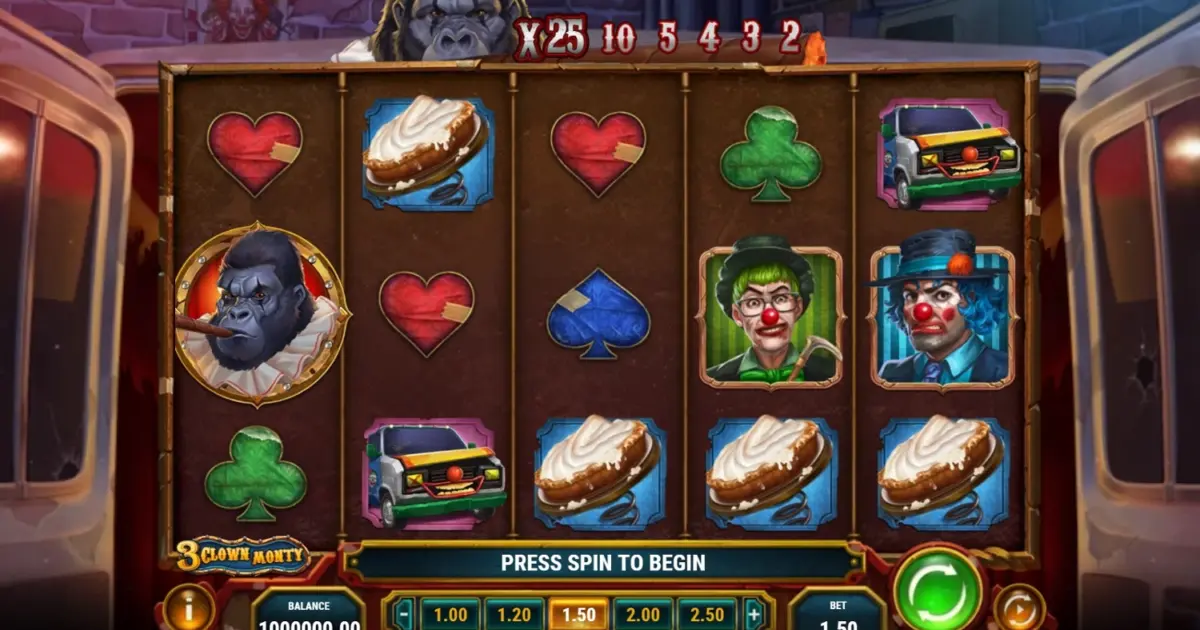
The only theme label attached to this release is “5-Reels”, which is structural rather than thematic: it describes the reel set, not a subject, setting or art direction. The game name points at a fairground or circus idea, but there is no confirmed detail here about symbols, characters, animation or sound, so nothing specific will be invented for you.
Five reels is the standard modern layout and it matters mainly for how wins are counted. Compared with three-reel formats, five reels give designers room for more symbol positions and therefore more ways to form a winning combination, whether those are counted as fixed paylines, adjustable lines or a “ways” system where any matching symbols on adjacent reels pay. Play’n GO uses all of these approaches across its range.
Because the payline or ways count is not published in the data available, the per-spin cost structure is unclear: some five-reel games charge one stake unit per line, others charge a single flat stake. The demo screen will show you which, and that is the first thing to check when you open it.
Stakes, session length and bankroll
No minimum or maximum stake is listed for this title, so the figures below are illustrative rather than confirmed. Open the 3 Clown Monty free demo and read the bet selector before you assume anything about affordability.
The arithmetic of session planning is simple once you know your stake. Divide your budget by your spin stake to get the number of spins you can afford in the worst realistic case, then apply the 3.77% house edge to estimate the average case. A £50 budget at £0.20 a spin covers 250 spins even with no returns at all; at an average return rate of 96.23%, the same £50 typically funds a considerably longer session because most spins return something to be re-wagered.
Two things not to do. Do not raise stakes after losses or lower them after wins expecting it to change your position: staking patterns alter the size of your swings, never the 3.77% edge. And do not treat a good demo run as a forecast. Demo play uses the same mathematics but tells you nothing about how your real-money session will land.
Alternatives if 3 Clown Monty is not for you
If the return rate is what brought you here, one Play’n GO title beats it: Legacy of Dead is published at 96.58%, a third of a point better, which on £1,000 of wagering is about £3.50 less expected cost. Divine Divas sits almost level at 96.25%, so choose between them on presentation rather than mathematics.
Worth knowing for contrast: Book of Dead, easily the most recognised name of the group, is listed at 94.25%. That is two full points below this release and 1.46 points below the corpus average, which translates to roughly £20 more expected cost per £1,000 wagered. Popularity and return rate are not the same thing, and this is a clean example of the gap.
Across the studio’s catalogue the spread runs from 94.25% to 96.58% among these four alone, so checking the number on each game’s paytable is a habit worth forming when you browse Play’n GO slots. On this measure, the game under review holds up well against its own stablemates.
Final take
A 96.23% return rate, five reels, a demo available, and genuine gaps in the published detail. That is the honest summary. If you want the best documented return among the Play’n GO titles listed here, Legacy of Dead has it by a third of a point; if the fairground idea appeals and the return rate is good enough at half a point above the corpus average, this one earns a look. The unknown volatility is the reason to start in the demo rather than at your usual stake.
Play is for over-18s only. Decide your budget before you open the game, treat that amount as the price of the entertainment rather than an investment, and stop when it is gone. If tracking what you have spent starts to feel difficult, deposit limits and self-exclusion tools exist at every licensed operator and are there to be used.
One last reminder about the mathematics: the 3.77% house edge is built into every spin and does not accumulate, expire or become due. No stake pattern, session length or time of day changes it.
Frequently Asked Questions
Can you play 3 Clown Monty for free?
A free demo is available for this title, which lets you see the reel layout, the bet selector and the pace of play without staking money. That matters here because volatility and payline count are not published, so a few hundred demo spins are the practical way to judge how the 96.23% return actually arrives.
What is the RTP of 3 Clown Monty?
The published RTP is 96.23%, meaning £96.23 returned per £100 wagered across a very large sample, with a 3.77% house edge. That sits above Play'n GO's 95.8% average across 434 games and 0.52 points above the 95.71% corpus average. It describes long-run behaviour, not any single session.
Is 3 Clown Monty a high volatility slot?
No volatility rating is published in the available data, so any confident claim either way should be treated cautiously. Volatility determines whether the 96.23% return arrives in frequent small amounts or rare larger ones, which affects how much bankroll you need. Watching the size and frequency of balance movements in the demo answers it faster than a review can.
Who makes 3 Clown Monty?
Play'n GO developed it, a studio with 434 titles catalogued here and an average published RTP of 95.8% across them. Their range spans from Book of Dead at 94.25% to Legacy of Dead at 96.58%, so return rates vary widely within the same catalogue. This release, at 96.23%, sits in the upper part of that spread.
How does 3 Clown Monty compare to Legacy of Dead?
Legacy of Dead has the better published return at 96.58% against 96.23%, a gap of 0.35 percentage points, or roughly £3.50 of expected cost per £1,000 wagered. Both are Play'n GO five-reel releases above the corpus average. Since volatility is unpublished for this title, the return figure is the cleanest comparison available.