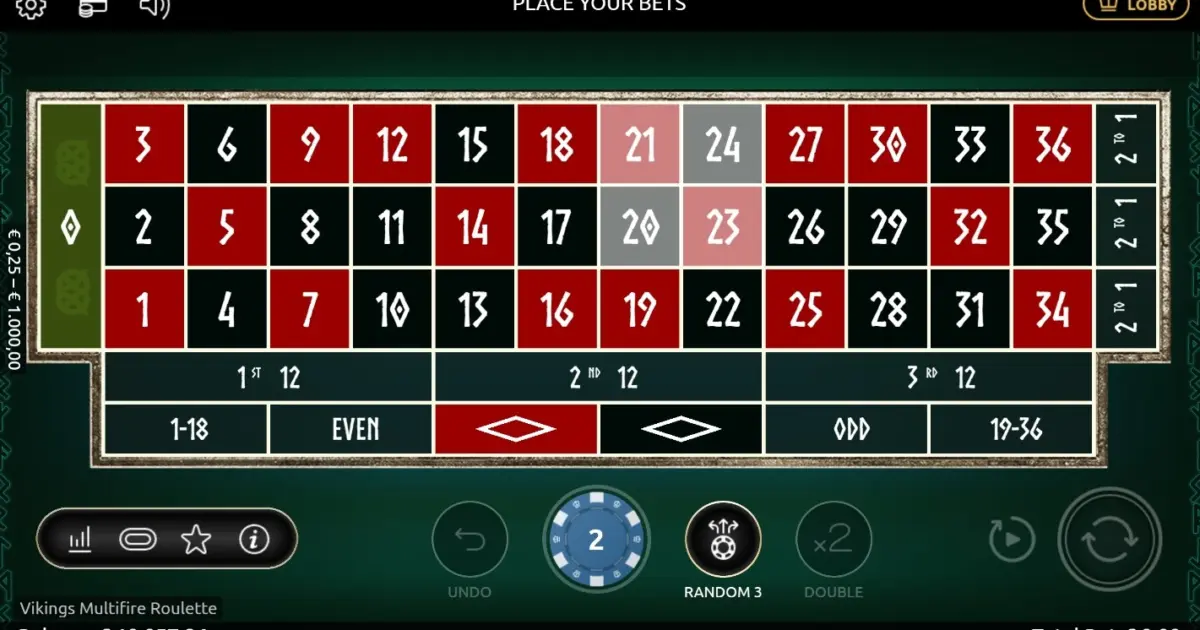
Vikings Multifire Roulette delivers a 97.3% RTP on a European wheel, which translates to the standard 2.70% house edge you find on any single-zero table. Real Dealer Studios has wrapped the mechanics in a themed studio environment, but the underlying game is classic roulette: 37 pockets, no La Partage, and every bet priced at the same expected loss. The decision here is whether the presentation adds enough to justify this table over a plain European wheel elsewhere, and whether 97.3% return sits where you need it in your session budget.
The name signals European rules, and the RTP figure confirms it. That makes this a middle-ground choice: better than any double-zero American wheel, but without the even-money edge reduction that French rules with La Partage would bring. For players prioritising the lowest house edge available, a French roulette table with En Prison or La Partage will always beat this one on even-money bets. For everyone else, this is a known quantity with a free demo and a clear number to compare against alternatives.
Is Vikings Multifire Roulette worth your spins?
It depends entirely on what you value in a roulette session. The 97.3% RTP is standard for a European wheel with no rule variations, so the maths won’t surprise anyone who understands the game. The 2.70% house edge applies uniformly across every standard bet type, from a single straight-up number to a red/black wager. You are not getting a hidden advantage or a worse-than-usual deal; you are getting textbook European roulette at the rate the wheel geometry dictates.
The “Multifire” branding and Vikings theme suggest visual or feature differentiation, but the FACTS available do not specify multiplier mechanics, side bets, or altered payouts. Without that detail, assume this is a presentation-focused variant rather than a mechanical departure. If the studio aesthetic or host presentation matters to your enjoyment, the theme may add value. If you care only about the house edge, this table offers nothing better or worse than any other single-zero wheel without La Partage.
The free demo is the single most useful feature here. It lets you assess the interface, betting controls, and pacing before committing real money. Use it to confirm the pocket count, check the paytable, and verify that the game flow suits your preferred bet cadence. No review can substitute for that direct experience, and Real Dealer Studios has made it available without registration friction.
Real Dealer Studios and this wheel
Real Dealer Studios operates a portfolio of 30 games with an average RTP of 97.25%, and Vikings Multifire Roulette sits exactly at 97.3%—marginally above the studio mean and 0.33 percentage points above the broader market average of 96.97%. That positioning is deliberate: Real Dealer Studios builds its catalogue around live and automated roulette variants with consistent return figures, avoiding the RTP variation you see in slot-heavy providers.
If you are comparing tables within the same studio, Real Auto Roulette offers an identical 97.3% RTP without the thematic overlay, and Roulette with Rachael matches the same figure with a named-host presentation. The choice between these three comes down to interface preference and studio atmosphere rather than any mathematical difference. For a lower-RTP alternative within the same provider, Fortune Finder with Holly drops to 96.6%, likely due to a side-bet or feature mechanic that funds additional payouts at the cost of base-game return.
Real Dealer Studios focuses on automated and hybrid roulette formats, which means faster spin rates and no waiting for other players. That speed advantage cuts both ways: more spins per hour means the house edge compounds faster, but it also means you can complete a session target in less clock time. If you prefer a slower, more social pace, a live multi-player table will stretch the same bankroll further in real time, even at an identical RTP.
House edge: 2.70%, 5.26% or 1.35%?
The house edge on any roulette wheel is a function of pocket count and rule variations, and the maths is exact. A European wheel has 37 pockets—numbers 1 to 36 plus a single zero. Every standard bet pays as if the zero does not exist, which creates the gap between true odds and payout odds. A straight-up number bet pays 35 to 1, but the true odds of hitting it are 36 to 1. That single-pocket shortfall is the house edge, and it works out to 2.70% on every bet type: inside, outside, columns, dozens, even-money wagers. The shape of variance changes, but the expected loss per euro wagered does not.
An American wheel adds a second zero, bringing the total to 38 pockets. The payouts stay the same, so the gap widens. The house edge rises to 5.26% on all standard bets, and the five-number basket bet—covering 0, 00, 1, 2, 3—jumps to 7.89%. There is no strategic reason to play double-zero roulette when a single-zero wheel is available at the same minimum bet. The American wheel costs you nearly twice as much per spin in expected value.
French roulette applies La Partage or En Prison to even-money bets when the zero lands. La Partage returns half your stake immediately; En Prison locks the bet for one more spin and returns it in full if you win. Both rules cut the house edge on red/black, odd/even, and high/low bets to approximately 1.35%, the lowest standard edge in the game. Vikings Multifire Roulette, with its 97.3% RTP and 2.70% edge, does not apply these rules. If your session plan revolves around even-money bets, a French table with La Partage will always outperform this one mathematically.
The name “Vikings Multifire Roulette” and the 97.3% RTP both point to a single-zero European wheel, and that interpretation is consistent with the numbers. Confirm the pocket count on the game’s own rules screen before betting, but expect 37 pockets and a uniform 2.70% edge across all standard bet types.
Bet types, payouts and true odds
The table below shows the standard bet types available on a 37-pocket European wheel, the payout each bet offers, the true odds of winning, and the house edge. Every bet listed here carries the same 2.70% edge because the payout shortfall is proportional to the probability.
| Bet Type | Payout | True Odds | House Edge |
|---|---|---|---|
| Straight (single number) | 35:1 | 36:1 | 2.70% |
| Split (two numbers) | 17:1 | 17.5:1 | 2.70% |
| Street (three numbers) | 11:1 | 11.33:1 | 2.70% |
| Corner (four numbers) | 8:1 | 8.25:1 | 2.70% |
| Line (six numbers) | 5:1 | 5.17:1 | 2.70% |
| Dozen / Column | 2:1 | 2.08:1 | 2.70% |
| Even-money (red/black, odd/even, high/low) | 1:1 | 1.06:1 | 2.70% |
Inside bets—straight, split, street, corner, line—concentrate your stake on fewer numbers and produce higher volatility. A straight-up bet will lose 36 times out of 37 on average, but when it hits, it pays 35 units on a 1-unit stake. Outside bets—dozens, columns, even-money wagers—win more frequently and produce smaller swings. A red/black bet wins 18 times out of 37, but it only doubles your stake when it does. Neither approach changes the 2.70% cost; they redistribute how that cost arrives over time.
What experienced players actually do
Players who understand the maths choose their bet type based on session goals and variance tolerance, not on any belief that one bet is “safer” or “smarter” than another. If you want your bankroll to last longer in clock time, even-money bets produce the slowest drawdown because they win nearly half the time. If you are willing to lose faster in exchange for the chance of a large single hit, straight-up or small-group inside bets deliver that shape. The expected loss per euro wagered is identical either way.
Flat staking—betting the same amount every spin—is the only approach that does not amplify risk. Progression systems such as Martingale, Fibonacci, and D’Alembert attempt to recover losses by increasing bet size after a loss, but they do not change the house edge. Every spin is independent; the wheel has no memory. Doubling your bet after a loss only guarantees that when you eventually hit the table limit or exhaust your bankroll, the loss will be larger than it would have been with flat stakes. These systems redistribute variance and create the illusion of control, but they do not produce profit over time.
Session limits—both time and money—are the only risk control that works. Decide in advance how much you are prepared to lose, and stop when you reach that figure. Set a win target if you want, but understand that walking away with profit on any given session is luck, not skill. The house edge ensures that over enough spins, the expected value converges to a loss. Roulette is entertainment with a known cost, not an income strategy.
Free play before real money
Vikings Multifire Roulette offers a free demo, and using it is the single most useful step you can take before committing real money. The demo lets you verify the pocket count, inspect the paytable, test the interface, and confirm the betting limits. No written review can substitute for direct experience of the game flow, and the demo removes the financial risk of discovering mid-session that the controls or pacing do not suit your preference.
Use the demo to place every bet type you intend to use in a real session. Confirm that the chip denominations, bet confirmation flow, and undo options work the way you expect. Check whether the game offers a racetrack for neighbour and call bets, and verify that the spin speed and result display match your tolerance for pacing. These interface details matter more than they appear to in static screenshots, and the demo is the only way to surface them before money is at stake.
Responsible gambling means setting a budget in advance, treating losses as the cost of entertainment, and never chasing losses with money you cannot afford to lose. Roulette is a negative-expectation game; no system, pattern, or betting progression changes that. If you find yourself betting more than you planned, or returning to recover losses, stop. The game will still be there tomorrow. This is entertainment for adults 18 and over, and it should never be mistaken for a way to make money.
Final take
Vikings Multifire Roulette is a European wheel with a 97.3% RTP, a 2.70% house edge, and a themed studio presentation from Real Dealer Studios. The maths is standard single-zero roulette, and the return figure sits marginally above the studio average and the broader market mean. The free demo is the most valuable feature, and using it before committing real money is the only way to confirm the interface and pacing match your session preferences.
If you are comparing this table to others, prioritise the house edge first. A French roulette table with La Partage will always cost you less on even-money bets, and a double-zero American wheel will always cost you more on everything. Within the European category, this wheel offers nothing unusual in the maths, so the decision comes down to provider trust, interface quality, and whether the Vikings theme adds or detracts from your session experience. The demo answers that question better than any review can.
Frequently Asked Questions
Is there a free demo for Vikings Multifire Roulette?
Yes, Vikings Multifire Roulette offers a free demo. Use it to verify the pocket count, test the interface, check betting limits, and confirm the game flow before committing real money. The demo is the only way to assess whether the pacing and controls suit your session preferences without financial risk.
What is the RTP of Vikings Multifire Roulette?
The RTP is 97.3%, which corresponds to a 2.70% house edge. This is the standard return for a European roulette wheel with 37 pockets and no rule variations like La Partage. The figure sits slightly above Real Dealer Studios' portfolio average of 97.25% and 0.33 percentage points above the broader market average of 96.97%.
Is Vikings Multifire Roulette a single-zero or double-zero wheel?
The 97.3% RTP and the "European" designation implied by the name both point to a single-zero wheel with 37 pockets and a 2.70% house edge. Confirm the pocket count on the game's own rules screen before betting, but expect standard European roulette mechanics without La Partage or En Prison rules.
Can a betting system beat Vikings Multifire Roulette?
No. Every spin is independent, and the house edge of 2.70% applies uniformly to every bet. Martingale, Fibonacci, and other progression systems redistribute variance and accelerate the risk of hitting table limits, but they do not change expected value. Flat staking and session limits are the only rational approach to managing risk on a negative-expectation game.
How does Vikings Multifire Roulette compare to other Real Dealer Studios tables?
Real Auto Roulette and Roulette with Rachael both offer the same 97.3% RTP within the same studio, so the choice between them is presentation and interface rather than maths. Fortune Finder with Holly drops to 96.6% RTP, likely due to a side bet or feature that funds additional payouts at the cost of base-game return. If the house edge is your priority, all three 97.3% tables are mathematically identical.




