Roulette with Rachael is a Real Dealer Studios table whose published RTP of 97.3% tells you almost everything you need before the first spin lands. That figure maps directly onto the single-zero wheel’s 2.70% house edge, meaning no multiplier gimmicks are diluting your return on standard bets and no double-zero pockets are quietly inflating the margin. A free demo is available, which is the responsible place to start if you want to understand the layout and pacing before committing money.
How Roulette with Rachael plays
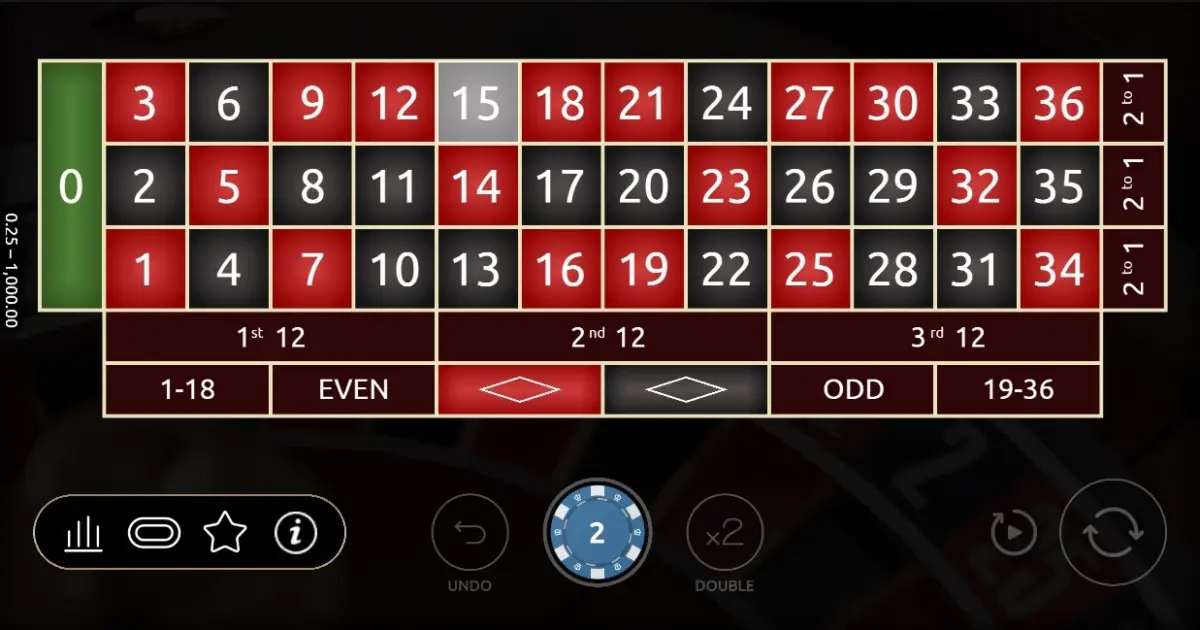
You get a traditional roulette experience: a wheel, a betting layout, chips on your chosen positions, and a croupier announcing the number. The game follows the structure of a single-zero European-style wheel, which means the pocket for zero exists but a second zero does not. The betting grid includes all standard inside and outside positions—straight numbers, splits, streets, corners, lines, columns, dozens, and the even-money bets on colour, parity, and range.
Because this is a Real Dealer Studios product, the presentation leans toward a live-dealer atmosphere rather than a purely automated one. The studio produced roughly 30 titles in its catalogue, and the portfolio’s average RTP sits at 97.25%, putting this table fractionally above its maker’s norm and comfortably above the broader corpus average of 96.97%. There is no confirmed information in the available data about French rules such as La Partage or En Prison. If those were active on even-money bets, the house edge would drop to approximately 1.35%—and the published RTP would likely reflect that. Since it does not, assume the standard 2.70% applies uniformly across the board.
The pocket count is the whole story
Every question about roulette’s mathematical fairness reduces to one number: how many pockets does the wheel have. A single-zero wheel with 37 pockets produces a house edge of exactly 2.70% on every standard bet, because the payout structure is calibrated against 36-to-1 true odds while the actual probability of any single number is 1-in-37. That single missing pocket is the entire casino advantage—there is no hidden rake, no separate fee, no progressive deduction lurking behind the numbers.
The 97.3% RTP published for this table is the direct arithmetic complement of that 2.70% edge. It is not an “average across bet types” figure or a weighted blend; it is the flat rate you face regardless of where you place your chips. Compare that with a double-zero wheel, which introduces a 38th pocket and pushes the house edge to 5.26%—more than doubling your expected loss per spin. If you are choosing between tables and one shows an RTP near 94.7%, you are looking at the double-zero layout no matter how friendly the dealer’s name on the marquee.
Reading the 97.3% RTP figure
An RTP of 97.3% means that for every 100 units wagered across a theoretically infinite number of spins, 97.30 units return to players and 2.70 units constitute the house margin. In practice, variance makes short sessions look nothing like that number. You could walk away 50 units ahead or 50 units behind within a few dozen spins; neither result contradicts the maths. The figure is a long-run expectation, not a session forecast.
Against the provider’s catalogue average of 97.25%, this table sits 0.05 percentage points above the norm. Against the full game corpus average of 96.97%, it is 0.33 points ahead. These are small margins. The 0.33-point gap between this table and the corpus average translates to roughly 33 units of additional expected return per 10,000 units wagered. Meaningful over very long sessions, statistically invisible over a single evening at the table.
If you are comparing this against Vikings Multifire Roulette, which carries the same 97.3% RTP, the difference will come down to feature design rather than mathematics. The underlying edge is identical.
Choosing bets for the session you want
The house edge on Roulette with Rachael does not change whether you put a chip on a single number or spread it across the red column. What changes is the shape of your results: how often you win, how large those wins are, and how painful the losing streaks feel. Inside bets concentrate variance; outside bets smooth it. Neither choice moves your expected loss per unit wagered by a single basis point.
Here is how the standard bet types compare on a single-zero layout:
| Bet type | Payout | Win probability | True odds | House edge |
|---|---|---|---|---|
| Straight up | 35:1 | 1/37 (2.70%) | 36:1 | 2.70% |
| Split | 17:1 | 2/37 (5.41%) | 17.5:1 | 2.70% |
| Street | 11:1 | 3/37 (8.11%) | 11.33:1 | 2.70% |
| Corner | 8:1 | 4/37 (10.81%) | 8.25:1 | 2.70% |
| Line | 5:1 | 6/37 (16.22%) | 5.17:1 | 2.70% |
| Column / Dozen | 2:1 | 12/37 (32.43%) | 2.08:1 | 2.70% |
| Even money (red, black, odd, even, low, high) | 1:1 | 18/37 (48.65%) | 1.06:1 | 2.70% |
A straight-up number loses roughly 73% of the time and wins 2.7% of the time. An even-money bet wins just under half your spins. Pick the pattern that matches your tolerance for long dry stretches, not the one that promises a better return—it cannot, because they all carry the same edge.
Martingale and friends: the honest answer
No betting progression alters the house edge on a wheel with 2.70%. This is not a matter of degree or debate. Each spin is independent; the ball has no knowledge of what happened on the previous spin, and no arrangement of stake sizes can create an expected profit from a negative-expectation game. The Martingale, Fibonacci, D’Alembert, Labouchère, and every variation you will find on a search results page redistribute the timing of your wins and losses without shifting their average.
What these systems actually do is increase your exposure to table limits and ruin. The Martingale doubles your stake after each loss, meaning six consecutive defeats turn a 5-unit base into a 320-unit next bet. Most tables will not accept that wager. When you hit the cap, you lose the entire accumulated sequence in one event. The system does not fail because of bad luck; it fails because of arithmetic. The house edge is baked into every individual spin, and no sequence of spins escapes it.
If you are looking for a demo environment to confirm this for yourself, the free play mode exists on this title. Watch a Martingale sequence play out without financial consequence.
Bankroll and table limits
The published data for this table does not include specific minimum or maximum stakes. That absence matters: your session strategy is constrained by whatever limits the operator has configured, and without them listed here you should verify them before you deposit. A high-variance approach with straight-up bets requires enough bankroll to survive long losing stretches; a low-variance approach with even-money bets requires enough to ride out the inevitable clusters of red or black outcomes. Neither works with a bankroll that is too small for the limits in play.
For reference, the single-zero house edge means the casino expects to retain 2.70% of total wagered over the long run. That is not a per-session guarantee—it is a statistical property of the game. You should set a loss limit before you sit down, treat the entire session budget as spent at the moment you begin, and never chase losses with money you were not prepared to lose. This is entertainment with a negative expectation, not an income stream. All play must be for those aged 18 and over.
Verdict on Roulette with Rachael
This is a clean, standard single-zero roulette table with nothing subtracted from its maths and nothing added to complicate it. The 97.3% RTP is the best you can expect from a classic layout without French rules, it places the game above the provider’s own catalogue average and well above the corpus norm, and the absence of multipliers or side bets means the edge stays flat and transparent at 2.70% across every bet.
If you value predictability in a roulette session—knowing exactly what edge you face and not having to parse a modified paytable to understand your real return—this table does its job well. For a contrast in presentation from the same provider, Real Auto Roulette matches the RTP with a different dealer format. If you want to see what a lower RTP looks like in context, Fortune Finder with Holly drops to 96.6% and is worth a look for comparison. Try the demo first, set your budget, and play the numbers honestly.
Frequently Asked Questions
Can I play Roulette with Rachael for free?
Yes. A free demo version is available, letting you interact with the full layout and betting grid without staking money. Demo play is useful for learning the pace and interface, but it has no predictive value for real-money sessions—the maths is the same regardless of whether you are playing with credits or cash.
What is the RTP of Roulette with Rachael?
The published RTP is 97.3%, which sits 0.33 percentage points above the broader corpus average of 96.97% and slightly above Real Dealer Studios' catalogue average of 97.25%. This figure corresponds to a flat 2.70% house edge applied uniformly across all standard bet types on a single-zero layout.
What house edge does Roulette with Rachael carry?
The house edge is 2.70%, derived from the 97.3% RTP. This is the standard single-zero roulette edge—lower than the 5.26% you face on a double-zero wheel. No French rules like La Partage are confirmed for this table, so even-money bets carry the same 2.70% edge as inside bets rather than a reduced 1.35%.
Does the Martingale system work on Roulette with Rachael?
No. The Martingale does not change the 2.70% house edge on any individual spin; it only redistributes the shape of your results. Because each spin is independent, a losing streak does not make a win more likely on the next one, and table limits eventually convert a long sequence of small wins into one loss that exceeds them all.
How does Roulette with Rachael compare to other Real Dealer Studios roulette tables?
It shares the same 97.3% RTP as Real Auto Roulette and Vikings Multifire Roulette. The difference lies in format: Real Auto uses automated dealing, Vikings adds a multiplier layer that reshapes individual payouts, while Roulette with Rachael presents a standard dealer-led single-zero game with no modified paytable.




