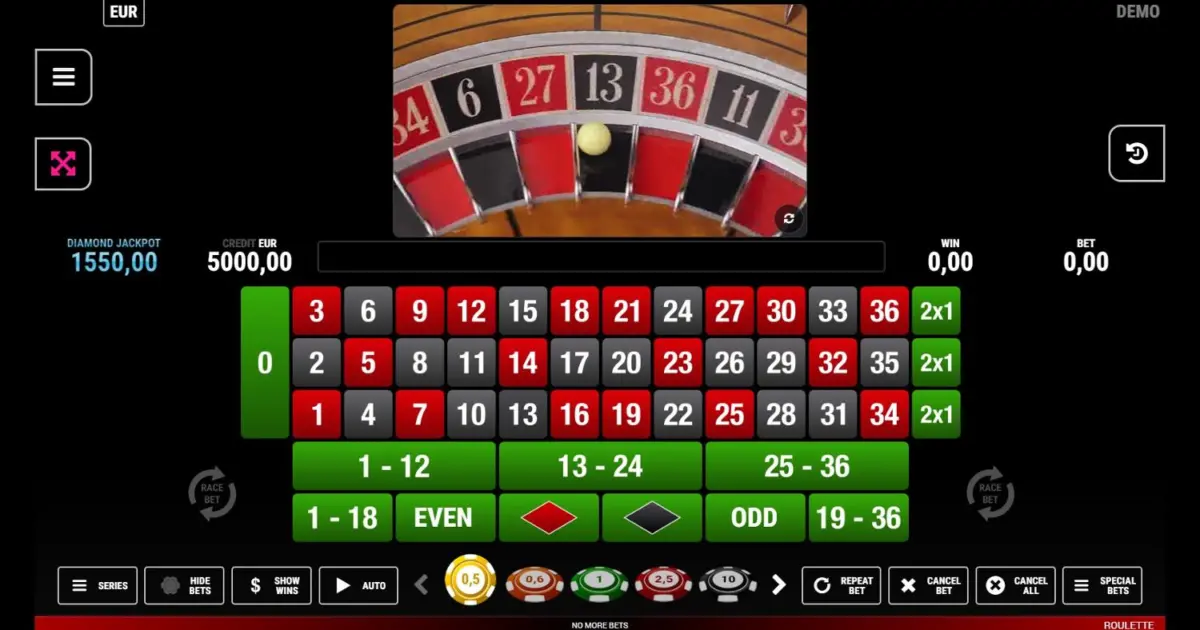
Roulette (Fazi) earns its rank of 34 on a straightforward promise: a 97.3% return-to-player figure that mathematically demands a single-zero wheel. The 2.70% house edge this produces is the lowest available on any standard roulette bet without French-rule concessions. Our dataset does not explicitly confirm the pocket count, call-bet layout, or table limits, so you should verify those on the game’s own rules screen before depositing. Compared against the corpus average of 96.97%, this table sits 0.33 points above the field — not a game-changer, but the kind of margin that adds up over long sessions. If you want to compare how a different provider handles the identical maths, European Roulette (Red Tiger) reports the same 97.3% RTP and may differ in pace and interface.
Return to player and house edge
The 97.3% RTP is the only confirmed numerical fact about this table’s economics. Translating that into practical terms: for every 100 units you wager over an arbitrarily long session, the game retains 2.70 units on average. That figure is uniform across all standard bets — it does not improve on inside bets and does not worsen on outside bets. It simply is the cost of playing.
Fazi’s average RTP across its entire range of three games is also 97.3%, meaning this table is not an outlier within its own portfolio. You are not getting a “generous” variant relative to what Fazi typically publishes. The 0.33-point advantage over our overall corpus average exists, but it is small enough that interface comfort and session length matter far more to your experience than that marginal RTP difference.
What the FACTS block does not tell you: whether La Partage or En Prison rules apply. If they do, even-money bets would return half your stake on a zero landing, cutting the effective house edge on those bets to roughly 1.35%. You can only discover this by checking the game rules in the interface. If French rules are absent, 2.70% is the floor you will not go below.
Reading the Fazi paytable before you bet
Because our data confirms only the aggregate RTP and not the per-bet structure, your first action with any Fazi roulette table should be opening the paytable or information screen and comparing every payout against its stated true odds. The paytable is where you confirm three things the RTP alone cannot tell you.
First, confirm the straight-up payout is 35:1 and not something unusual. If it is, the maths is consistent with a standard layout. If it is lower — as happens in multiplier roulette formats — the effective RTP on those specific bets diverges from the headline 97.3%. Second, check whether any basket or five-number bet exists. On American double-zero wheels, a five-number bet carries a 7.89% house edge, which would be a red flag. Third, look for side bets or extra wager options. Fazi’s small portfolio of three titles means their features are often shared across V.I.P. Roulette (Fazi) and Lux Roulette; comparing the paytables across all three can reveal whether one offers French rules that the other does not.
Bet coverage, variance and session length
Given the 2.70% house edge this table reports, the standard single-zero payout structure applies. The table below shows each bet type, its payout, the true odds against, and the resulting variance level. The gap between the “Payout” column and the “True odds” column is the house edge in miniature — one pocket of advantage on a 37-pocket wheel.
| Bet type | Payout | True odds against | Variance level |
|---|---|---|---|
| Straight up (one number) | 35 : 1 | 36 : 1 | Very high |
| Split (two numbers) | 17 : 1 | 18 : 1 | High |
| Street (three numbers) | 11 : 1 | 12 : 1 | High |
| Corner (four numbers) | 8 : 1 | 9 : 1 | High |
| Line (six numbers) | 5 : 1 | 6 : 1 | Medium-high |
| Dozen or Column (12 numbers) | 2 : 1 | 3 : 1 | Medium |
| Even money (red/black, odd/even, high/low) | 1 : 1 | 2 : 1 | Low |
The expected loss per spin is identical regardless of which row you choose: 2.70% of your stake. What changes is the shape of your bankroll curve. Even-money bets keep you in the game longer with smaller swings, which matters if your session budget is limited and you are buying entertainment time rather than chasing a single large payout.
Patterns, hot numbers and the gambler’s fallacy
Every spin on this RNG roulette is independent. The wheel has no memory, no balance mechanism, and no obligation to “correct” after a run of reds or a cluster of low numbers. The number that appeared four times in your last hundred spins has exactly the same probability of appearing on the next spin as any other number: one in 37, assuming the single-zero layout implied by the RTP.
No betting system — Martingale, Fibonacci, D’Alembert, Labouchère, or any progression you have seen marketed as “low risk” — changes the expected value of a spin. The 2.70% edge is a property of the payouts, not of the sequence you bet on. Progressions merely redistribute your variance: Martingale doubles your exposure to table limits and produces a high probability of small wins punctuated by rare, catastrophic losses that exceed any bankroll you will realistically hold. If you arrived looking for a system that works against this table, the honest answer is that one does not exist.
Neither does tracking results help. An RNG wheel produces outcomes governed by a certified random-number generator, not by physical bias that historical frequency could reveal.
Trying the demo
Fazi offers a free demo of this table, which means you can play with virtual credits indefinitely. The demo is useful for three specific purposes: learning the interface, testing whether you enjoy the pace and animation speed, and checking the paytable to confirm the information you need before playing for real. It is not useful for predicting real-money outcomes, testing a system’s profitability, or building a sense of when the wheel is “due” to pay.
A demo that feels generous is a demo with generous virtual credits, not a demo with a different random distribution. The maths is the same whether the chip is real or virtual.
Roulette should be treated as paid entertainment, not as income or investment. Set a budget before you begin a session, never exceed it, and play only if you are 18 or older and have the means to lose the staked amount without consequence. If you find yourself chasing losses or feeling an urgency to “win it back,” stop and take a break.
Verdict on Roulette (Fazi)
The verdict on Roulette (Fazi) is simple: the maths is sound, the RTP is competitive, and there is nothing hidden or unusual in the numbers we can confirm. At 97.3% return with a 2.70% edge, this table does not disadvantage you beyond what the game’s nature requires. Its rank of 34 places it in the upper quartile of our roulette catalogue by popularity, and its 85.2nd-percentile rating suggests players engage with it readily.
What keeps it from a higher recommendation is that our data cannot confirm the finer rules: whether French concessions apply, what the table limits are, or which call bets the racetrack offers. Those details can meaningfully improve or worsen your experience relative to competitors. Fazi has only three titles in its range, so the entire portfolio sits at the same 97.3% — you are not losing anything by checking their other options before committing to a session length. Open the demo, read the paytable, confirm the pocket count, and you will know within minutes whether this table is the best available to you in that moment.
Frequently Asked Questions
Can I play Roulette (Fazi) for free without an account?
Yes. FACTS confirms a free demo is available for this table. You can play with virtual credits to test the interface, confirm the paytable payouts, and gauge whether you find the pace comfortable before deciding to wager real money.
What is the RTP of Roulette (Fazi)?
The published RTP is 97.3%, which corresponds to a house edge of 2.70% across all standard bets. This figure sits 0.33 percentage points above the average RTP of roulette games in our catalogue and matches the typical return for a single-zero European layout.
Is Roulette (Fazi) a European or American wheel?
The 97.3% RTP implies a 2.70% house edge, which is mathematically consistent with a 37-pocket single-zero European wheel. However, our data does not explicitly confirm the pocket count. Always verify the wheel layout in the game's own rules screen before playing for real money.
Can Martingale or any betting system beat this roulette table?
No. The 2.70% house edge applies to every spin regardless of how you sequence your bets. Martingale and other progressions redistribute variance and increase the probability of hitting table limits, but they do not alter the expected loss per unit wagered. No system changes the mathematics of this table.
How does Roulette (Fazi) compare to V.I.P. Roulette by the same provider?
Both report the same 97.3% RTP, and Fazi's average across all three titles is 97.3%, so the underlying maths appears identical. The difference will lie in interface design, animation speed, and possibly table limits or call-bet availability. Check both paytables to see if one offers French rules the other lacks.




