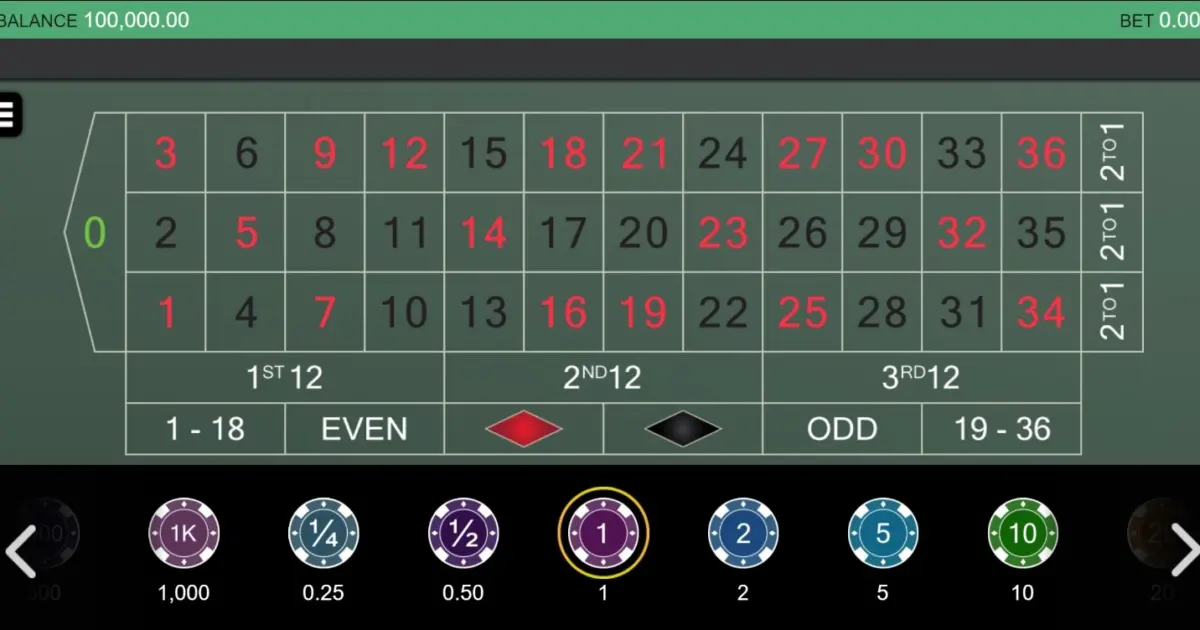
If you are searching for Real Roulette with Holly and want to know whether it is worth your time, the short answer is that its published return-to-player figure of 97.3% places it squarely in line with the best classic roulette tables available online. It is neither a gimmick game nor a high-edge trap — it is a clean, traditional roulette experience presented through a live dealer format.
What kind of roulette is Real Roulette with Holly?
The RTP published for this table tells you most of what you need to know about its structure. A 97.3% return means a 2.70% house edge, which is the exact mathematical signature of a European single-zero wheel with no additional rule modifications applied. On a 37-pocket wheel, every standard bet — inside or outside — carries that same 2.70% disadvantage to the player, because the zero pocket creates a single gap between true odds and the payout the casino offers.
What the FACTS do not specify is whether French supplementary rules such as La Partage or En Prison are active at this table. If they were, the house edge on even-money bets would drop to approximately 1.35%, which would push the overall RTP above 97.3% depending on bet distribution. The fact that the RTP sits at exactly 97.3% strongly suggests these rules are absent, but you should verify on the game’s own rules screen before placing real-money wagers.
Real Dealer Studios operates 30 games with a provider average RTP of 97.25%, so this table sits marginally above their house average and well above the corpus-wide average of 96.97% across all reviewed roulette games.
Return to player and house edge
The single most important number on this page is 97.3%. That is the theoretical RTP that Real Dealer Studios publishes for Real Roulette with Holly. The flip side is the house edge: 2.70%. This does not mean you will lose exactly 2.70% of every deposit in a single session. It means that across an infinitely long run of spins, the casino retains 2.70% of all money wagered. Your individual session will deviate from that figure, sometimes dramatically in either direction.
What separates a good roulette table from a bad one is almost entirely the house edge. A double-zero American wheel carries 5.26% — nearly double the disadvantage. Many game-show multiplier roulette variants trade a portion of their straight-up payout for occasional 50x or 100x multipliers, landing somewhere between 95% and 97% RTP. This table at 97.3% is at the top of the practical range for online roulette without special rule enhancements.
Comparing this against another entry from the same provider, Real Auto Roulette carries the identical 97.3% RTP, so choosing between them is purely about presentation format rather than mathematical advantage.
Reading the Real Dealer Studios paytable before you bet
Paytable literacy is the skill that separates informed players from those who guess. For any roulette table, three things must be confirmed before you place a real-money bet: the pocket count (which determines base house edge), whether any rule modifications apply to even-money bets landing on zero, and whether any multiplier or bonus mechanism exists that alters standard payouts.
For this table, you know the RTP from the provider’s published figure. You do not know from available data whether the racetrack call bets (Voisins du Zero, Tiers du Cylindre, Orphelins) are available, what the table minimum and maximum limits are, or whether any side bets or bonus features exist. These are all fields that appear in the game’s own interface rather than in third-party review metadata, and checking them is your responsibility before wagering.
Real Dealer Studios as a provider maintains a consistent approach across their roulette portfolio. If you compare with Roulette with Rachael, the identical RTP suggests the same underlying mathematical model, with the human dealer being the primary point of differentiation rather than the rules.
Bet coverage, variance and session length
Understanding the relationship between bet type, payout, and variance helps you choose a playing style that matches your bankroll and patience. The table below shows standard European roulette payouts alongside the true mathematical odds and the resulting edge, which is uniformly 2.70% regardless of which bet you choose.
| Bet type | Stake covers | Pays | True odds | House edge |
|---|---|---|---|---|
| Straight-up | 1 number | 35:1 | 36:1 | 2.70% |
| Split | 2 numbers | 17:1 | 17.5:1 | 2.70% |
| Street | 3 numbers | 11:1 | 11.33:1 | 2.70% |
| Corner | 4 numbers | 8:1 | 8.25:1 | 2.70% |
| Line | 6 numbers | 5:1 | 5.17:1 | 2.70% |
| Dozen / Column | 12 numbers | 2:1 | 2.083:1 | 2.70% |
| Red / Black / Odd / Even | 18 numbers | 1:1 | 1.056:1 | 2.70% |
The house edge is identical across all seven rows. That is the fundamental truth of roulette: no bet selection improves your expected value. What changes is variance. A straight-up bet wins roughly once every 37 spins; an even-money bet wins roughly once every 1.85 spins. If your goal is a longer session with smaller swings, cover more numbers per spin and accept smaller payouts. If you want occasional large wins, concentrate your stake on fewer pockets. Neither strategy changes the long-run outcome.
Patterns, hot numbers and the gambler’s fallacy
Real Roulette with Holly is delivered through a live dealer format, which adds an interesting psychological wrinkle. When you watch a human spin a physical wheel, your pattern-detection instincts fire more aggressively than when you observe a digital RNG animation. You might notice that number 22 has come up twice in the last ten spins, or that red has dominated the last minute. Neither observation carries predictive value.
The wheel has no memory. Each spin is an independent event. On a European wheel, every pocket has a 1-in-37 probability on every single spin regardless of what came before. The fact that the dealer is a real person does not make the wheel “due” for any particular number, nor does it make any sector genuinely hot or cold in a statistically meaningful way over short sessions. Over tens of thousands of spins, all pockets converge toward their expected frequency. Over the dozens of spins in a typical session, that convergence has not occurred, and what looks like a pattern is almost always noise.
The same logic applies to betting systems. The Martingale — doubling your stake after each loss on an even-money bet — does not overcome the 2.70% edge. It redistributes outcomes so that you win small amounts frequently and lose a large amount occasionally, and that large loss will eventually hit the table maximum or your bankroll ceiling. No progression, sequence, or timing trick alters the expected value of a 2.70% edge across independent trials.
Trying the demo
A free demo is available for Real Roulette with Holly, which means you can experience the presentation, the dealer interaction, and the interface without risking a single unit of real money. Use the demo to familiarise yourself with the layout, test how the racetrack or call-bet interface works if it is present, and get comfortable with the spin pace before transitioning to real play.
Keep in mind that demo outcomes carry no information about future real-money results. The wheel does not remember that you hit three reds in a row during the free-play session. Demo play teaches you the interface, not the mathematics.
If you do transition to real money, set a budget before you start, treat that budget as the cost of entertainment rather than an investment, and stop when it is spent. You must be 18 or older to gamble. The RTP of 97.3% means the house wins over time — that is not a flaw to be overcome but a design feature to be understood.
Verdict on Real Roulette with Holly
Real Roulette with Holly is a well-constructed table with a clean mathematical profile. The 97.3% RTP is as good as classic online roulette gets without French rules, and the Real Dealer Studios presentation adds a human element that some players find more engaging than purely digital alternatives. There is nothing in its numbers that should deter a roulette player, and nothing that offers a mathematical edge over competitors at the same RTP level.
If you prefer the company of a human dealer over automated spinning, this is a legitimate option. If you prefer variety in features and are open to trading some RTP for potential multiplier wins, explore alternatives like Fortune Finder with Holly at 96.6% RTP to see how the provider balances different design philosophies. For pure mathematical fairness, this table at 97.3% is a sound choice.
Frequently Asked Questions
Is Real Roulette with Holly free to play?
Yes, a free demo is available. You can play without downloading software or depositing funds. The demo uses the same interface and visual presentation as the real-money version, letting you explore the table layout, bet placement, and dealer interaction at no cost before deciding whether to play with real stakes.
What is the RTP of Real Roulette with Holly?
The published RTP for Real Roulette with Holly is 97.3%, meaning the theoretical house edge is 2.70%. This is consistent with a standard single-zero European wheel. It sits above the Real Dealer Studios provider average of 97.25% and above the corpus average of 96.97% across reviewed roulette titles.
Does Real Roulette with Holly use a single-zero or double-zero wheel?
The RTP of 97.3% corresponds exactly to the 2.70% house edge produced by a European single-zero wheel. A double-zero American wheel would produce a 5.26% edge and an RTP around 94.7%. The numbers strongly indicate a single-zero wheel, though you should confirm on the game rules screen.
Can any betting system beat Real Roulette with Holly?
No. The 2.70% house edge applies uniformly to every standard bet on this table. Martingale, Fibonacci, and D'Alembert progressions redistribute variance without altering expected value. Spins are independent events; no system exploits the 97.3% RTP to produce a long-term profit.
How does Real Roulette with Holly compare to Roulette with Rachael?
Both tables are from Real Dealer Studios and carry the identical 97.3% RTP, meaning they share the same underlying mathematical model. The primary difference is the live dealer presenting the game. Neither table offers a numerical advantage over the other, so the choice comes down to personal preference for dealer style and presentation.




