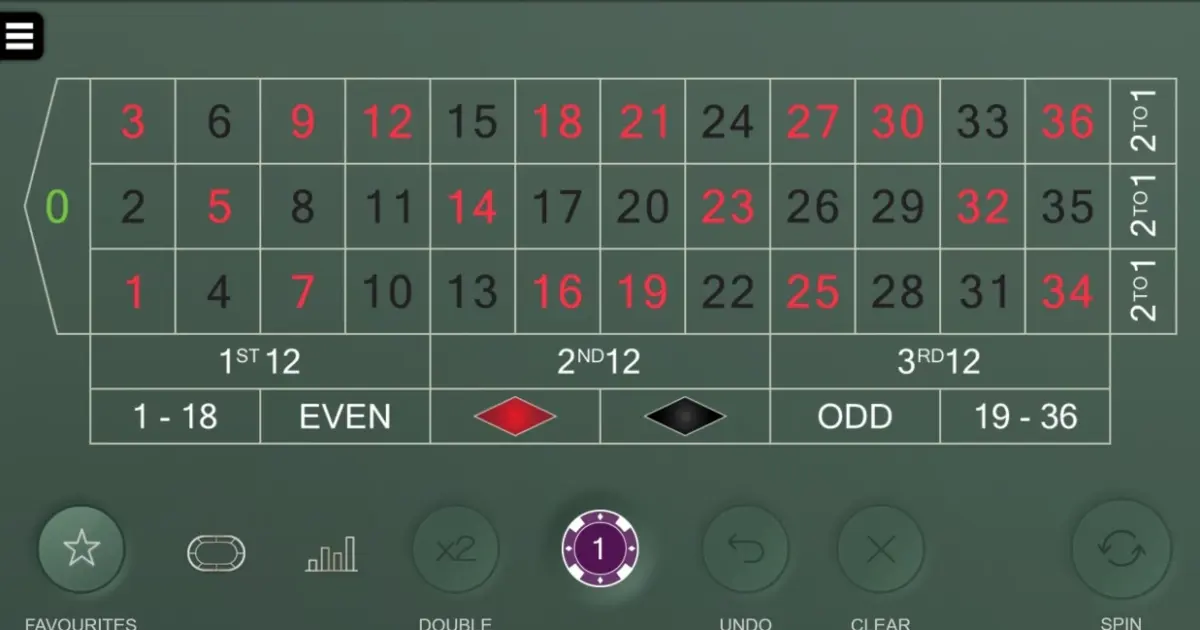
If you want a dealer-led roulette table you can try without spending anything, real roulette with george is a straightforward yes: the free demo is available and the published RTP is 97.3%. What the facts on hand do not tell you is the pocket count or whether half-stake zero rules apply, and those two details matter more to your long-run cost than anything else on the screen.
So treat this review as two halves. The confirmed numbers below are solid. Everything about wheel layout, table limits and call bets needs a glance at the game’s own rules panel before your first real spin.
Is Real Roulette with George worth your spins?
The case for it is simple. A 97.3% return sits above the 96.97% average across the roulette titles in our database, and above the 97.25% average for this studio’s own catalogue. The gap is small in absolute terms, 0.33 percentage points against the wider corpus, but roulette is a game of small fixed margins and there is no reason to accept a worse one when a better one is on the same shelf.
The 97.3% figure is worth reading carefully, because it does not match any of the three classic roulette house edges exactly. A single-zero wheel returns 97.30% on standard bets. That is a near-perfect match, and it is the most likely explanation. But a published figure can also be a blended average across bet types, or reflect rules the studio has documented elsewhere. The facts available here give the number and not the derivation.
Ranked 116th and sitting in the 48th popularity percentile, this is a mid-table title by traffic rather than a headline release. That says nothing about the maths, which is fixed regardless of how many people are playing.
Real Dealer Studios and this wheel
Real Dealer Studios has 30 games in our database, averaging 97.25% RTP. That average is unusually tight for a studio catalogue, which suggests a deliberate house standard rather than a spread of generous and stingy releases. This table sits marginally above it.
The studio’s signature is pre-recorded cinematic footage of a named dealer paired with an RNG outcome engine. You get the pacing and presentation of a live table without a live stream, and the results come from a random number generator. That distinction matters for one specific reason: there is no physical wheel bias to hunt, no dealer signature to read, and no sequence to track. Each spin is drawn independently.
If you want to compare within the same studio, Roulette with Rachael carries the same 97.3% published RTP with a different dealer, so the choice between them comes down to presentation rather than cost. Real Auto Roulette also lists 97.3% and strips out the dealer footage entirely, which suits players who want faster spin cycles. For something outside the roulette format, Fortune Finder with Holly lists a lower 96.6% return.
House edge: 2.70%, 5.26% or 1.35%?
Three numbers cover almost every roulette table you will meet, and knowing which one you are sitting at is the single most valuable thing you can learn.
A European or single-zero wheel has 37 pockets, numbers 1 to 36 plus one zero. The house edge is 2.70% on every standard bet. An American or double-zero wheel has 38 pockets, and the edge nearly doubles to 5.26% on every standard bet, rising to 7.89% on the five-number basket bet. Same game, same payouts, one extra pocket, almost twice the cost.
French rules add La Partage or En Prison. When zero lands, even-money bets return half the stake or are held for the next spin. That drops the even-money house edge to roughly 1.35%, the best standard bet available anywhere in roulette.
The published 97.3% return here points strongly to a single-zero layout with a 2.70% edge, because those figures are two ways of saying the same thing. The facts provided do not confirm the pocket count or whether any half-stake rule applies, so open the rules screen and check for a second zero and for La Partage before you stake real money. A single glance settles a difference worth double your long-run cost.
Bet types, payouts and true odds
Assuming a 37-pocket single-zero wheel, which is what the RTP figure implies, here is where every bet’s margin comes from. Note that the edge is identical across the board. The gap between payout and true odds is the entire house advantage, and it never moves.
| Bet | Pockets covered | Payout | True odds | House edge |
|---|---|---|---|---|
| Straight up | 1 | 35:1 | 36:1 | 2.70% |
| Split | 2 | 17:1 | 17.5:1 | 2.70% |
| Street | 3 | 11:1 | 11.33:1 | 2.70% |
| Corner | 4 | 8:1 | 8.25:1 | 2.70% |
| Line | 6 | 5:1 | 5.17:1 | 2.70% |
| Column or dozen | 12 | 2:1 | 2.08:1 | 2.70% |
| Red, black, odd, even, high, low | 18 | 1:1 | 1.06:1 | 2.70% |
Inside and outside bets change the shape of your session, not its expected cost. A straight-up bet hits roughly once in 37 spins and pays 35 times your stake. An even-money bet hits a little under half the time and pays once. Choose based on how much swing you want to sit through, not on which one you think is better value.
What experienced players actually do
They stake flat. The same amount every spin, session after session. This is not superstition, it is arithmetic. No progression changes expected value. Martingale, Fibonacci, D’Alembert, waiting for five reds before backing black — every one of them redistributes variance and none of them touches the 2.70% or 5.26% you are paying. Spins are independent. The wheel does not know what it did last time, and on an RNG table there is no physical mechanism that could carry memory forward.
What progressions do reliably is accelerate the moment you hit a table limit or run out of budget. Doubling after losses means a modest run of bad luck asks for a stake you cannot make, at which point the recovery plan stops working and the losses stay.
They also set a session limit in advance, in money and in time, and stop at it regardless of whether they are up or down. And they pick the lowest-edge bet the table offers. If La Partage is available, even-money bets at roughly 1.35% cost you half what any other bet on the same wheel costs. That is the only real choice on the layout that changes your maths.
Free play before real money
The free demo is available for this table, and it is worth twenty minutes. Use it to check the pocket count, look for La Partage or En Prison in the rules, find the table’s minimum and maximum limits, see whether a racetrack for call bets is offered, and get familiar with how the dealer footage paces each round. All five of those details are unconfirmed in the facts available here, and all five are visible in the game itself within a couple of spins.
One thing the demo cannot do is predict what happens with real money. Free play uses the same maths, but a short sample tells you nothing about a longer one, and a winning demo session is not evidence of anything.
Roulette is entertainment, not income. This game is for players aged 18 or over. Decide what you are willing to spend before you start, treat it as the price of the entertainment rather than a stake you expect back, and walk away when you reach the number. If it stops feeling like a game, stop playing and use the deposit limits and self-exclusion tools your operator provides.
Final take
A 97.3% published RTP, a free demo, and a studio catalogue averaging 97.25% across 30 games. Those are good signs, and the return figure lines up cleanly with a single-zero wheel at 2.70%.
What you should not do is take that inference as settled. Open the rules screen, count the zeros, and look for a half-stake rule on even-money bets. Then stake flat, pick the lowest-edge bet available, and set your limit before the first spin rather than during a losing run.
Frequently Asked Questions
Can you play Real Roulette with George for free?
Yes, a free demo is available for this table, so you can spin without depositing. It is the fastest way to check details the published data does not cover, including the pocket count, whether La Partage applies, and the table's minimum and maximum bet limits. Demo results carry no predictive value for real-money play.
What is the Real Roulette with George RTP?
The published RTP is 97.3%. That is above the 96.97% average across the roulette titles in our database and marginally above the 97.25% average for Real Dealer Studios' own 30-game catalogue. A 97.3% return corresponds exactly to a single-zero wheel's 2.70% house edge, though the facts available do not confirm the layout.
Is this a European or American wheel?
The 97.3% RTP points strongly to a single-zero European layout with 37 pockets and a 2.70% house edge. A double-zero American wheel would return closer to 94.74%, and French rules with La Partage would push even-money bets to roughly 98.65%. Confirm the pocket count on the game's rules screen before betting.
Does the Martingale system work on this table?
No. No betting system changes expected value on any roulette wheel. Martingale, Fibonacci and D'Alembert redistribute variance, making small wins frequent and large losses rare but severe. Spins are independent and this is an RNG table, so previous results carry no information. Progressions mainly speed up hitting table limits or your budget ceiling.
Who makes Real Roulette with George?
Real Dealer Studios, which has 30 games in our database averaging 97.25% RTP. The studio pairs pre-recorded cinematic dealer footage with an RNG outcome engine, giving live-table presentation without a live stream. Roulette with Rachael from the same studio lists an identical 97.3% RTP with a different dealer.




