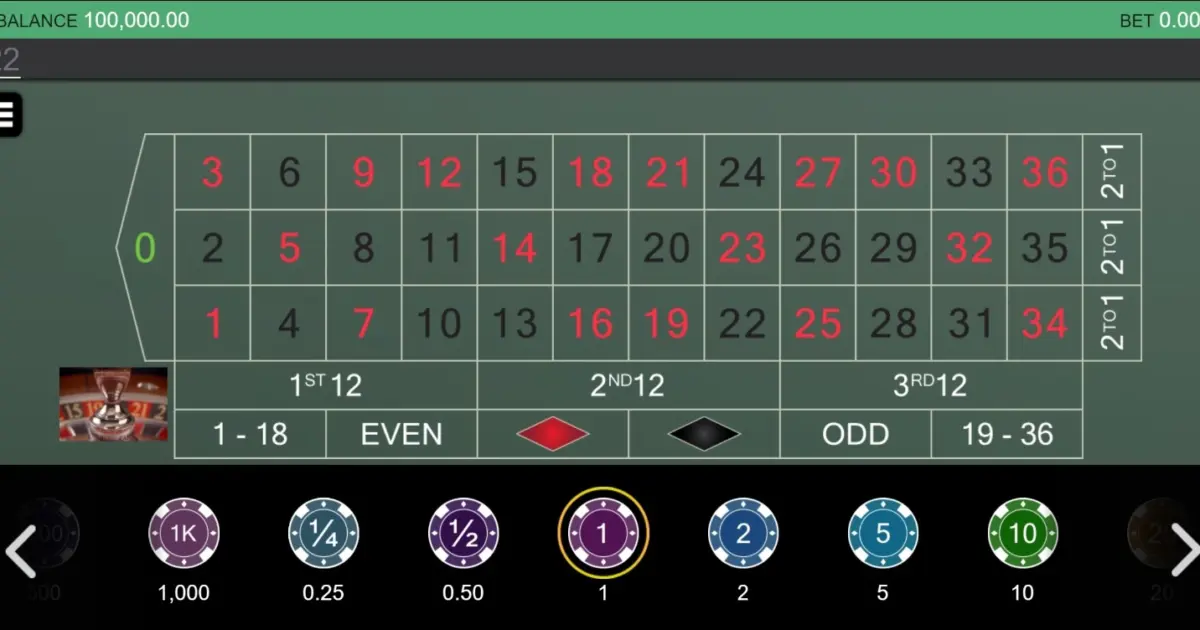
Real roulette with Bailey carries a listed RTP of 97.3%, which is the number that matters most before anything else about it. That figure sits above the 96.97% average across the tables covered here and matches Real Dealer Studios’ own 97.25% average across its 30 games. A free demo is available, so you can watch the table run without spending anything.
What the facts do not tell you is which wheel this is. That gap is worth closing on the game’s rules screen before you stake real money, because the pocket count is the single biggest lever on your expected cost per spin.
Is Real Roulette with Bailey worth your spins?
On the numbers available, yes, with one caveat. A 97.3% RTP implies a 2.7% house edge, and 2.70% is exactly the figure a single-zero wheel produces on every standard bet. That correspondence is suggestive but it is not a confirmation. The RTP figure supplied here is the game’s listed return; it does not by itself tell you the pocket count, whether French rules apply, or what the table limits are.
If the wheel does turn out to be single-zero with standard rules, you are looking at one of the better-value roulette tables on offer, because 2.70% is the standard European figure and there is no way to beat it through play. If French rules are in force on even-money bets, the effective edge on red, black, odd, even, high and low drops to roughly 1.35% — but nothing in the available facts says whether that applies.
The practical answer: the headline number is good, the demo is free, and the rules screen will tell you in thirty seconds what the listing does not.
Real Dealer Studios and this wheel
Real Dealer Studios has 30 games in this collection, averaging 97.25% RTP. That is a tight, roulette-heavy portfolio rather than a sprawling one, and the average sits comfortably above the 96.97% corpus figure. This table’s 97.3% is a fraction above the studio’s own house average.
Two stablemates share the identical listed figure. Roulette with Rachael also lists 97.3%, so if you want the same maths with a different presenter, that is the direct comparison. Real Auto Roulette matches the number too and strips out the presenter entirely, which usually means faster rounds — relevant if you care about spins per hour, since the house edge applies to every spin and a faster table compounds the same percentage more often.
If you want something from the studio that is not a wheel at all, Fortune Finder with Holly sits lower at 96.6%. The point of noting these is not that one is luckier than another; it is that three Real Dealer Studios tables share a 97.3% listing, so your choice between them is about format and pace, not value.
House edge: 2.70%, 5.26% or 1.35%?
These three figures cover almost every roulette table you will meet, and the difference between them is larger than anything else in the game.
A single-zero wheel has 37 pockets. Every standard bet on it costs 2.70% of turnover in expectation. A straight-up number pays 35:1 against true odds of 36:1, and that one-pocket gap is the entire edge — it is identical on a corner, a column or on red.
A double-zero wheel has 38 pockets and the same payouts, so the edge nearly doubles to 5.26%. The five-number basket bet on that layout is worse still at 7.89%, and there is no reason to place it.
French rules — La Partage or En Prison — return half your stake on even-money bets when zero lands. That cuts the even-money edge to about 1.35%, the best standard bet available anywhere in roulette. It does not change inside bets at all.
The name of this table points at a single-zero wheel, and 2.70% is what that would normally mean. Treat that as a hint from the title, not a stated fact. The available facts do not confirm the pocket count or whether La Partage applies, and both change your cost per spin materially. Confirm on the game’s own rules screen before betting real money.
Bet types, payouts and true odds
Assuming a single-zero layout, which the name implies, the arithmetic runs like this. Note that the edge column is flat across every line — the bet you choose changes how wildly your balance swings, not what it costs you over time.
| Bet | Pays | True odds (37 pockets) | House edge |
|---|---|---|---|
| Straight up (1 number) | 35:1 | 36:1 | 2.70% |
| Split (2 numbers) | 17:1 | 17.5:1 | 2.70% |
| Street (3 numbers) | 11:1 | 11.33:1 | 2.70% |
| Corner (4 numbers) | 8:1 | 8.25:1 | 2.70% |
| Line (6 numbers) | 5:1 | 5.17:1 | 2.70% |
| Column or dozen (12) | 2:1 | 2.08:1 | 2.70% |
| Red/black, odd/even, high/low | 1:1 | 1.06:1 | 2.70% |
If the table turns out to run La Partage, only the bottom row improves, to roughly 1.35%. If it is a double-zero wheel, every row becomes 5.26%. This is why the rules screen matters more than any strategy discussion.
What experienced players actually do
They stake flat. Not because flat betting wins, but because progressions do not. Martingale, Fibonacci, D’Alembert and “wait for five reds then back black” all leave expected value exactly where it was. Spins are independent and the wheel has no memory; a doubling progression simply concentrates your risk into rare, large losses and drives you into the table maximum faster. No system converts a negative-expectation game into a positive one.
They also do not track previous results looking for signal. On an RNG wheel, no number, colour or sector is ever due, hot or cold. A results history is decoration.
What is actually within your control is narrow but real. Pick the lowest-edge bet available: if French rules are in force, even-money bets at roughly 1.35% are the best value on the layout. Set a session budget and a session length before you start, and treat both as fixed. Watch your spins per hour, because turnover is what the house edge feeds on — a slower table costs less per hour at the same stake. And take the payout structure as fixed, because it is.
Free play before real money
A free demo of Real Roulette with Bailey is available, and it is the sensible first stop. Use it to check the things the listing does not tell you: how many zero pockets the wheel has, whether La Partage or En Prison is mentioned in the rules, what the minimum and maximum bets are, and whether any racetrack or call-bet panel is offered. None of those are confirmed in the available facts, and all of them affect what a real-money session costs you.
What the demo cannot do is forecast results. Demo play uses the same maths but a different sequence of outcomes, and a good or bad run in free mode carries no information about a paid one.
Roulette is entertainment, not income. Play only if you are 18 or older, decide your budget before you open the game, and stop when you reach it rather than when you feel like it. If losses stop feeling like the price of an evening’s play, that is the point to walk away and seek support.
Final take
The listed 97.3% RTP is the strongest thing on this table’s card. It beats the 96.97% average here, edges past Real Dealer Studios’ own 97.25%, and is consistent with a single-zero wheel run under standard rules. On that basis, the value is competitive.
The honest limitation is that the facts stop short of confirming pocket count, French rules, table limits or call bets. Those unknowns are the difference between a 2.70% table, a 1.35% even-money proposition and a 5.26% one. Open the free demo, read the rules screen, and you will know which you are dealing with before a single unit is at risk.
Frequently Asked Questions
Can I play Real Roulette with Bailey free with no download?
Yes. A free demo of Real Roulette with Bailey is available, so you can open the table and watch full rounds without staking anything. Use that time to read the rules screen, since the pocket count, table limits and any French-rule provision are not confirmed in the listing and all affect real-money cost.
What is the Real Roulette with Bailey RTP?
The listed figure is 97.3%. That sits above the 96.97% average across the roulette tables covered here and just above Real Dealer Studios' own 97.25% average across its 30 games. A 97.3% return corresponds to a 2.7% house edge, which is what a single-zero wheel produces under standard rules.
Is this a European or American wheel?
The available facts do not confirm the pocket count. The name points toward a single-zero wheel, and the 97.3% listed RTP is consistent with the 2.70% edge that 37 pockets produce. A double-zero wheel would cost 5.26% instead, so confirm it on the game's rules screen before betting real money.
Does the Martingale system work on this table?
No. Martingale, Fibonacci, D'Alembert and waiting-for-a-streak all leave expected value unchanged. Spins are independent and the wheel has no memory, so no sequence of past results makes any outcome more likely. Progressions only reshape variance, replacing frequent small losses with rare large ones and hitting table limits sooner.
How does it compare to Roulette with Rachael?
Both list 97.3% RTP, so the underlying value looks identical and the choice comes down to presentation. Real Auto Roulette also lists 97.3% and removes the presenter, which typically speeds up rounds. Faster play means more spins per hour, and the house edge applies to every spin regardless of pace.




