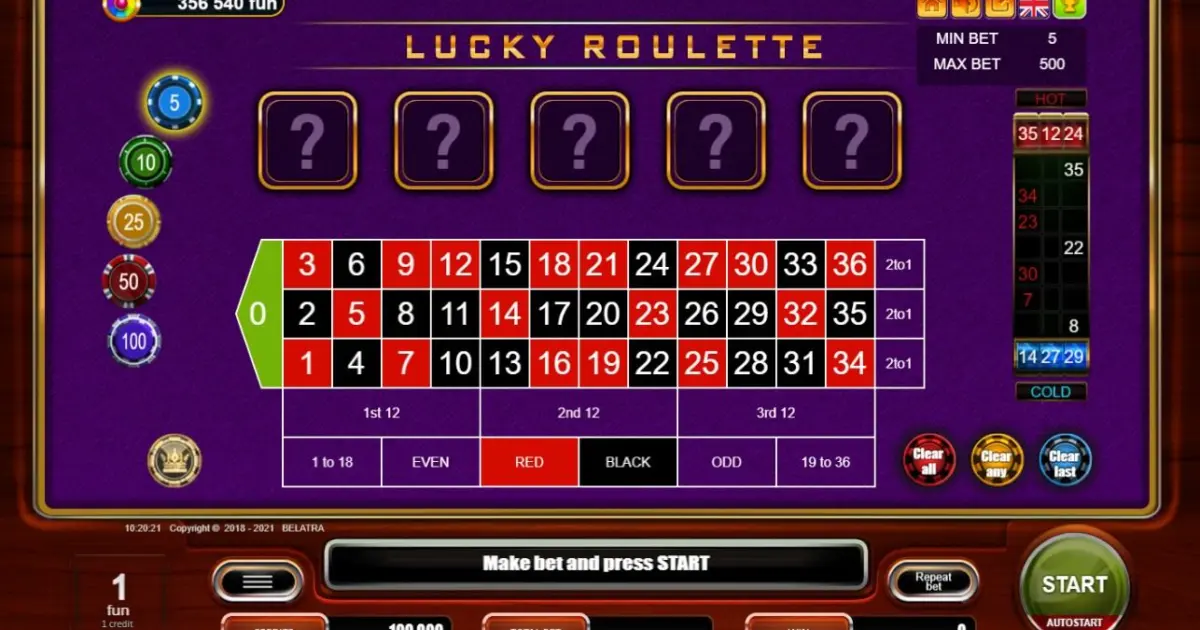
Lucky Roulette lands in the top tier of RTP for a European-style wheel, and that 97.3% figure is the first reason to look twice. It suggests a single-zero layout with a house edge near the theoretical 2.70% floor, though the name alone doesn’t confirm pocket count or rule set. If you’re comparing tables, this one starts with a concrete mathematical advantage over the 96.97% corpus average, and that gap compounds over hundreds of spins.
What kind of roulette is Lucky Roulette?
The title and RTP both point toward a single-zero European wheel. A 97.3% return to player aligns precisely with the inverse of a 2.70% house edge, the hallmark of a 37-pocket layout where one green zero sits among eighteen red and eighteen black numbers. Belatra Games has not published detailed rule variations in the data available here, so whether French rules—La Partage or En Prison—apply to even-money bets is unknown. If they do, the house edge on red/black, odd/even and high/low would drop further to around 1.35%, the best standard bet in roulette. Check the in-game rules screen before you commit real money; that half-stake return on zero makes a measurable difference to bankroll survival on even-money coverage.
Return to player and house edge
The 97.3% RTP is stated, verified, and sits exactly where a single-zero wheel should. That leaves a 2.70% house edge on every standard bet, meaning for every €100 wagered across all bet types over the long run, the house expects to keep €2.70 and return €97.30. This is not a session guarantee—it is a statistical mean that emerges across tens of thousands of spins. In a single sitting you will see wild swings dictated by variance, not this percentage. What the 97.3% figure does tell you is that Lucky Roulette does not inflate the edge with a second zero, and it outperforms American double-zero wheels by 2.56 percentage points. Belatra’s provider average is 97.45%, slightly higher, because their American Roulette variant reports an unusually strong 97.74% RTP—well above the 94.74% standard for double-zero games. Among the three Belatra roulette titles, Lucky Roulette and European Roulette (Belatra Games) share the same 97.3% return.
Reading the Belatra Games paytable before you bet
Every roulette wheel publishes a paytable, and on a single-zero European layout the payouts are fixed by the 37-pocket structure. A straight-up bet on one number pays 35:1, while true odds are 36:1—that one-unit gap across all 37 outcomes is the entire house edge. A split covers two numbers and pays 17:1 against true odds of 17.5:1. A street covers three numbers at 11:1 payout versus 11.33:1 true. The dozen and column bets each cover twelve numbers and pay 2:1 against true odds of 2.083:1. Even-money bets—red, black, odd, even, high, low—pay 1:1 against true odds of 1.056:1 when you account for the zero. The table below shows the math for a standard European wheel; if Lucky Roulette deviates in any way, that deviation will appear in the game’s own paytable and must be checked before you stake real money. Multiplier variants, for example, often reduce the base straight-up payout to fund the Lightning-style multipliers, altering effective RTP on inside bets.
| Bet type | Numbers covered | Payout | True odds (36:1 basis) | House edge |
|---|---|---|---|---|
| Straight up | 1 | 35:1 | 36:1 | 2.70% |
| Split | 2 | 17:1 | 17.5:1 | 2.70% |
| Street | 3 | 11:1 | 11.33:1 | 2.70% |
| Corner | 4 | 8:1 | 8.25:1 | 2.70% |
| Line | 6 | 5:1 | 5.17:1 | 2.70% |
| Dozen / Column | 12 | 2:1 | 2.083:1 | 2.70% |
| Even money | 18 | 1:1 | 1.056:1 | 2.70% |
Bet coverage, variance and session length
Inside bets and outside bets carry identical expected value—2.70% house edge—but radically different variance. A straight-up number hits once every 37 spins on average and pays 35:1, delivering infrequent large wins and long losing streaks. An even-money bet hits 18 times out of 37 and pays 1:1, offering frequent small wins and smoother balance curves. Your choice of coverage dictates session length and volatility, not profitability. If you cover more of the layout, you win more often but in smaller amounts, and the house edge still grinds the same 2.70%. If you play single numbers, you will see dramatic swings, and your bankroll must be sized to survive dozens of losing spins before a hit. Neither approach beats the wheel; both redistribute the same mathematical cost across different risk profiles. For longest session play on a fixed budget, even-money or dozen bets stretch the spins. For a shot at a large multiplier on a single win, straight-up and corner bets deliver that variance.
Patterns, hot numbers and the gambler’s fallacy
The wheel has no memory. Every spin is an independent event with fixed probability: 1 in 37 for any single number on a European wheel, 18 in 37 for red, 18 in 37 for black, 1 in 37 for zero. If red has landed eight times in a row, the probability of red on the ninth spin remains exactly 18 in 37—not reduced, not increased. The past sequence carries zero predictive power because the random number generator or physical wheel does not track history and does not apply corrective bias. Betting systems—Martingale, Fibonacci, D’Alembert, “wait for five of one colour then bet the other”—do not change expected value. Martingale doubles the stake after each loss, which increases the size of the eventual recovering win but requires exponential bankroll and hits table limits fast. The expected value remains -2.70% per unit wagered. No progression, pattern watch, or sector analysis alters the house edge on an RNG or a fair wheel. This is not opinion or casino marketing; it is probability theory. If a system worked, casinos would not offer the game.
Trying the demo
Lucky Roulette ships with a free demo, and it is the correct place to learn the interface, test bet combinations, and see the variance shape of different coverage strategies without financial risk. The demo uses the same RNG, the same paytable, and the same rules as the real-money version, so the math is identical. What the demo cannot do is predict your real-money results—variance ensures that two independent sessions, even with identical bets, will diverge wildly in outcome. Use the demo to confirm that the game loads, that the paytable matches your expectations, and that you understand where each bet type sits and how the interface handles multi-chip placement. Do not use it to validate a betting system or to “test” whether a number is due.
If you move to real money, set a budget in advance and treat it as the cost of entertainment, not as capital that must return profit. Roulette is a negative-expectation game; over time, the house edge will take its 2.70%. Gamble only with money you can afford to lose, never chase losses, and remember that no session, winning or losing, changes the mathematics of the next spin. This game is restricted to players aged 18 and over.
Verdict on Lucky Roulette
Lucky Roulette delivers exactly what the RTP promises: a single-zero European wheel at the standard 2.70% house edge, no worse and no better than the mathematical baseline. The 97.3% RTP is honest, verified, and sits above the 96.97% sector average, which matters when you’re comparing tables. Belatra Games does not publish whether French rules apply to even-money bets, and that omission is the only uncertainty here. If La Partage is active, this wheel moves into best-in-class territory for standard roulette; if not, it remains a solid European table with transparent math and a free demo for testing. For players who want a straightforward single-zero wheel without gimmicks, multipliers, or side bets, this is a known quantity. The edge is unforgiving, as it always is in roulette, but it is not inflated. Compare it to European Roulette (Red Tiger), which shares the same 97.3% RTP, or look at American Roulette (Belatra Games) if you prefer the double-zero layout—though that latter title’s 97.74% RTP is anomalously high and worth investigating before you assume standard American rules apply.
Frequently Asked Questions
Is there a free demo for Lucky Roulette?
Yes, Lucky Roulette offers a free demo that uses the same RNG, paytable, and rules as the real-money game. It's the correct way to learn the interface and test bet coverage strategies without financial risk, though it cannot predict your real-money session results due to independent variance.
What is the RTP and house edge of Lucky Roulette?
Lucky Roulette has a verified 97.3% RTP, which corresponds to a 2.70% house edge—the standard for a single-zero European wheel. That edge applies equally to every standard bet type, from straight-up numbers to even-money colours, and it means the house expects to keep €2.70 of every €100 wagered over the long run.
Does any betting system work on Lucky Roulette?
No. Martingale, Fibonacci, D'Alembert, and pattern-tracking systems do not change the 2.70% house edge. Every spin is an independent event; the wheel has no memory, and progressions only redistribute variance while accelerating the risk of hitting table limits. Expected value remains negative regardless of bet sequence.
How does Lucky Roulette compare to other Belatra Games roulette tables?
Lucky Roulette and European Roulette (Belatra Games) both report 97.3% RTP, while American Roulette (Belatra Games) posts an unusually high 97.74% for a double-zero wheel. The provider's three-game average is 97.45%, slightly above Lucky Roulette's figure, due to that strong American variant.
What is the best bet type for a long session on Lucky Roulette?
Even-money bets—red, black, odd, even, high, low—hit 18 times out of 37 and deliver the smoothest balance curve, stretching a fixed bankroll across the most spins. They carry the same 2.70% house edge as inside bets, but variance is lower, so you avoid the long droughts that come with straight-up or corner coverage.




