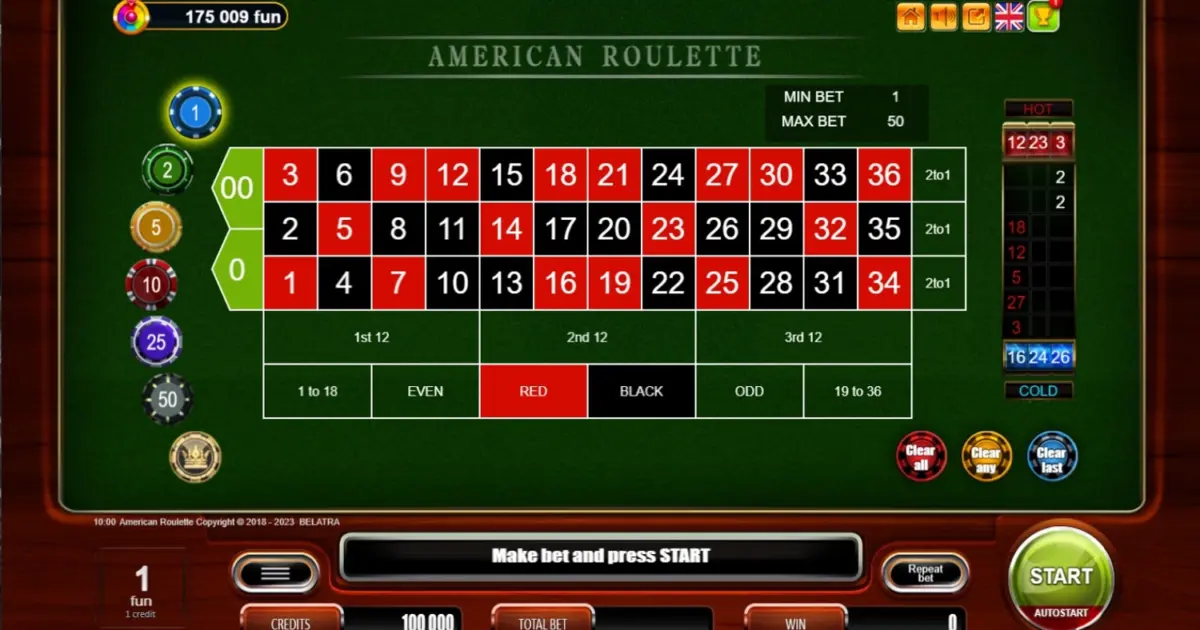
American roulette (Belatra Games) is worth a look if you specifically want the double-zero layout and you understand what that second green pocket costs you. The listed RTP is 97.74%, which is higher than the 96.97% average across the roulette tables in our database and higher than the 97.45% average across Belatra’s own three tables. That figure is unusually strong for a game carrying the American name, and it is the single thing on this page most worth checking against the game’s own rules screen before you stake anything real.
American Roulette (Belatra Games) and the Belatra Games roulette range
Belatra Games has three roulette tables in our index, and this one sits at rank 197 with a popularity percentile of 12.1 — meaning roughly 88% of the roulette titles we track see more play. That is not a quality signal. Roulette outcomes are decided by pocket count and payout rules, not by how many people happen to have found a particular table, and a quiet game with good rules beats a busy one with bad rules every time.
The two stablemates give you a direct comparison. European Roulette (Belatra Games) lists 97.3% and, if the name holds, uses a single-zero wheel — which normally means a 2.70% house edge rather than the 5.26% a standard double-zero wheel carries. Lucky Roulette also lists 97.3%, though FACTS does not tell us what wheel or extra features it uses, so treat it as unknown until you open its rules.
What FACTS does not include for this table: the pocket count as confirmed by the game itself, table limits, whether a racetrack or call bets are offered, and the release date. Limits matter more than most players expect. A low maximum on outside bets caps how you can structure a session, and you cannot find that out from a review — only from the table.
The wheel, the pockets and the edge
The title points to an American wheel, and that is a strong hint rather than a confirmed rule for this specific table. A standard double-zero wheel has 38 pockets: 1 through 36, plus 0 and 00. Every standard bet on that wheel carries a house edge of 5.26%, with one exception — the five-number basket bet covering 0, 00, 1, 2 and 3, which sits at 7.89% and is the worst bet on any roulette layout.
Compare that to the single-zero wheel: 37 pockets, and a flat 2.70% house edge on every standard bet. The mathematics is not subtle. Adding one pocket while leaving the payouts unchanged roughly doubles what the game costs you per unit staked. French rules go further — where La Partage or En Prison applies, a zero returns half your even-money stake, which drops the even-money edge to about 1.35%, the best standard bet in roulette. FACTS does not tell us whether any such rule applies here, so do not assume it does.
The mechanism behind the edge is simple arithmetic. On a 38-pocket wheel, a straight-up number has 37 losing outcomes against 1 winner, so the true odds are 37:1. The payout is 35:1. That two-unit shortfall, spread across every bet type on the layout, is the entire house advantage.
97.74% in practice
An RTP of 97.74% implies a house edge of 2.26%, which does not match the 5.26% a standard double-zero wheel produces. There are a few possible explanations: the table may apply a rule that returns part of the stake on zero, the figure may be calculated across a specific bet mix, or it may reflect something in Belatra’s own paytable that FACTS does not describe. Because we cannot resolve which, the honest reading is that this number needs verifying on the game’s rules screen before you treat it as the edge you are facing.
What RTP means either way: it is a long-run average measured across an enormous number of spins, not a session forecast. At 97.74%, the theoretical long-run return is 97.74 units for every 100 staked — but “staked” counts total turnover, not deposits. Bet 5 units a spin for 200 spins and you have staked 1,000 units, regardless of how much you put in your balance.
Short sessions land nowhere near the average. Roulette variance is driven by bet type, not by RTP. Straight-up bets swing hard in both directions; even-money bets grind closer to the expected line. Neither changes what the game returns over time.
Building a bet you understand
The table below sets out payouts against true odds on a standard 38-pocket wheel. Confirm the layout on this table matches before you use it.
| Bet | Pockets covered | Payout | True odds (38 pockets) | House edge |
|---|---|---|---|---|
| Straight up | 1 | 35:1 | 37:1 | 5.26% |
| Split | 2 | 17:1 | 18:1 | 5.26% |
| Street | 3 | 11:1 | 11.67:1 | 5.26% |
| Basket (0, 00, 1, 2, 3) | 5 | 6:1 | 6.6:1 | 7.89% |
| Corner | 4 | 8:1 | 8.5:1 | 5.26% |
| Column or dozen | 12 | 2:1 | 2.17:1 | 5.26% |
| Red/black, odd/even, high/low | 18 | 1:1 | 1.11:1 | 5.26% |
The pattern is the point. Every bet except the basket carries the same edge, so choosing between them is about how much swing you want, not about finding value. Outside bets give you close to even-money frequency and small movements; a straight-up number pays 35 times your stake and misses roughly 97% of the time. Avoid the five-number basket bet entirely — it is the only line on the layout that costs you extra for no compensation.
Systems, streaks and independent spins
No betting system changes the expected value of a roulette bet. Not Martingale, not Fibonacci, not D’Alembert, not waiting for five reds before backing black. Each spin is independent, the wheel has no memory, and the edge applies identically to spin one and spin one thousand.
What progressions actually do is reshape variance. Martingale doubles after every loss, which converts a large number of small wins into an occasional catastrophic one, and it collides with the table maximum exactly when you need one more double. Seven consecutive losses on an even-money bet is not rare — it happens often enough that any system relying on it not happening will meet it.
Result-tracking displays are entertainment, not information. A number that has not landed in 300 spins is not due; a number that landed three times running is not hot. On an RNG wheel every spin is drawn fresh, and past results carry no predictive weight whatsoever. Anyone telling you otherwise is selling something.
Free demo and staying in control
American Roulette (Belatra Games) is available as a free demo, so you can open the table, read the rules screen, confirm the pocket count and check the limits before any money is involved. That is the practical value of demo play: verifying the specifics FACTS does not cover. Use it to learn the layout and the bet-placing interface, not to test a system — demo results tell you nothing about what real-money play will do.
Roulette is for players aged 18 or over. Decide your budget before you open the table, treat it as the cost of entertainment rather than a route to income, and stop when you reach it. The maths guarantees a long-run loss; the only variable you control is how much you are willing to spend on the experience.
If you want to compare rule sets side by side, European Roulette (Red Tiger) at 97.3% is a useful reference point for what a single-zero table looks like.
Who should play American Roulette (Belatra Games)
Play it if you want the double-zero layout specifically and you have confirmed the RTP figure on the rules screen. The listed 97.74% is 0.77 points above the category average, which is a real advantage if it holds for the bets you intend to place.
Skip it if you are hunting the lowest edge available. A single-zero table at 2.70%, or one with La Partage at roughly 1.35% on even money, will cost you less per unit staked over any meaningful volume — and Belatra’s own European table is one click away.
Frequently Asked Questions
Can I play American Roulette (Belatra Games) free with no download?
Yes, a free demo is available, and it runs in your browser without a download. Use it to check the details this review cannot confirm: the pocket count on the rules screen, the table minimum and maximum, and whether a racetrack or call bets are offered. Demo results have no bearing on real-money outcomes.
What is the American Roulette (Belatra Games) RTP?
The listed figure is 97.74%, which is 0.77 percentage points above the 96.97% average across the roulette tables we index and above Belatra's own 97.45% average. That implies a 2.26% house edge, which is lower than a standard double-zero wheel produces, so verify it on the game's rules screen before staking real money.
How many pockets does the wheel have and what is the house edge?
The title points to an American wheel, which normally means 38 pockets including 0 and 00, and a 5.26% house edge on every standard bet except the five-number basket bet at 7.89%. FACTS does not confirm the layout for this specific table, and the 97.74% RTP does not match that edge, so check the rules screen.
Does the Martingale system work on this table?
No. No betting system changes expected value, because each spin is independent and the wheel has no memory. Martingale trades many small wins for occasional very large losses and runs into the table maximum during long losing runs. Tracking previous results, or waiting for a colour to be due, has no predictive value on an RNG wheel.
How does it compare to European Roulette (Belatra Games)?
The European table lists 97.3%, slightly below this one's 97.74%, but if the names hold, it uses a single-zero wheel with a 2.70% house edge against 5.26% on a standard double-zero layout. Because the RTP figures here are close and the wheel rules differ, confirm both on their rules screens and compare the edge rather than the RTP alone.




