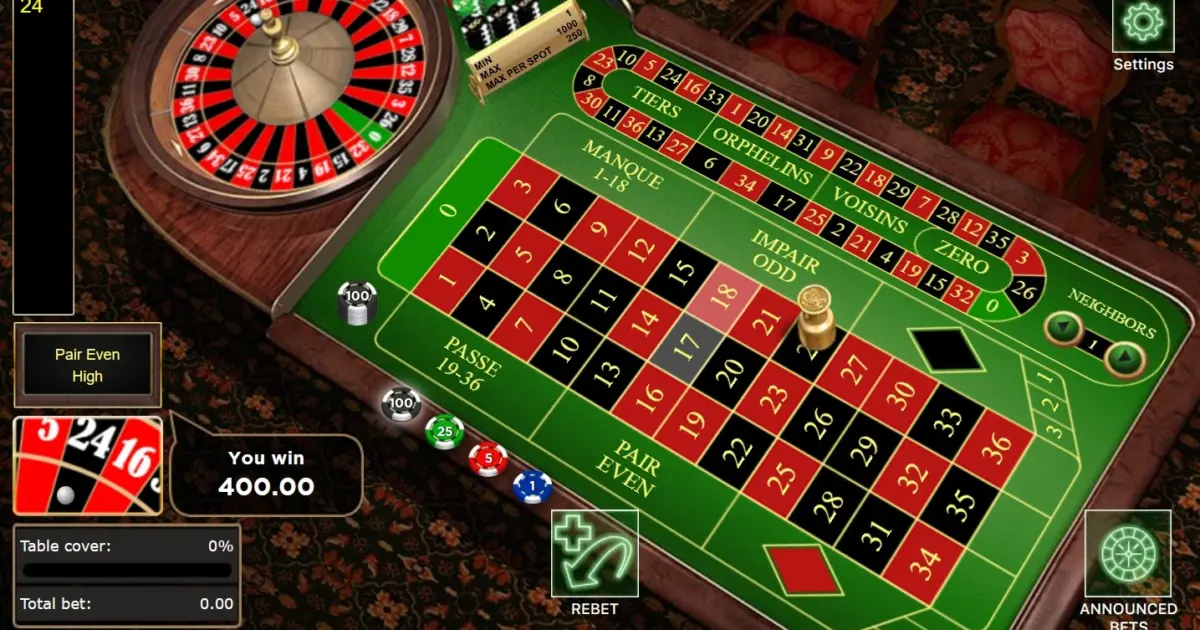
French Roulette (Section8) is a single-zero roulette table from a provider with a small catalogue. The headline RTP of 97.3% is strong on paper — better than the typical 97.3% European game and well ahead of the 94.74% you will often see on American Roulette. Whether it is worth your time depends on two things the game title suggests but that you must confirm inside the game itself: does it use La Partage or En Prison, and what are the exact table limits?
French Roulette (Section8) at a glance
Section8 is a small provider with just three roulette titles to its name, so this is not a studio with a sprawling portfolio. The provider’s average RTP across those three games sits at 96.45%, which makes this 97.3% table the best of the bunch — the American Roulette variant drops to 97.3% as well, while the standard European Roulette is on par. Your decision here is straightforward: if you want the lowest house edge in Section8’s range, this is the one to pick, provided the rules screen confirms the French rules implied by the title.
The game is available as a free demo with no download required, so you can check every rule before committing real money. That matters more with a title like this than with most, because “French Roulette” means different things to different providers. Some apply La Partage, some apply En Prison, and some apply neither — they just put the label on a standard European wheel.
Which wheel is this, and what it costs you
The name “French Roulette” strongly suggests a single-zero wheel with either La Partage or En Prison applied to even-money bets. On a standard single-zero wheel there are 37 pockets, numbered 0 to 36. The zero is what gives the house its edge: on every standard bet that edge is 2.70%. That number does not change based on your bet size, colour choice, or whether the last ten spins were all red.
If La Partage is in play, even-money bets (red/black, odd/even, high/low) return half your stake when zero lands. That cuts the house edge on those bets to about 1.35% — the best standard bet in roulette. En Prison works similarly: your even-money bet is “imprisoned” when zero hits, and if it wins on the next spin you get the full stake back. The mathematical effect is almost identical to La Partage.
The 97.3% RTP listed in the facts is consistent with a single-zero wheel where La Partage applies to even-money bets. But RTP is a composite figure that depends on how much you bet on which types of bets. The only way to be certain is to open the game’s rules or info screen and read what it actually says. A name is a hint. The rules screen is the contract.
What a 97.3% RTP means per spin
RTP stands for Return to Player. Over an enormous number of spins, a 97.3% RTP means the game returns 97.3 cents for every dollar wagered. That sounds close to break-even, but the key phrase is “over an enormous number.” In a single session the variance is what dominates. You might win 50% more than you started with, or you might lose your entire bankroll. Both outcomes are perfectly normal on a game with this RTP.
Here is the concrete maths. If you bet $10 per spin and make 100 spins, you have wagered $1,000. At 97.3% RTP, the expected return is $973 — a loss of $27. That is the long-run average. Short sessions swing wildly around it. The 97.3% figure also assumes you are betting in a way that is consistent with how the RTP was calculated, which usually means a mix of bet types. If you bet exclusively on straight-up numbers, the RTP for those bets may differ from the headline figure.
Compared to the corpus average RTP of 96.97%, this table sits slightly above the midpoint. Compared to Section8’s own average of 96.45%, it is noticeably better. The gap between 97.3% and the 94.74% on Section8’s American Roulette is significant: on a $10 bet over 100 spins, the American version costs you roughly $53 instead of $27. That difference is real, and it compounds the longer you play.
Inside versus outside bets
Inside bets cover specific numbers or small groups; outside bets cover large sections of the layout. The house edge on a standard single-zero wheel is 2.70% for every bet type — the shape of variance changes, but the expected loss per dollar does not. Straight-up bets pay 35:1 against true odds of 36:1, and that single-pocket gap is the entire house edge.
| Bet | Payout | True odds (single zero) | House edge |
|---|---|---|---|
| Straight up | 35:1 | 36:1 | 2.70% |
| Split | 17:1 | 17.5:1 | 2.70% |
| Street | 11:1 | 11.33:1 | 2.70% |
| Corner | 8:1 | 8.25:1 | 2.70% |
| Six line | 5:1 | 5.17:1 | 2.70% |
| Column / Dozen | 2:1 | 2.08:1 | 2.70% |
| Even money (red/black, etc.) | 1:1 | 1.055:1 | 2.70% |
If La Partage applies, that last row drops to 1.35%. That is the best value on the table, but it only applies to even-money bets. Straight-up bets remain at 2.70% regardless. Choosing inside or outside bets is a question of what kind of session you want — volatile and swingy, or slower and steadier — not a question of getting better value.
Why no betting system changes the maths
You will find no shortage of systems that claim to beat roulette. Martingale doubles your bet after every loss. Fibonacci follows a sequence. D’Alembert increases by one unit. They all share the same fatal flaw: every spin on an RNG wheel is independent. The wheel does not know what happened on the last spin, and it does not care.
These systems do not change the expected value. What they do change is the variance profile — they make small wins more frequent and large losses rarer, until a losing streak hits and the losses are catastrophic. Martingale is the clearest example: you grind out tiny profits, then a run of reds or blacks destroys your bankroll or slams into the table limit. The math is not ambiguous on this. No progression, no pattern recognition, no “wait for five reds then bet black” strategy shifts the 2.70% house edge by even a fraction of a percent.
If you play the demo, you will see winning streaks and losing streaks. They feel informative. They are not. On a random wheel, past results carry zero predictive power. Use the demo to learn the interface and the rules, not to search for patterns.
Playing the French Roulette (Section8) demo
The free demo is available without download, so you can open it in your browser and start spinning immediately. Use it to do the one thing that matters before any real-money session: open the rules screen and confirm whether La Partage or En Prison is active. If neither is, you are playing a European wheel with French branding and a standard 2.70% house edge on even-money bets. That is still a perfectly good game — just not the sub-1.4% edge the name promises.
Set a budget before you play, whether in demo or for real. Treat roulette as entertainment with a cost, not as an income source. Never chase losses, never bet money you cannot afford to lose, and be honest with yourself about whether the session is still fun. You must be 18 or older to play for real money.
Verdict
French Roulette (Section8) is a clean, no-frills single-zero table with a 97.3% RTP that puts it above the provider’s own average and slightly above the corpus average. The name points to La Partage rules, which if confirmed in-game would make even-money bets one of the best-value bets in online roulette at around 1.35% house edge. The provider is small — three games total — so do not expect a polished ecosystem of side bets or advanced features. What you get is a straightforward French wheel where the maths does the talking. If you want something different from the same provider, American Roulette (Section8) runs on a 38-pocket wheel with a significantly higher house edge. For a similar RTP from a bigger studio, European Roulette (Red Tiger) is worth comparing. Open the demo, check the rules, and let the numbers — not the name — make your decision.
Frequently Asked Questions
Is there a free demo for French Roulette (Section8)?
Yes. The demo is available with no download, so you can open it in a browser and play without registering. Use the demo to check the rules screen and confirm whether La Partage or En Prison is active before betting real money.
What is the RTP of French Roulette (Section8)?
The listed RTP is 97.3%, which is consistent with a single-zero wheel where La Partage applies to even-money bets. Check the game's info screen for the exact breakdown, since RTP can vary depending on your bet mix.
What is the house edge on this table?
On a standard single-zero wheel the house edge is 2.70% on all bets. If La Partage applies, even-money bets drop to about 1.35%. The title suggests French rules, but only the in-game rules screen can confirm which rule variant, if any, is used.
Does any betting system work on this roulette game?
No. Every spin is independent, and no system — Martingale, Fibonacci, D'Alembert, or pattern tracking — changes the house edge. Systems redistribute variance and can accelerate losses, especially when a table limit or bankroll cap stops the progression.
How does French Roulette (Section8) compare to American Roulette (Section8)?
The French version lists a 97.3% RTP on a single-zero wheel, while Section8's American Roulette lists 94.74% on a double-zero wheel. On a $10 bet over 100 spins, the American version costs roughly $53 in expected loss versus about $27 on the French table.




