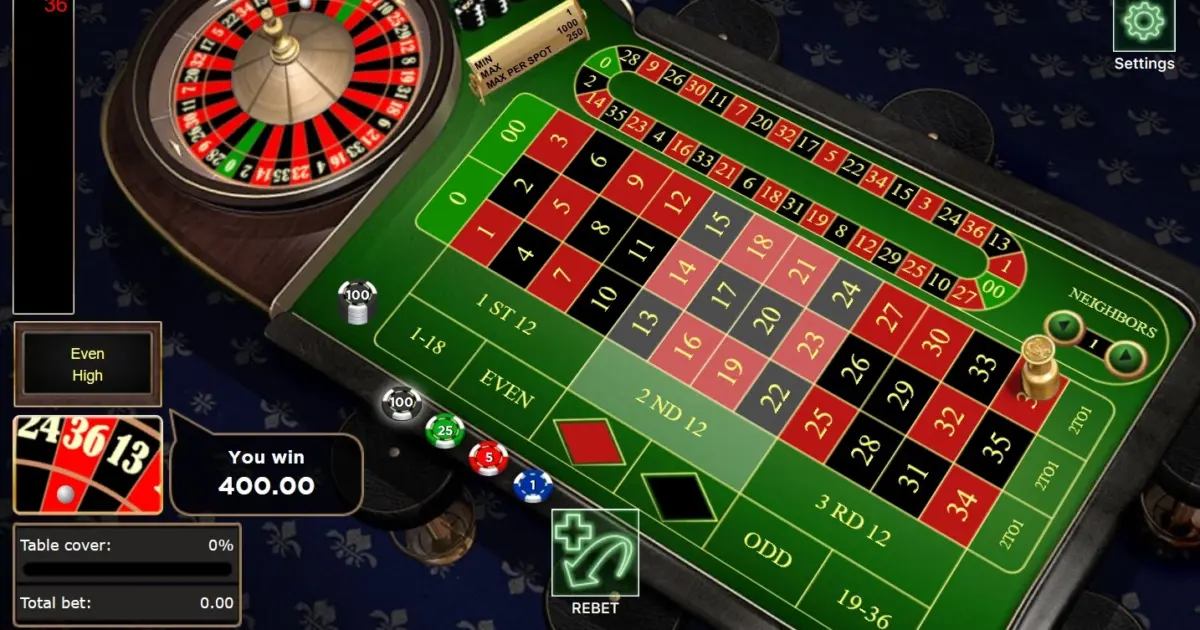
The headline number tells you most of what you need: a 94.74% RTP means the table keeps 5.26% of everything staked over the long run, and that figure applies to almost every bet on the layout rather than just one corner of it. A free demo is available, so you can spin it without money at risk. But if you are choosing between wheels rather than just browsing, this one is the most expensive shape of roulette on offer.
American Roulette (Section8) in one minute
Section8 publishes this table at an RTP of 94.74%, which is the exact arithmetic signature of a double-zero wheel. The variant hint in the game data points the same way: an American layout with 0 and 00, 38 pockets in total.
Treat the pocket count as strongly indicated rather than confirmed. The name and the RTP figure both point to 38 pockets, and 94.74% is precisely 36/38 expressed as a percentage, but the game’s own rules screen is the only place that confirms the layout you are actually being dealt. Check it before you stake real money.
Several things are not in the published data for this table, and their absence matters. There is no stated minimum or maximum bet, so you cannot work out in advance whether your intended stake size fits inside the limits. There is no information on whether a racetrack or call bets (voisins, orphelins, tiers) are offered, which affects how quickly you can place sector bets. There is no release date and no note on side bets or multipliers. All of that has to come from the game itself.
The maths of a single spin
Roulette is the one casino game where the maths is fully closed. On a 38-pocket wheel, a straight-up number wins once in 38 spins. The true odds against it are 37:1. The payout is 35:1. That two-pocket gap, repeated across every bet type on the layout, is the entire house edge.
The same arithmetic produces 5.26% on red, black, odd, even, high, low, dozens, columns, splits, streets, corners and lines. Changing bet type changes the shape of your results, not the expected cost. A straight-up bet gives you long dry runs punctuated by 35-unit hits; an even-money bet gives you something close to a coin flip with a small tax attached. Both bleed at the same rate per unit staked.
One bet on an American layout is worse than the rest. The five-number basket bet covering 0, 00, 1, 2 and 3 pays 6:1 against true odds of 6.6:1, giving a house edge of 7.89%. There is no situation in which it is the right bet. If the layout on this table offers it, skip it.
| Bet | Pockets covered | Payout | True odds (38 pockets) | House edge |
|---|---|---|---|---|
| Straight up | 1 | 35:1 | 37:1 | 5.26% |
| Split | 2 | 17:1 | 18:1 | 5.26% |
| Street | 3 | 11:1 | 11.67:1 | 5.26% |
| Corner | 4 | 8:1 | 8.5:1 | 5.26% |
| Basket (0, 00, 1, 2, 3) | 5 | 6:1 | 6.6:1 | 7.89% |
| Line | 6 | 5:1 | 5.33:1 | 5.26% |
| Column or dozen | 12 | 2:1 | 2.17:1 | 5.26% |
| Red/black, odd/even, high/low | 18 | 1:1 | 1.11:1 | 5.26% |
Where the 94.74% comes from
Divide 36 by 38 and you get 0.9474. That is the whole derivation. A winning straight-up bet returns 36 units (your stake plus 35), but the wheel has 38 places to land, so the return is 36/38 of what a fair game would pay. Every other standard bet on the layout is built from the same ratio, which is why the number repeats so cleanly.
The European wheel does the same sum with 37 pockets: 36/37 is 97.30%, a house edge of 2.70%. The single extra pocket is not a small difference. It nearly doubles the cost of playing. In practical terms, staking 1 unit per spin for 500 spins carries an expected loss of about 26 units on a double-zero wheel against roughly 13.5 units on a single-zero one, for identical play.
Worth being clear about what RTP is and is not. It is a long-run average across an enormous number of spins, not a schedule. It does not promise you 94.74% back in a session, and a short run can land anywhere. It also says nothing about what the next spin will do — each spin is independent, and the wheel carries no record of what came before it.
Even-money bets and the zero problem
On some tables, the zero problem is partly refunded. La Partage returns half your stake on even-money bets when zero lands. En Prison locks the bet for one more spin instead, releasing it whole if the next spin wins. Either rule cuts the even-money house edge to about 1.35%, which is the best standard bet available anywhere in roulette.
Nothing in the published data for this table says whether either rule applies, and that gap is worth flagging. These rules are conventionally a feature of French layouts rather than American ones, so the honest position is that you should not assume you have them here. Check the rules screen. If they are absent, red and black cost you the full 5.26% like everything else, and the appeal of the even-money bets is purely that they keep sessions long and variance low, not that they are cheaper.
This is also the point where progression systems get sold to people. Martingale, Fibonacci, D’Alembert, waiting for five reds before backing black. None of them work, and none of them can. Spins are independent, so no sequence of past results changes the probability of the next one. A progression rearranges when your losses arrive: it produces many small wins and occasional very large losses, and it runs into the table maximum exactly when you need one more double. Expected value stays at 5.26% of total turnover throughout.
How American Roulette (Section8) compares to other online roulette
The site-wide average RTP across the roulette tables here is 96.97%. At 94.74%, this table sits 2.23 points below that, and it also sits below Section8’s own three-game average of 96.45%. It is the weakest of the provider’s own set on paper.
The comparison is unusually easy to act on, because the same studio publishes the alternatives. European Roulette (Section8) is listed at 97.30% and drops the second zero, which is the single change that matters most. French Roulette (Section8) is also listed at 97.30% and is the family where La Partage conventionally lives, so it is the one to check if you mainly bet red and black. If you would rather compare across studios, European Roulette (Red Tiger) carries the same 97.30% figure.
Ranked 105th on the site and around the 53rd percentile for popularity, this table is neither obscure nor a headline draw. Its main use is if you specifically want the American layout — the double zero, the basket bet, the traditional feel of it — and accept the cost.
Playing responsibly
Roulette is 18+ entertainment, not income. Decide your budget before you open the table, treat it as the cost of the session rather than a stake you expect to recover, and stop when it is gone. Set a time limit too, since long sessions are exactly where the 5.26% has room to do its work. Demo play uses no real money and its results carry no predictive value for cash play — a hot streak in the demo tells you nothing. If your play stops feeling optional, use the deposit limits, reality checks and self-exclusion tools your operator provides, and contact a national gambling support service.
Verdict
This is a straightforward double-zero table with a clearly published 94.74% RTP and a free demo, and the arithmetic behind it is not in dispute. The problem is not the game — it is the layout. Every standard bet costs 5.26%, the basket bet costs 7.89%, and the same studio lists two 97.30% alternatives one click away.
Play it in demo if you want to learn the American layout or you simply prefer it. If you are staking money and the wheel type is negotiable, take the single-zero option and keep the extra 2.56 points. Confirm the pocket count, limits, and whether any zero-refund rule applies on the game’s own rules screen first, since none of that is published here.
Frequently Asked Questions
Can I play American Roulette (Section8) for free?
Yes, a free demo is available for this table, so you can learn the American layout and bet placement without staking money. Demo results have no predictive value for real-money play, though — the RNG treats every spin independently, so a good or bad demo run tells you nothing about what follows.
What is the American Roulette (Section8) RTP?
Section8 publishes it at 94.74%, meaning the table retains 5.26% of turnover over the long run. That figure is 2.23 points below the 96.97% site average for roulette and below Section8's own 96.45% average across its three games. It is a long-run average, not a session guarantee.
Which wheel is this and what is the house edge?
The title and the 94.74% RTP both point to a double-zero American wheel with 38 pockets, giving a 5.26% house edge on every standard bet — and 7.89% on the five-number basket bet covering 0, 00, 1, 2 and 3. Confirm the pocket count on the game's rules screen before betting real money.
Does the Martingale system work on this table?
No. Spins are independent and the wheel has no memory, so no progression changes expected value — you still lose 5.26% of total turnover on average. Martingale simply converts many small wins into rare very large losses, and it fails when doubling hits the table maximum, which is unpublished here.
Should I play European Roulette (Section8) instead?
If the wheel type is negotiable, yes. European Roulette (Section8) is listed at 97.30% against 94.74% here, purely because it removes the second zero. That is 2.56 points cheaper per unit staked for essentially identical play, and French Roulette (Section8) also lists 97.30% with potential zero-refund rules.




